RSS

The Facts Of Life

Maude

It’s been forty years since the passing of Roe v Wade. Forty years. That’s a very long time. In 1973 we were still smoking in restaurants, elevators and hospitals. In 1973 women were called girls and people of color were called worse. Push button phones were the edgiest things in communication technology and fancy people had remote controls for their televisions. We’ve come a long way baby! Or have we? The fight against reproductive freedoms is in full force and we seemed to have learned little. Literally. If you were to listen to the arguments or soundbites of anti-choice proponents you’d find yourself wondering how you missed that particular biology lesson. It’s alarming to discover grown people (who have made reproduction their raison d’etre) know so little about reproduction.

Babies don’t live inside of people, zygotes, embryos and fetuses do (in that order.) Semantics you say? Perhaps, but words are power; just ask any 50 year old “girl” or racially slurred man.

Contraception and birth control are not the same thing (though their end results are the same.) Contraception prevents conception. Any barrier device (i.e., diaphragm, condom, etc.) or spermicide (in the best case scenario) prevents a sperm from fertilizing an egg. Sterilization would fall into the category of contraception as well. Any method or procedure that prevents a fertilized egg from becoming a baby is birth control. All hormonal methods fall into this category (i.e., I.U.D., birth control pills, implants, etc.) as part of their efficacy is that they work to prevent uterine adherence. Spontaneous and medical abortions are also birth control. If anti-choice advocates believe that a fertilized egg is a human life, they should take a long hard look at all birth control.

By ignoring the erroneous use of terminology and the manipulation of biological fact it’s as if we endorse the fallacies. Of course we need only go to the movies or watch television to know that we’re doing a pretty bang-up job of ignoring the whole issue altogether. It’s been forty years since Maude had an abortion (with zero viewer controversy,) yet you’d be hard-pressed to ever see a character rationally choosing this option. In 2013 soap operas (once the bastion of contemporary socially relevant dramatization) refers to abortion only with hush and horror; “She was seen outside of an abortion clinic!” A relatively sophisticated police drama depicted a female athlete (how 21st century) choosing to be charged for a crime she didn’t commit rather than have people know she had (gasp) an abortion. Routinely teenage characters are depicted as having only two choices when faced with an unplanned pregnancy (and both involve giving birth.)

Half of all unplanned pregnancies in the Unites States are terminated. It’s left to our imaginations to determine how many unplanned pregnancies occur. It’s a relatively safe bet that at any book club across our land there are at least a couple of stories to be told. And maybe that’s part of our fractured and false conversation. Women don’t talk about abortion. They’ll talk about everything else under the sun, but not abortion. You can’t get through a bridal shower without hearing about pee sticks, frequency, duration, enhancers, gizmos, gadgets and gewgaws. But nothing would bring the consistency of mucus conversation to a screeching halt like the mention of the “A” word. Why? How did we come to believe that there was any shame in freedom of choice? How did taking responsibility for our health, our lives and for the future become tainted? How did we fall under the spell of the anti-choice rhetoric?

We can create small individual revolutions by adopting appropriate terminology. It’s probably a bit of a buzz kill to discuss any gynecological procedure at a bridal shower. But there’s ample opportunity to correct on-air and real people when they refer to fetuses as babies. Pointing out that birth control works very much like abortion does could make some waves as well. We’ve gotten to a point in this country where the loudest voice gains the most credence, not matter how ill informed or flat out wrong that voice is. Tuning out the screamers is not good enough; we need to add scientific and sociological fact to the noise.

 
1 Comment

Posted by on January 17, 2013 in Cultural Critique, Well-Being


Tags: , , , , , , , ,

When Progress Falls Short

rail

New York State is passing new gun regulations. They are the first to do so after the 2012 Newtown (Connecticut) school shooting. The legislation will be lauded for its expanded ban on assault weapons and a broader definition of those weapons. The part of the legislation that will probably get the least attention the mention of mental illness. We seem to agree (subconsciously at least) that massacring innocent people is not the work of a sane individual. We also collectively agree that there are many many people struggling with their thoughts and feelings every single day. Most of us would agree that if we have a mental health system in this country to speak of, it is filled with holes and dead ends. So any legislation that even begins to address the mentally ill is a good thing, no?

Not when the legislation is a directive to mental health practitioners to report patients who are going to harm themselves and others, allowing the authorities to then remove guns from that patient’s home. Talk about your paper tigers! If people struggling with mental illness had access to a practitioner we’d have reason to celebrate! If mental health practitioners could predict who will cause harm we would be living in a very safe world indeed. A person is determined to be a danger to him/herself or others when the patient says that he or she is a danger to him/herself or others. So this ‘dangerous’ group is now a minute percentage of the actual group of potentially dangerous people. Now compound that with the fact that this new legislation might deter someone with any hint of paranoia or delusion from seeking mental health support. Add to that mess the fact that the shooting that prompted this legislation was done with weapons belonging to the murderer’s mother, not the man himself. You see how this might be more smoke than substance?

This could and should be the opportunity to decree that people haunted by their thoughts and impulses should not have to work so hard to get care. This is our chance to say that mental illnesses are complex and challenging to treat, but so is cancer and like cancer we need to go at it with everything we’ve got. Right now before the voices or the rage or the hopelessness cause a person to lash out on a subway platform, or slash someone on the street or shoot a toddler with a handgun or burn down a home; is when we should say that decent people do not allow this to continue. Decent people know that when we choose to not fight for those that need us most we forever must bear some responsibility for the consequences. Decency doesn’t allow for empty gestures or placating. There is no doubt that any restriction on guns is good for our country, and this legislation makes an impact on that goal. The public may very well applaud the creators of this legislation. There may be pats on the back and a nice sense of achievement. But at the end of the day the authors of this legislation know that they missed a golden opportunity to make real, humane and lasting change and may have stalled whatever building momentum there was to do so.

 
Leave a comment

Posted by on January 15, 2013 in Cultural Critique, Well-Being


Tags: , , , , , , , , , ,

Managing Binge Drinking

animal house

Not every college students spends 5 out of 7 days binge-drinking. But to look at Facebook photos (and videos!) you would certainly think that is the case. It’s simply not possible to be that intoxicated all the time and still pass your classes; even in the most remedial of college programs. But there are a fair share of schools at which it appears that the number one form of recreation is drunkenness (which is not the same as ‘drinking’.) This behavior, even if we were to ignore the immaturity of it, is not innocuous. It’s physically dangerous. People die, people are raped, bad things happen. (College students would be a lot further ahead if pot became the substance of choice. There’s no such thing as ‘pot poisoning’ and long before a user would consider a violent act, they’ve nodded out.)

For parents (and others) who are concerned about the excess it’s helpful to consider the root causes. For students aged 17-22 there are probably finite reasons for habitual binge-drinking. There is most likely some percentage who suffer from alcoholism (a condition which has no age limitation.) But for the rest of the students it could be issues of social maturity and/or boredom. For the socially immature, they may be best served in a community college (living at home) for a while, or at a very small school at which social interactions are less daunting and actively encouraged. The socially immature should be encouraged to step away from the keyboard and find people with like interests (e.g., clubs, religious groups, teams, performance groups.) Even if this was all encouraged and done in high school, some people are never quite comfortable socially. For them it might be best to talk about managing their intoxication. With enough coaxing and patience you might be able to come up with a plan that helps the student avoid dangerous levels of drunkenness. (i.e., “When I no longer can hear the music, it’s time to stop.” or “I will always eat and drink water while drinking booze.”) We may never love underage binge (or any other kind of) drinking, but we do want our children to learn to be responsible and to care for themselves.

Binge drinking out of boredom seems much simpler to manage. If the student is seasonally bored (ex. he/she is an athlete on their off-season) a job or heavier course-load every other semester could work wonders. If the student is continuously bored they might be at the wrong school. Perhaps they’re disinterested in academics all together? Perhaps the rigor of the institution is not challenging? Perhaps they’d be more suited to an urban university? It’s best to address the issue before serious time and money is wasted (pun intended.)

There’s nothing wrong with letting off steam, making a fool of oneself, and learning one’s limits. But there is something troubling about defining one’s college experience with a series of blurry drunken episodes. One of the simplest and time-tested methods to ensure that a person gets the most they can out of an experience is for them to have a financial interest in the endeavor. Working during every school break, or at school not only breaks up any boredom, it boosts social maturity and self-esteem. It also helps (anyone at any age) to consider the value of what they’re paying for when they are paying for it themselves.

 
Leave a comment

Posted by on January 14, 2013 in Education


Tags: , , , , , , ,

One Nation…*

church state

The minister selected to deliver the benediction at the 2013 inauguration has withdrawn. It seems that his well-publicized (and recorded) anti-homosexual remarks were creating a distraction. This of course is not the first time that a preacher who has expressed bigotry has been offered an exalted platform by (current and past) White House occupants. This may however been the first time that bigotry was acknowledged as potentially offensive (after the selection but before the event.)

The thing is, religion by its very definition is about exclusion. ‘This is what we believe in.’ There can be no ‘we’ without a ‘thee.’ Whether we personally engage with the philosophy of organized religion or not is somewhat beside the point. What is of significance is how comfortable we seem to be with mixing church and state. In most of our lifetimes we have never before seen the extreme polarizing and lethal effects of religion that are in play today. War is raged and terror acts committed by people citing a conflict of religious ideals. We know from our own recent presidential election how divisive religion has become in this country. It has been many decades since we considered ourselves a white Christian nation. Our language reflects that change. We are cautious in how we identify people, we use euphemisms and/or bundle all winter occasions in place of casually tossing about; “Merry Christmas.’ We can and do change. Yet, our public institutions are still decorated with Christmas trees (presumably paid with tax dollars.) Our government hosts prayer breakfasts and includes prayer in ceremonies of state. Why?

Religion is a private matter and personal decision. If memory serves, that was the motivation for founding America. So why do we unconsciously continue to allow religion into our government? Is it unconscious? Could it be that there are people in power who still have cold war tics? Are we afraid of seeming the very thing some accuse us of; godless? Could it be that there are people who do not trust strength of character, integrity and morality without clear and present doctrine? Perhaps it’s a little bit of habit, a little bit of superstition and just a dash of unconsciousness. At a time in history when we seem to go to lengths to seem inclusive and/or ‘tolerant’ it all seems embarrassingly anachronistic. Seeing a modern president (or any elected official) include religious observance into official state business is like seeing someone pat their secretary on the bottom. To my eyes anyway.

*In 1954, (during the McCarthy era and communism scare) Congress passed a bill, which was signed into law, to add the words “under God” to the pledge of allegiance. 

 
Leave a comment

Posted by on January 11, 2013 in Cultural Critique


Tags: , , , , , , , , ,

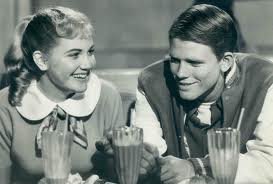
A Chance For Happy Days

arnolds

Adolescence is not fun or pretty. There is nothing “How lovely to be a woman” or “I am 17 going on 18” about it. It’s a wretched maelstrom of physical and emotional change. Everything feels chaotic and unending and there’s not enough life experience to offer a glimmer of hope. This is why teen suicide is so very tragic. No one would deny a teen’s real and crushing psychic pain. But we would probably challenge them in their sense of permanency. ‘Wait’ we collectively say; ‘it gets better.’ And we mean it, and it’s likely to be true. For some time the news of teen suicides has be packaged with pleas for adolescent mental health care. Articles and news desk pundits tell us how to identify a child in crisis and where to get help. But today’s news that 55% of suicidal teenagers had received mental health care is jarring. Yes, there are still 45% of suicidal teenagers not receiving care. But the majority of teens in crisis are getting help. Therapy is tricky business of course. Finding the right therapist for a patient can be challenging. Finding gifted and accessible adolescent specialists can be tough. Prescribing just the right medication to someone who isn’t growing and changing daily is difficult. Monitoring the taking of medication is…well if you’ve ever met (or been) a teen, you know how crafty they can be.

Whether we think that ending one’s life is a personal choice is irrelevant when it comes to adolescents. We may believe that grown people who have exhausted themselves and every option to alleviate their physical and/or psychic pain are entitled to just stop, but that’s not applicable to discussions of children. Teenagers are by definition closer to children on the maturity spectrum. They simply don’t have the life experience or fully developed brain to make such a decision. There are teens who have serious physical and/or mental health issues. There are teens who’ve witnessed or been victims of horrific acts. If they were middle-aged people still suffering intensely this would be a different conversation. But they are teenagers. They are not allowed to drink, vote, live alone or rent a car. They are simply incapable of making a rational terminal decision.

So what can be done? We know that boys are more ‘successful’ at attempts than girls. We also know they tend to be more violent overall. Unfortunately it does not go without saying that there should never be weapons in a home that includes children. There also should be no access (no guns or other weapons in cars, workplace, sheds, trailers, etc.) No weapons ever. There needs to be talking lots of talking. Most teens are sullen and uncommunicative at times, but adults should not be. Your teen may be bigger and stronger than you, but you are still the adult. If your child is more sullen than not, and/or has lost interest in activities (did he/she quit a team or a friend?) tell the school’s administration and teachers. The more people watching out the better. If the child is utterly noncompliant (won’t come out of room, won’t go to school, etc.) it’s time to involve more people and perhaps inpatient care.

It’s hard to think of an adult-ish appearing person with a full vocabulary as a child. But they are. For some purposes a teenager is more akin to a newborn than an adult. They are on the brink of learning an entirely new way of engaging with the world. They are often frightened of leaving the security of the home and entering the world on their own. We, (i.e., all adults in a teens life) must think back to how we scrutinized every movement and development in their newborn lives. We must revert back to the parenting that intervenes when something seems off. It’s frightening to challenge anyone let alone your child who makes your heart ache. It’s scary to exert authority over someone who might be larger then yourself. It’s terrifying to think that you might say the wrong thing; the thing that will actually drive him/her over the edge or out of your reach. Silence never saved anyone.

 
Leave a comment

Posted by on January 9, 2013 in Childhood, Well-Being


Tags: , , , , , , ,