RSS

Tag Archives: Review

Desire Under the Elms – Review


The Goodman Theatre’s Desire Under the Elms has come to the St. James Theatre.  Last night was the first night of previews in this limited NYC production.  Starring Brian Dennehy, Carla Gugino (Suddenly Last Summer) and Pablo Schreiber (Awake and Sing) and directed by Robert Falls (Death of a Salesman, Long Days Journey into Night) this remarkable production is going to create a stir.  The play itself (Eugene O’Neill) holds few surprises but packs an emotional wallop nonetheless.  It has good structure and as bizarre as this sounds, is the perfect starting point for this production. What is really going on, on the very large stage, is cinematic in scope.  This production is HUGE.  There are hydraulics, gargantuan set pieces, farm animals and lots of smashing and hurling.  It is a credit to the cast that they were never overpowered by the set and design.  There is an actual house that is raised and lowered throughout the production, which often hangs over the family.  Metaphor aside, I was terrified.  Call me a worry wart, but I did not entirely trust the cables.  This being the first night, the hydraulics were often a bit slow on the uptake, leaving yawning holes in the stage for minutes.  I was concerned for the actors’ safety.  All of this motion is not actually distracting; in fact it takes a relatively sedate play and brings it into the 21st century attention span demands. Music is used as a powerful device in this production.  There is one scene that has no dialogue, just a riveting musical accompaniment, lending a modern cinematic touch.  At one point a “violinist” comes on upstage.  He is obviously “bow synching” his playing (I’m not sure why) and lends an edgy touch.  The opening and closing music that accompanies father and sons as they tow rocks is pitch perfect in tone and emotion. The set is very dark, and the music works to give it a more colorful dimension.  The set and costuming echoes the bleakness of the storyline, and in such a large space does not feel overly oppressive.
Although, it is clear that this production dictates the use of a large stage, the St. James is not the right venue.  It is very large.  Musical large.  The actors are wearing body mics, although where, remains a mystery, as we saw one of the actors disrobe.  The distortion is a travesty.  The set is dark, and several times I could not discern who was actually speaking.  The volume settings were off at times, creating a  pearl crashing Singing In The Rain reality that just didn’t work.  A smaller theatre would have allowed the actors to be free to unplug.  The accents are a bit off as well.  Mr. Dennehy was using his lovely brogue with no reference to being Irish, but Ms. Gugino seemed to struggle with a New England accent.  I much prefer no accents as a rule, as so few people, save Meryl Streep, can actually master one. The acting is phenomenal, the direction perfection, and the staging out of this world.  It is a dark and sad play, with very little humor.  See it if you can, but not for a first date.


Leave a comment

Posted by on August 19, 2011 in Uncategorized


Tags: , , , , , , , , , ,

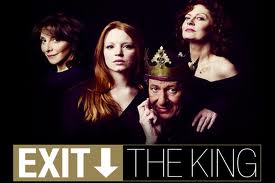
Exit The King – Review


I went to see Exit The King this weekend, with just a tad of reservation.  Well, more “dark foreboding” than a “tad of reservation.”  I was almost certain that Eugene Ionesco and I would never understand each other.  I discovered that I was right, and also that I don’t need to understand someone to enjoy them.  Take the French for example.

I found myself completely absorbed for two and a half hours.  This 1963 revival was directed by Neil Armfield (hailing from Australia) and performed at the stunning Ethel Barrymore Theatre.  The small cast is headed by Geoffrey Rush, Lauren Ambrose, Andrea Martin and Susan Sarandon.  The strong, often absurd characters work in perfect concert with each other and the set design.  It is a credit to Mr. Armfield that the small cast, top heavy with powerhouses, works as a synchronized ensemble.
The storyline and references of Exit The King are shockingly modern.  Yes, 1963 was not that long ago, but the political references are so current, as to be somewhat depressing.  What have we been doing for the last 45 years?  It’s probably more a testament to Ionesco than a critique of our current culture, which makes this play feel so modern.

The king and the natural resources are all dying, but Andrea Martin will make us all forget it.  She is a gem, and I am delighted that she has been on the New York stage at least three times in the past year (On The Town, Young Frankenstein.)  Lauren Ambrose (Romeo and Juliet, Hamlet) is ethereal and stunning and will rule the Broadway stage at some point.  Geoffrey Rush is incredibly physical throughout this play.  He is a dynamo and very very funny.  The doctor (William Sadler) and the guard (Brian Hutchinson) were both quite good, although I must confess to picturing Tim Conway in the guard.  Mr. Hutchinson’s mannerisms were either lifted from the “Old Man” character, or I just watched far too much television as a child.  Ms. Sarandon spent most of the play in profile, and seated as I was in the fourth row, I was mesmerized by her two tone make-up (neck brown, and face white to give definition to the jaw line.)  I was also quite taken with her (very large) tattoos and thumb ring.  I’m guessing Mr. Armfield lost that round.  Her performance was not terribly interesting.  The body accouterments plus the Playbill biography (omitting all acting credits, and simply citing “motherhood and activism” as her accomplishments) scream “star.”  I much prefer watching an actress than a star.

My only hesitation in recommending this production is that I had incredible seats.  I’m not sure if I would have enjoyed it as much in the balcony.  Seated front and center, I truly felt swept up.


Leave a comment

Posted by on August 19, 2011 in Uncategorized


Tags: , , , , , , , , , ,

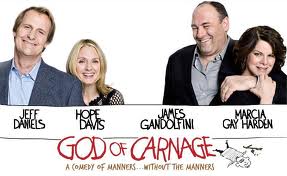
God of Carnage – Review

Hitting the leg of the person next to you (while laughing out loud) repeatedly during a performance is a good sign.  My stinging palm is proof that God of Carnage, at the Bernard Jacobs Theatre, is an absolute delight.  This French expose of modern marriage is written by Yasmina Reza (translated by Christopher Hampton) and directed by Matthew Warchus (Boeing Boeing, Follies, and numerous West End productions.)  Set in Cobble Hill Brooklyn in 90 minutes of real time, there is never a dull moment.  It seems dismissive to describe Ms. Reza’s work as a 21st century Who’s Afraid of Virginia Woolf, but somewhat apt.  Perhaps any theatrical construct of two married couples exposing the underbelly of their selves and their marital dynamics is going to conjure Edward Albee.  In the case of God of Carnage it was the fierce humor, and quite frankly, the drinking, that whispered “Virginia Woolf” repeatedly.  But that reference is merely a jumping off point for this play.  Without resorting to Lifetime movie tactics, God of Carnage manages to tackle; bullying, gangs, violence and social class while never losing its humor or dramatic interest.  The fact that the evening stays above the sentimental fray must be greatly credited to the incredible cast.  Hope Davis and Jeff Daniels as one couple and Marcia Gay Harden and James Gandolfini as the other couple.  Not enough can be said about the sheer delight in watching these four very talented people.  Ms. Harden has a luscious role and plays it like a virtuoso; she is hysterical and heartbreaking and infuriating.   As difficult as it is to take ones eyes off of Ms. Harden, this truly is an ensemble piece and it is clear that this quartet is having the time of their lives.  It speaks volumes to me that during repeated silences, the acting was equally as riveting as it was during the explosions.

Ms. Davis and Mr. Daniels (a wealth management professional and attorney) are visiting Ms. Harden and Mr. Gandolfini (an art historian and home fixture retailer) to discuss their sons’ recent physical altercation.  The stage is set in a dramatic fashion.  The entire stage is used as the living room; a rather unbelievable conceit for a Brooklyn home.  However, in an entertainment world in which Greenwich Village rent controlled apartments are 2,000 square feet with terraces, and newspaper columnists can support $650 a pair shoe shopping habits, all NYC scale bets are off.  There is a bold textured wall separating the living room from the rest of the apartment.  The wall is set at an angle and we can see the walls behind it, painted red.  As the play/story unfolds, the walls become progressively darker; a nice touch.  Despite the expanse of the apartment, it is surprising how much of the production so accurately represents time and place; keeping in mind that this play is French.  The only nod to its original Parisian setting is the omnipresence of the clafouti (a French pastry.)  The costumes, mannerisms and parental concerns simply scream “NYC 2009!”
I strongly recommend seeing this production, and seeing it with someone who does not bruise easily.
.

 
Leave a comment

Posted by on August 19, 2011 in Uncategorized


Tags: , , , , , , , , , , , , ,

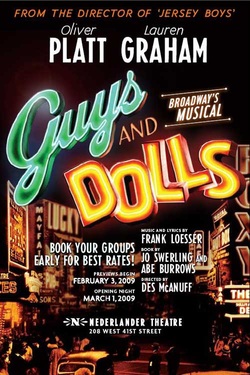
Guys and Dolls – Review

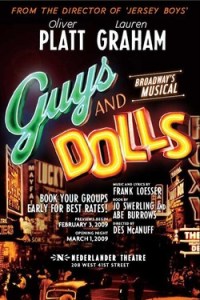
What’s playing at the Nederlander?  I’ll tell you what’s playing at the Nederlander; one of my favorite musicals, Guys and Dolls.  This current revival (the most recent was starring Nathan Lane and Faith Prince) is a throwback to the “let’s put on a show in the barn” milieu of shows.  I am not referring to the ingenuity or frugality of kids performing in a barn, I am instead referring to the the plethora of novices involved in this production.  The director, Des McAnuff has limited, if any musical theatre experience (does Jersey Boys count as musical theatre?)  The choreographer, Sergio Trujillo lists Jersey Boys and All Shook Up as his most significant credits.  I believe that both of these jukebox musicals involved a lot of rhythmic standing.  The four leads in this revival have nary a musical between them of which to speak. To Mr. McAnuff’s credit, he knows that he is in over his head.  His insecurities can be seen in his “throw everything on the wall and see what sticks” direction.  There are more devices and gimmicks in this production than you can shake a pair of dice at.  Mr. McAnuff actually took the stage before the houselights dimmed to “explain” the preview process; in essence he was apologizing.  Oh dear, Mr. McAnuff.  The show opened in the most promising of manners.  The stage lights went up to show a three tiered orchestra upstage, set in the most delicious art deco bandstand (times three.)  It was a glorious way to highlight the (very small) orchestra.  And then they disappeared, never to be seen again until the opening of Act II.  Having the orchestra upstage and not in the pit provided a missed opportunity to not mike the actors.  The Nederlander is a small house, and the reduced orchestra set upstage would not have blocked even the weakest voiced.
For those of you unfamiliar with the show, it opens with a New York City street scene; cops, gangsters, regular people, all walking and interacting during the overture (almost a silent movie if you will.)  Well, Mr. McAnuff decided to try something new; he opened with Damon Runyon typing the story.   Now before I rant about the kitschy and absurd nature of this gimmick, let me stress that if you want to direct something new, do not REVIVE something old.  The Damon Runyon character shows up (silently and ridiculously) throughout the performance.  Just when I learned to ignore the shadowy figure, the surreal wall is broken in Act II and a character talks to Mr. Runyon (groan!)
The use of space is a tad bizarre as well.  The orchestra pit is used continuously for no effect that I could discern.  Picture Mama Rose walking up and down up and down up and down those orchestra steps for two and a half hours.  The gimmick works once, at most.  The boxes are used as well, to simulate what, I am not sure.  During the two Hot Box performances, extras are in the boxes “manning the spots.”  That might work.  But why is Nathan using a pay phone in the box? Speaking of the Hot Box…when did it become a pole dancing strip club?  While we’re on the subject, when did time go backwards in the Hot Box Club?  Mr. McAnuff (I suspect) changed one line of lyric to indicate that it was the early thirties in the Club.  Someone forgot to tell the set designer and costumer, they both think it’s the early fifties.  Of course the video designer(!) Dustin O’neill knows what year it is, and pushes the “elevated train” button on his console several times to prove it.  The video is used once brilliantly.  It is always a challenge on the stage to move the actors and action into the sewer.  The video and sewer pipes lowered from the fly is a perfect solution.  The theatre needs more of that ingenuity and less video of rays of sun gleaming from the heavens in the background of the Save the Soul Mission.

The cast of this revival is consistent.  Everyone seems equally ill suited to the task.  There are two rather small roles that shine in this production.  Harry the Horse (Jim Walton) and Arvide Abernathy (Jim Ortlieb.)  They both are utterly convincing and add a great deal to the production.  Mr. Otlieb accompanies himself on the piano adding an incredible intimacy to “More I Cannot Wish You.”  (I’ll let you have that revision Mr. McAnuff.)  Oliver Platt is Nathan Detroit, a role that does not require much dance and calls for limited singing as well.  Mr. Platt is a very gifted comic and poignant actor who is offered nothing to play off of with Adelaide played by Lauren Graham.  Ms. Graham is being directed to play Miss Adelaide in an overly enunciated monotone.  Zero affect.  In a more compelling actress, I suppose this might work, but Ms. Graham can neither sing nor dance and is excruciatingly uncomfortable on a stage.  She was not served well by the people around her.  Novice or not, someone could have explained the laugh lines to her.  “A female remaining single; just in the legal sense” should be achingly funny!  I am still wondering why Miss Adelaide, a cabaret performer, would be played by someone who can not sing or dance.  The choreography for Ms. Graham consisted of having her stand still and taking off her clothes.  Perhaps Mr. McAnuff saw Gypsy too many times?  Craig Bierko as Sky Masterson had about as much charisma as Ms. Graham and a vocal range of one octave.  While his voice is pleasant, the songs are almost unrecognizable due to the arrangements necessary to accommodate Mr. Bierko.   Mr. Bierko spent his first twenty minutes on stage doing a passable Marlon Brando imitation, and then seemed to lose interest.  It is extremely telling that the most captivating character in this production was  Sarah Brown, played by Kate Jennings Grant.  Sarah Brown and her merry band of missionaries is usually the downer of the show.  But as the only singer in the cast, she was a joy to watch.  I got the impression during some of the songs, that the musical director, Ted Sperling, worked alone.  The non-dancing songs, were so well designed, I have to believe they were done in a vacuum.  To be frank, all of the songs were non-dancing for all intents and purposes.  Even the sewer scene (“Luck Be A Lady”) an explosion of male dancing under almost any direction, staggered with only a series of backflips to indicate dancing.   The Havana scene, usually a burst of color and sex, is disappointing.   If I did not know the dance story line (Sarah becomes jealous of the attention paid to Sky) I would have missed the plot entirely.  I was reminded throughout the (very long) evening of how many high schools have done a better job with this show.  To Mr. McAnuff’s poor drowning credit, I must say that I was touched by how protective he was of Oliver.  Every number is staged to draw attention away from Mr. Platt’s (very valiant) attempts at dance/movement.  Mr. Platt could be wonderful as Nathan, and it is terribly wasteful that the cast and production staff is squandering this opportunity.  I saw Mr. Platt after the show, and I believe that he is as disappointed as I am.

 
Leave a comment

Posted by on August 19, 2011 in Uncategorized


Tags: , , , , , , , , , ,

The American Plan & The Cripple of Inishman – Review

This weekend found me at The American Plan (Manhattan Theatre Club) and The Cripple of Inishmaan (Atlantic Theatre Company.)  As a lover of language, I spent most of the weekend a bit buzzed and am now suffering somewhat from a dialogue hangover (which presents itself in sufferers as a tendency to use small words and wishing for minimalism in others.)  Besides intensely rich dialogue, these plays shared several other attributes.  Both of these (straight) plays were sold out, and had installed additional seating!  This was confusing and very inspiring.  The audiences were also highly responsive, laughing, gasping and otherwise demonstrating attentiveness.  Both of these period pieces, The American Plan is set predominantly in 1960 and The Cripple of Inishmaan is set in 1934, use the narrative of the stories we tell ourselves and others, in order to navigate our way through life.  They also both have as their central characters, twenty year old challenged people.
The American Plan by Richard Greenberg (Take Me Out, The Violet Hour, etc.) and directed by David Grindley (Pygmallion, Journey’s End) is simply stunning.  Set across the lake from a Catskill resort, the story focuses on an emotionally unstable twenty year old Lili (Lily Rabe) and her mother of German origin, Eva Adler (Mercedes Ruehl.)  Their relationship has a slight hint of Light in the Piazza, in time period and maternal ambivalence about launching a flawed daughter into the world.  The Adler family is perfectly rounded out by servant turned companion Olivia (Brenda Pressley.)  Olivia’s quiet presence is jarring and reassuring throughout the play.  While all of the dialogue is stunning in its intelligence, humor and rhythm, it might be the one line of Olivia’s that will stay with me.  I will not give it (or my psyche) away, but it relates to the comfort of one’s own counsel. Mercedes Ruehl has got a character to die for in Eva.  She is rich and accented, both literally and figuratively and Ms. Ruehl knows exactly what to do with her.  She is a stunning woman and actress and it is mesmerizing to see her gripped with a bout of degeneration (Parkinsons?) from the vantage point of the second row.  Lily Rabe is heartbreaking, amazing and so terribly sad.  She is a tour de force.  The male lead/suitor Nick (Kieran Campion) is wonderful and perfectly suited to the role.  The set design is simplistic brilliance.  A dock on an incline, a table and two chairs and a curtain make up the set.  While the scene changes are plentiful, the period music and rapid fire transitions (the dock is on a turntable) do not give pause, in fact, it was the anti-Country Girl.  There are twists and turns in the story that result in an intensification of the audience’s connection to the characters.  The title of the play refers to the three-meal-a-day, anesthetizing resort meal plan that was popular during the 1960s.  It is also a reference to the prescribed expectations of our culture.  This is a sublime play, directed and staged and performed perfectly.  If you can see it, you will not be disappointed.
The Cripple of Inishmaan is written by the delectable Martin McDonagh (The Pillowman, The Leuitenant of Inishmore, The Beauty Queen of Leenane) and directed by Garry Hynes (Druid Theatre Company.)  It is set in the tiny and dull town of Inishmaan while a Hollywood film crew is scouting in nearby Inishmore.  This plot line is actually based on a real documentary filmed in Ireland at the time.  The “cripple” is twenty year old Billy (Aaron Monaghan) who has been abandoned and thus raised by his foster aunts (Dearbhala Molloy and Marie Mullen.)  Billy’s body is twisted in an agonizing manner and he suffers from respiratory distress throughout the play.  Mr. Monaghan manages to convey all this with a trained athlete’s commitment.  My body and lungs ached for him.  It is not possible that this play could be performed more than once a day.  It is an outrageously physically demanding role.  The remainder of the cast is predominantly Martin McDonagh players with one American exception (the doctor.)  They are all exquisite with the exception of the Irish accent of the American actor.  I would have preferred they had him speak in his own voice as Oliver Platt did in Shining City.  The story has several twists and turns and is almost flawless.  There is some violence that is gratuitous (this /is /McDonagh after all) and inconsistent with the character perpetrating the bashing.  Overall, the story is captivating.  Judging by the audience response, I suspect that this production will move to Broadway.  Before it does however, I suggest just a wee bit tightening up.  While the staging and effects are wonderful, particularly the lighting cue on the final exit (stellar!) there is some awkward business with eggs.  It is not particularly amusing, and very time consuming (not including the time taken for the crew to clean up!)  The dialogue/story could also use some tightening up.  It is a little too sprawling and slow in places.  Had I not seen The American Plan immediately prior, I would have no doubt been more captivated by this play.  It is good, just not as good as The Lieutenant of Inishmore or The Pillowman.

 
Leave a comment

Posted by on August 19, 2011 in Uncategorized


Tags: , , , , , , , , , , ,