
Times Square is all about sensory overload. Even during daylight the cacophony of lights and video are enough to give a person vertigo. Thousands of disoriented and staggering people whip their heads up & down and to & fro taking in any and everything. Advertisements flash and beckon from the sidewalk up to the sky. Spotting themselves on the jumbotron, visitors wave frantically to big brother. They squeal and scream in disharmony with ticket hawkers and coupon dealers. Underneath their sound is the white noise of traffic, preaching and ranting.
Yesterday the chaos of sound was silenced and the sight was undistracted for several minutes when a couple of hundred of us raised our hands in synchronicity and protest of gun violence. We held up our hands for 26 seconds, each second representing a victim in Newtown. Instantly the crowd was silenced. We slowly sank to the ground as our ‘partners’ held their hand over our hearts for 26 seconds, and then outlined our bodies in chalk. Lying on the ground, and hearing nothing, absolutely nothing was more realism than most of us bargained for. It was the subway rumbling underneath that reminded us to get up and chalk our partners’ body. We wrote inside the body outlines.; “Crisis” “Boy” “Joseph” “Glock” “Emilie age 6” and quickly dispersed. Making our way through the tour groups and Elmos we looked back. The ground was covered with chalk outlines in a chilling and strangely beautiful tableau. On the perimeter of the ‘performance space’ the assigned police officers still solemnly stood. Moments before the start time they had asked for their friend’s name to be chalked into an outline.
Thank you to ART=AMMO for organizing this event.
Tags: ART=AMMO, Brenda Tobias, flash mob, gun control, Newtown, NYPD, police, Times Square
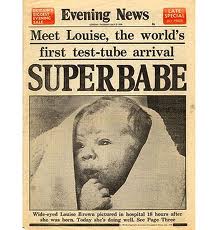
Procreation has changed an awful lot in the past few decades. Do you remember Louise Brown? She was the very first ‘test tube’ baby (aka known as the result of the first successful in vitro fertilization.) Her mother’s story (splattered on every British tabloid) was an international shock. Would the child be normal? Should we be making people in a laboratory? Were eugenics far behind? What kind of person goes to such sci-fi lengths to replicate themselves? Even the Pope weighted in. Well, little Louise is 34 years old now and my have times changed. Medical advances have redefined not just how we make babies but when mothers can be made as well.
Thirty plus years ago a pregnant woman over the age of 35 raised eyebrows. The elevated eyebrows were less about impropriety and more about biology. “Geriatric pregnancy” is an actual medical term and has nothing to do with walkers or graying hair. The human body is designed to be at peak fertility and health before age 35. Specific gestational and delivery risks are more probable after this age. Medical advances have made it safer (through early detection methods) for older women to carry and deliver, but the risks still exist. Historically women over 40 have had children, often quite by surprise. It is not unusual for a woman to develop a (false) sense of infertility security at the start of menopause. But it is only in the last decade or so that women over 40, trying to become pregnant has become normative. It was as recent as 1995 that (actress) Jane Seymour made magazine covers and evoked national gasps by becoming pregnant (with twins) at 44. Public judgments were made about her vanity and sense of entitlement. “She’ll be over 60 when they graduate!” It’s rather unlikely that today such an endeavor would warrant mention let alone prompt a national discussion.
Celebrities (and regular folk) routinely become parents at an older age; often through elaborate intervention. A woman can use her eggs (if they are viable) or a donor’s eggs. She can use her own or someone else’s uterus. Sperm is easily and equally transferable. There are many means and methods of now creating people. It’s hard to imagine that any new configurations could possibly be discovered/invented. All of this progress brings its own host of issues. Medical ethicists must smack their lips and rub their hands together every time a surrogate is hired. What does it mean to create a population who may never know to whom they’re related? Will children grow up and marry their siblings? What does it mean when the eggs of a woman with cancer are frozen for future use? Do doctors have a medical (and ethical) imperative to determine any genetic component to her cancer before fertilizing the eggs? And while we have the ethicists in the room: should health insurance cover fertility expenses? Is replicating one’s genes and/or having a birth experience, medically necessary? If not, are only the wealthy then entitled to these means to parenthood?
And what of other means to parenthood? What is the (current state and) future of adoption? International adoption has become a bit trendy as a few celebrities publicize their children’s origins. But limits to these adoptions are imposed everyday. What of domestic adoptions? There was a time that celebrities regularly and publicly adopted locally out of need. Fertility, contractual obligations, marital status or state of marriage necessitated adoption. If celebrities are adopting domestically today they’re doing it quietly behind closed doors (as the surrogate signs over her rights.) There will never be a shortage in this country of children needing parents. Accidents happen, death happens, life happens; and children are left in precarious situations.
There is no one way or even right way to make a family. In fact often it’s the messiest and most complicated households that are the richest. However as we make these incredible medical advances in maternity let us not lose sight of what we want parenthood to be. Nurturing and guiding a human being is an incredibly rewarding endeavor. Giving a child solid roots and the freedom to fly is the greatest of gifts. How that child arrives into your home and life is immaterial.
Tags: adoption, Brenda Tobias, childhood, families, fertility, geriatric pregnancy, insurance, IVF, Jane Seymour, Louise Brown, parenting, surrogacy, test tube baby
A museum when done right should teach, inspire and evoke an emotional response. There are some museums whose content and themes are so inherently powerful they must rely on the absence of stimuli to evoke a response. Often some section of the museum is devoid of audio or descriptive copy. There is a four-story glass sculpture of freedom, or a pile of suitcases or a melted police car. The power of these selected image(s) can be breathtaking and utterly unnerving.
The Newseum (in Washington D.C.) has not a single quiet space. It is like the topic itself, unrelenting, riveting and compelling. Headlines, newsprint, broadcasts, artifacts and photographs form a cacophony of meta and micro information. “Oh right, THAT event! And how was it covered?” No stone is left unturned in answering the question. (Did you know a journalist created the FBI 10 Most Wanted list? See that!) The Pulitzer Prize Photography gallery is an embarrassment of riches. There are 70 years worth of stunning imagery to be admired and absorbed. Factoring in that the prize was offered in two categories beginning in 1968, that’s a lot of photos. It’s easy to become overwhelmed and mentally mutter “Nice” “Well done” in a monotonous tone. But something unexpected happens by the time you reach the 1960s-1970s section. A theme, spanning over 10 years, begins to develop, and a lump in the throat and pit of the stomach forms.
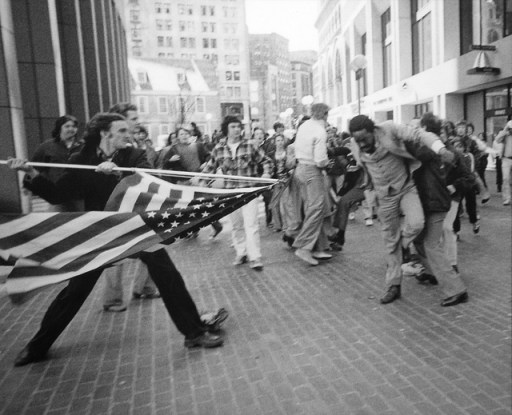
We’ve seen (most of) these photos over the years individually. The image of Jack Ruby shooting Lee Harvey Oswald (Robert H. Jackson) has become part of how we talk about Kennedy’s assassination. We’ve all seen, and perhaps turned our heads, from the image of a naked child running from napalm (Huyhn Cong Ut) and of the Saigon execution (Edward T. Adams). We may recall the university campus gun violence (Kent State and Cornell.) But it is the (1967) photo of James Meredith (the first African-American student to attend the segregated University of Mississippi,) shot on a Mississippi road displayed in proximity to a photo of Ted Landsmark being attacked with the United States flag a full ten years later that is horrifying. And that is the point of this startling decade of American history. There was simply so much, so very much violence. Even the uplifting photos are a reminder of violence and sorrow. The unadulterated joy on the faces of Col. Robert L. Stirm’s family upon his return is a reminder of the heartbreak of Viet Nam soldiers Missing In Action. The war, the assassinations, the racism, the plight of the migrant workers and the violence; it’s all there in obscene excess in those 10 years.
Tags: Brenda Tobias, broadcast, Col. Robert L. Stirm, Coretta Scott King, Cornell University, Edward T. Adams, FBI, headlines, Huyhn Cong Ut, Jack Ruby, James Meredith, Kennedy assassination, Kent State, Lee Harvey Oswald, Media, MIA, Missing In Action, news, Newseum, photographs, Pulitzer Prize, Robert H. Jackson, segregation, Ted Landsmark, Viet Nam, Washington D.C.
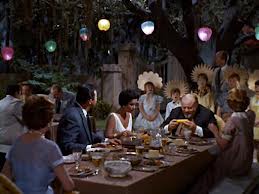
The squalling band of no-necked monsters in Tennessee William’s Cat On A Hot Tin Roof makes their presence known. They screech and howl and run amok in an attempt to get on our very last nerve. And oh what a fine job they do. They evoke a mental “get the hell off the stage” audience response. They are to Cat what the Save the Soul mission band is to Guys and Dolls: a loud grating interruption of what we came to see. And that is the point. We are to experience those no-neck monsters, as do the primary adult characters. Their mother is a familial terrorist and her children are her weapons. It is a testament to Mr. Williams that his monsters still horrifying in the 21st century.
The 1950s (when Cat On A Hot Tin Roof was written) was a period known for “seen but not heard” children. Adults enjoyed a post-war life and children had their place, and that place was often upstairs in their rooms. Children were introduced to adults (whom they called by their surname) and were ushered out of the room/party. The manners and behavior of a child was a direct reflection of the parent. The fifties were nothing if not the exaltation of propriety. Manners and appearances mattered (which goes a long way in explaining girdles and white gloves.) For children this manifested itself in a clear understanding of limits. Adults belonged to the world and knew best. It was a frustrating but secure paradigm in which to grow.
Just imagine the shock of the 1950s adult (children did not attend the theatre) audience upon seeing those no-necked monsters. Those grating little characters were hauled out and scattered like confetti on a parade. There they are playing Dixie at the airstrip to greet Big Daddy (who reacts with the same horror/disgust of the audience.) There they are “performing” at Big Daddy’s birthday party to which adult friends have been invited. (Big Daddy voices our wishes and asks for an intermission.) There they are barging into bedrooms and demanding adults engage in play. And there they are repeating hateful remarks to their aunt. It’s enough to evoke a gasp. That it still does that today is remarkable.
Children are not sequestered today. In fact if anything the world has become theirs and adults are seen but not heard. Adults can often not be heard over the din of children in restaurants, theatres, museums and funerals. Babies and children are not so much integrated into adult lives, as adults are integrated into the lives of children’s. We’ve created retail empires for babies and children. Broadway has discovered the steady income stream of children and the white way is dotted with flying people and talking teapots. Infants and children unfamiliar with the term “indoor voices” are dining out at 7:00, 8:00 and even 9:00 PM. They don’t shy from the highest end restaurants either. A simple dress code of: No Pull-Up Pants would put an end to that; but we digress. The point is that the world has changed tremendously since Mr. Williams created those no-neck monsters. Yet they still have the power to horrify. That is partly due to the scenic background of their terrorizing. They are clearly in an adult environment. The house in which they are running rampant is stately; there is no great room, there are no toys. It is clearly adult space.
Cat On A Hot Tin Roof is about living and dying and truth telling. The struggles within and between the characters are fascinating. The children are a reflection of the vulgarity of their parents: Gooper and Mae (the least interesting characters in the play.) The no-neck monsters’ antics threaten to get in our way as we try to learn about the adults. But by the middle of the play they are gone. Put to bed (or out to pasture); they are gone and that’s when things get really interesting.
Tags: 1950s, Big Daddy, Brenda Tobias, Broadway, Cat On A Hot Tin Roof, childhood, children, Gooper, Guys and Dolls, Mae, no-neck monsters, Tennessee Williams, Theatre
“Pre-K for all!” As rallying cries go it’s a bit sweet and conjures up some pretty adorable images: Tiny people with finger painted signs toddling their way to Capitol Hill. It’s an expensive proposition but one that is difficult to argue. “It’s for the children!” “Children are our future!” You know the rest. But beyond the sentimentality and cynicism is the truth. The world has changed tremendously and we need to catch the hell up.
It is no longer the norm that small children spend their days with a parent, and it hasn’t been for quite some time. Childcare can be expensive and uneven in quality. Some toddlers are deposited in front of a television set for 8-10 hours and some are learning Dvorak on miniature violins. Of course these childcare discrepancies always existed. But there was a time when 5 year olds from every background arrived at kindergarten to start from zero together. Kindergarten (often held for 1/2 days) was for cutting, pasting, coloring, letter learning and learning to stand in line and raise one’s hand. There was story time and maybe some music and snack. Today’s Kindergarten is a bit more serious and most likely an all-day affair. The academics start much earlier than years past.
The day is spent learning letters, numbers, science, social studies, and yes, standing in line and hand raising. What was once an entire year consisting of an easing away from the home and into the world is now much more like the real thing. It’s understandable, there’s an awful lot to learn after all. In the past Kindergarten might have been the first time little people spent their day with other little people. (Socialization is serious business.) It makes a great deal of sense to beef up this precious year of public education. We know that early education makes an impact on life long learning (the good people of Sesame Street ran with that ball 40 years ago.) We also know that children come from vastly different backgrounds and opportunities. Those who can afford it or are fortunate to live in states with it, are already sending their tykes to pre-Kindergarten. Public education, despite its ideals, is not equal. Some schools are far superior to others. Some parents are far savvier than others. Any moves we can make to democratize education and prepare children for life long learning should be supported and applauded. I join those little people carrying the finger painted placards in setting down my juice box, and putting my hands together for universal pre-K.
Tags: Brenda Tobias, Capitol Hill, childcare, children, education, Kindergarten, pre-K, pre-Kindergarten, public education, Sesame Street, toddlers



 Here She Is Boys