RSS

Category Archives: Uncategorized

The Lady From Dubuque – Review

Edward Albee is not for the faint of heart.  You would not take in a matinee of his, expecting a light and frothy afternoon.  What you will get is a beautifully crafted peek into the human spirit. Those spirits are fighting for their lives in The Lady From Dubuque (Signature Theatre.)

Set in a suburban home, the play takes place over the course of one night and the following day.  The play (directed by David Esbjornson) opens on three couples playing a party game that involves the (oft repeated) phrase; “Who am I?”  The hosts Sam (Michael Hayden) and Jo (Laila Robins) bear a passing resemblance to another Albee couple; George and Martha.  In this case however, Sam is weakened by the kryptonite of his wife’s terminal disease.  Jo is biting, but not nearly to the degree to which she is entitled.  Their friends are mostly silly.  Edgar (Thomas Jay Ryan) and Lucinda (Catherine Curtin) are that special blend of vapid and shrill that makes some people phobic of the suburbs.  Fred (C.J. Wilson) and his girlfriend (Tricia Paoloccio) are at least interesting by virtue of his vulgarity and her preening.  There’s a reason these people all drink.

A bit past the midway of the first act, Jo rapidly deteriorates in (literal) gut wrenching pain.  It is difficult to watch the exquisite portrayal.  When Edgar demands that Jo, writhing in agony on the floor, get up and go apologize to his wife, Lucinda for an insult, it is almost too much to witness.  But then he points out what is so true it can not be discounted; his wife did not cause Jo’s pain, but Jo had caused Lucinda’s.  As Jo struggles to her feet, she is living rather than dying.  It is her last act of physicality.  The first act ends with a cresendo of agonizing wails and the appearance of an otherworldly figure; Elizabeth (Jane Alexander) and a dashing escort; Oscar (Peter Francis James.)

The tone of the second act is decidedly more physical, combative and high stakes.  Sam is frightened by the arrival of Elizabeth, who claims to be Jo’s mother.  His hysteria heightens and results in him being restrained (and ‘put to sleep’ with a strategic touch by Oscar.)  While he cannot articulate it, Sam knows who these people really are and why they are there.  The reality of death is simply far too painful for him to realize.

The rhythm and banter of Albee’s dialogue is a perfect conduit for this allegory.  His characters are so raw and real they create a platform for the surrealism that could feel forced or twee.  This play was not well received in 1980.  Death rarely is.  The only sticking point, for this audience member, was the treatment of race.  Much is made of Oscar’s “blackness” and the transition from superfluous racial humor to minstrel is rapid and unpleasant.  No doubt there is a dramatic intent, it just alluded me.

This is a flawless and beautiful production and should be seen by many.
 
Leave a comment

Posted by on April 1, 2012 in Uncategorized


Tags: , , , , , , , , , , , , , ,

Pipe Dream – Review

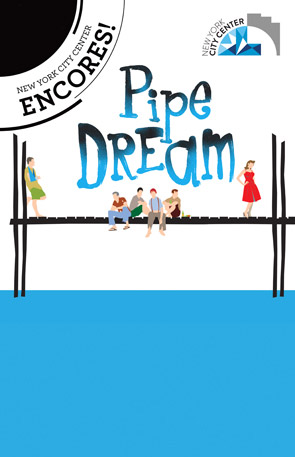
N.Y. City Center Encores! is back to its old self with its production of Rodgers & Hammerstein’s Pipe Dream (1955.)  Fully choreographed (Kelli Barclay,) with a perfect set (John Lee Beatty) and costumes (Toni-Leslie James) that by all rights should be in my closet, Encores! once again, does not disappoint.

Pipe Dream is based on two John Steinback novels (Cannery Row and Sweet Thursday) and has a certain grittiness that one may not always associate with Rodgers & Hammerstein.  To be perfectly candid, I often suffer from insulin depletion at declarations of climbing every mountain, or of the corn being as high as an elephant’s eye.  I’ve always been more of a; boy like that, sit down you’re rocking the boat, you’ll never get away from me, kinda gal.  And while Pipe Dreams is by no means a perfect show, it has lured me onto Team R&H.

The theme of the show is that of the world of work, and not the button downed briefcase carrying kind.  Much of the show takes place in both a house of…well, a house of female comfort and a flop house.  There are some simply beautiful songs; Everybody’s Got A Home But Me and Suzy Is A Good Thing (which opening notes are reminiscent of the opening to Bali Hai.)  There are also one or two songs that simply fall flat.  However, with a strong producer (back in 1955) it’s clear that this show could have been work-shopped into something wonderful.

With any show that does not come complete with recognizable tunes or story, or has not come directly from a film or comic book; casting is key.  Marc Bruni (director) hit a trifecta with Leslie Uggams, Tom Wopat and Stephen Wallem.  Mr. Wopat and Ms. Uggams are in great voice and simply devour their characters.  Mr. Wallem is an extremely enjoyable character actor (with a very good singing voice) and captures the character of Hazel perfectly.  The male and female romantic leads; Will Chase and Laura Osnes are not as suited to their roles.  Romantic leads are never that interesting to play, and without a certain spark, or electric magnetism, they are not very interesting to watch.

The real star of any Encores! production is the thirty(!) piece orchestra, directed by Rob Berman.  At a time when paired down orchestras are being divided and sequestered into basement rooms with tiny monitors of the stage (across the street) it is phenomenal to see a full orchestra on the stage.  When the curtain rose to reveal the elevated orchestra I heard a young girl gasp.  If there is anything that is less than positive about Encores! is that the run is always far too brief.  Pipe Dreams plays until April 1st.

 
2 Comments

Posted by on March 28, 2012 in Uncategorized


Tags: , , , , , , , , , , , , , , ,

Ask Me How Do I Feel

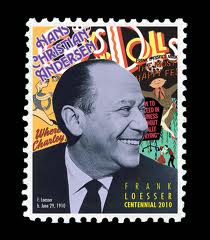
Sitting in Avery Fisher Hall, with the N.Y. Philharmonic upon the stage, celebrating Anywhere I Wander: The Frank Loesser Songbook, I felt like a  ringing bell, popping spring and swinging gate all at once.  From the very first note of the “Frank Overture” the packed house knew they were in for an amazing night.  The evening’s program was introduced by Robert Morse, his ovation demonstrating how much audiences believe in him.

The first number; Bushel and a Peck was performed by a male trio (John Bolton, Bernard Dotson, Michael Seelbach) in three part harmony.  I was left wondering why it is not always performed in that manner!  The trio were choreographed (Andrew Palermo) down to the half-note, their standing microphones used as dance partners.  The numbers following were predominately from the stage (The Most Happy Fella, Where’s Charley, etc.) but there were film and pop songs performed as well.  Marc Kudisch’s rendition of Hans Christian Anderson was moving and amusing.

Of particular personal joy was the performing of several numbers from Guys & Dolls.  I had never previously had the privilege of seeing a perfect professional rendition of these songs.  Victoria Clark was positively luminescent in her rendition of If I Were A Bell.  It was somewhat poetic to have Mary Testa performing Adelaide’s Lament, as she and I had both endured the (2009) Guys & Dolls revival.  Ms. Testa, with all her sneezing and wheezing and her sinus that’s really a pip, made the song all her own and it was fabulous!  If there was any disappointment to the evening it was the quality of Robert Morse’s microphone.  What felt like a once in a lifetime experience; seeing Mr. Morse perform I Believe In You, was marred by static and feedback.  I was left wondering how the N.Y. Philharmonic does not have a stage manager adept at killing the body mic and running on stage with a hand-held.

Fortunately that is not what lingers.  What I will always recall is the incredible orchestra, joyfully conducted by Ted Sperling and over 2,700 people singing along to Once In Love With Amy.

 
Leave a comment

Posted by on March 27, 2012 in Uncategorized


Tags: , , , , , , , , , , , , , , , , ,

The Total Bent – Review

The Public is a distinct theatre, at times self-consciously so.  Often it is challenging to recall its noble origins amidst the marquee Central Park players, and lobby filled with smug hipsters.  But a physical set back (in this case a massive messy renovation) will do wonders to a persona.  Plastic tenting drapes the facade (and sidewalk) of the building.  Visitors are shuttled through a labyrinth of particleboard and exposed electricals to a makeshift box office.  The Public staff seems to have multiplied threefold and have been trained to move everyone safely and informatively to their respect seats.  Even with all of the helpful friendliness, I braced myself upon entering the theatre space.  Yes, the seats are plush and comfy, but the stage is always awkward and it becomes exhausting to ignore the obstructing columns time and time again.  Yet there it was, designed to be a southern (somewhat shabby) recording studio and it was impossible to imagine a more perfect stage. The set seemed to seep into the audience and into the very fabric of the infrastructure.  Those annoying columns (wrappers in carpet remnants and secured with duct tape) seemed to have been created just for Andrew Lieberman’s design.  The pieces of furniture are random in style and utterly realistic.  Wires, recording devices, and used instruments dot the stage.

All of this would fit into the category of commendable “art installation” if it wasn’t just a hint of what splendor awaits in The Total Bent (Stew-book, lyrics and music with Heidi Rodewald.)  This is the second major theatrical endeavor since Passing Strange (2008) and has elements that may now be seen as Stew trademarks.  As in Passing Strange: the musicians are an integral part of the story and on stage.  The core of the story is the parent/child tensions that result from a successful “coming of age.”  Joe Roy (Vondie Curtis Hall) is a dynamic larger than life father/recording producer.  His son Marty (William Jackson Harper) has been recording since he made the ladies swoon in church at the age of ten.  Their generational divide centers around the “type” of music they each want to record.  His father wants to continue to package spiritual songs for the living rooms of white people.  The son has something a little more contemporary and authentic in mind.  Beyond that issue, was a song that resulted in disaster (through a misinterpreted lyric) and a great recording that never was.  The boy breaks free of his father’s overbearing grip (or does he?) and struggles to find his voice.

The music, not surprisingly, is excellent: a little bit gospel, a little bit rock and roll.  There is a lot of foot tapping and swaying happening in the audience.  It isn’t entirely clear what the time period is.  There are times the costumes suggest the 1970s, yet the vernacular speaks to the present, presumably this is intentional.

Directed by Joanna Settle, the tight ensemble never falters.  The British record producer (David Cale) is a wonderful addition with his energy, awkwardness, and pale angular Britishness.  The church bus driver and janitor (aka the back-up band) played by Eddie R. Brown II and Julian Rozzell, Jr. are incredibly watchable.    The use of space, light (Adam Silverman) and sound (Obadiah Eaves) are spot-on and add a roundness and completeness to the play.  While there is never a dull or “down” moment, and one never tries to spy one’s watch in the dark, the show does need a trim.  Two and a half hours is not extreme, but some of the emotional impact of The Total Bent is diluted with (what are in essence) repeated scenes.  It is a compelling, well crafted and staged play that could be perfect with just a snip or two.  No doubt in such an organic feeling piece, the cuts may hurt a bit.

There is a perfect storm at work right now.  The Public, and all the metaphorical significance of its massive face-lift, and The Total Bent create a magic together.  I’m not sure I’ve experienced theatre at which the lobby informs the experience of the play.  This play would most certainly work in a multitude of venues, but if you can, see it now; at The Public.


Leave a comment

Posted by on March 7, 2012 in Uncategorized


Tags: , , , , , , , , , , , , , , , , , , ,

And God Created Great Whales – Review

It is rare that a new musical production appears; beautifully crafted and perfectly executed.  And God Created Great Whales is just that.  This two-person play is the story of Nathan (Rinde Eckert) and his muse Olivia (Nora Cole) and their creation of a Moby Dick opera.  Olivia is Nathan’s fantasy, inspiration and musical partner.  She is also often all that is left of his mind.  Nathan is suffering from a rapidly progressing form of memory loss.

The stage is set with several cassette tape recorders, post-it notes, and flashcards.  Evidently, Nathan in the first throes of his illness created effective prompts for the future diminished Nathan.  Through much of the play Nathan wears a recorder around his neck, duct taped to his waist.  Each session at his piano starts with listening to the tape.  He must listen to more and more of these previously recorded reminders as to who he is and what he’s doing as the play progresses.   It would be unbearable to watch if not for the rich bursts of lush operatic score that emerge. The opera is the play within the play and allows for ravishing duets and solos.

There is also much humor in the play.  But its true Amazonian strength is its flawless storytelling.  What could be a depressing and predictably sentimental theme is made beautiful and inspiring.  There is simply no separating the performers from the performance in this production.  Eckert and Cole are mature actors completely immersed in their characters.  They move like trained dancers, in and around each other on the thrust stage.  Eckert is also the creator of the play (and score) as well as the sound designer.  The sound design of this production is worthy of its own review.  It would be overstating to suggest that the sound is a third character in the play.  The lighting (John Torres, Caleb Wertenbaker) and costuming (Clint Ramos) add a great deal to the very exposed and intimate stage.  But it is the fluidity and high production value of the sound that are the most essential.

Directed by David Schweizer, there is a wholeness to this play that is rarely seen on or off-Broadway.  There is not a whiff of anything forced, or a moment that doesn’t exist to propel the story forward.  The structure of the storytelling is very traditional which leaves room for great innovation.  (This alchemy is similar to that of Passing Strange (2008) and Unnatural Acts (2011.))  Both actors are on stage for 90 minutes and at every moment are completely mesmerizing .  My only complaint is I often could not watch both of them at once.  There is much to linger with this play; the fragility and resilience of the mind, the mysteries of the creative process, the many means to an end.  But what will stay with me is a paragon of musical theatre.

Playing at Culture Project until March 25th.

 
Leave a comment

Posted by on February 25, 2012 in Uncategorized


Tags: , , , , , , , , , , ,