RSS

Tag Archives: Theatre

Storefront Church – Review

The Atlantic Theatre has had a recent facelift.  And like a lot of us small unassuming people when having 8.5 million dollars at one’s disposal, they have rendered themselves unrecognizable.  There is a lobby now, and a box office, and that odd musty smell is gone, and that’s nice.  But the house now looks like every other house.  Gone are the oddly pitched bleacher seats, the modest stage and what made the space so unique; the public restroom in the wings.  The stage is now massive, there’s a fly (or perhaps two) and the seats are brand new and set somewhat below the apron.  It looks shiny and new, but it’s lacking in character.

Aptly, the new space is being christened with Storefront Church.  Written and directed by John Patrick Shanley’s, Storefront Church is the final installment in his “church and state” trilogy.  (The first two were Doubt and Defiance.)  Storefront Church would not be recognizable as part of this trilogy, except we are told that it is.  Doubt, about the Catholic Church, and Defiance about the military (both directed by Doug Hughes) were tightly told tales of imposing institutions.  It’s difficult to put the same dramatic significance upon banking.

The story is about faith and the mortgage business.  (That’s “AND” not “IN”) and is as creaky as it sounds.  Issuing a second mortgage to a poor risk doesn’t seem to have the same resonance as that of child molestation or the moralistic labyrinth of the military.  If we are to extrapolate the insidious racism at work in the refinance industry, why is the recipient of the second mortgage married to a white Jewish man?  That may be just too “riddle wrapped in an enigma” for me. The first act is at times a demonstration of the new technical toys at the theatre’s disposable.  The stage crew seemed to be on stage as much as the cast.  (Doubt and Defiance were simply staged powerful pieces.)  There are so many scene changes in the first act that whatever power was there, was part of what got swept up by the crew (I’m not kidding, they come out and sweep the stage while we watch.)  There are (massive) set changes twice, to stage soulful staring on a bench.  A song plays for each of these stareathons.  “Snow” falls for one of them, which may provide a nice wink for The Hunchback of Notre Dame riff, but is distracting as it keeps accidentally falling throughout the play.  (That’s not a technical problem, fake snow always does that.)  The Hunchback reference is interesting but is a bit belabored.  When the play opens on a bug-eyed droopy-lipped Reed Van Druyten (the stunning Zach Grenier) and Ethan Goldklang (the powerful Bob Dishy) is holding the book and talking about it; we get it.  There is one reference in Act II that should stay because it’s funny, but the others?  Well that’s why you shouldn’t necessarily direct your own new work.

Another director might not bring out the beauty that Mr Shanley does in his actors, but he might have also had a little heart-to-heart with the playwright.  The theme of the play is far too vague to burden it with superfluous scenes and lumbering set changes.  This becomes even clearer during Act II.  There are only two scenes and they are perfectly written.  They are clear, powerful, engaging and terribly moving.

The cast includes Tonya Pinkins who (much to the audience’s delight) sings a spiritual.  That voice!  Her role is not large, but she is absolutely delightful.  Giancarlo Esposito (Donaldo) and Ron Cephas Jones (Chester) are incredibly convincing as the Bronx Borough President and Pastor.  Their (lengthy) scene in the first act is clunky and far too esoteric, but they do a splendid job with it.  The wonderfully smarmy Jordan Lage (Tom) rounds out the cast.  You know Tom, you’ve worked with Tom, you want to hurt Tom.

Storefront Church is in previews and will be open June 11 – June 24.  If Act I can more resemble Act II this will be a stunning play.  As it is now, it should be seen for the performances.  It is rare to see a collection of seasoned actors like this in such an intimate space.
 
Leave a comment

Posted by on May 21, 2012 in Uncategorized


Tags: , , , , , , , , , ,

Peter And The Starcatcher – Review

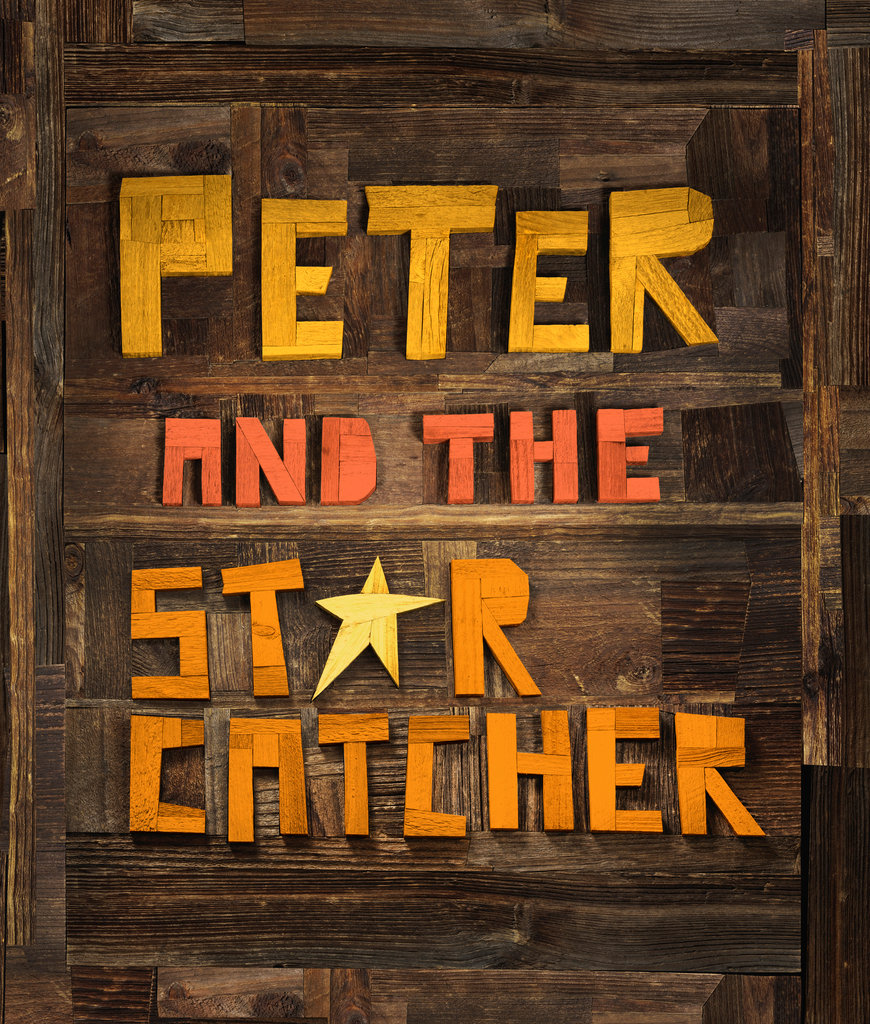
Peter and the Starcatcher is the most innovative, rollicking, sophisticated, silly, magnificent new show to come along in a very long time.  A musical derivation of Peter Pan, this show simply soars.  This is not a musical in the traditional sense.  At most there are four songs, or songletttes.  However, it is the best orchestrated show you may ever see.  Musical punctuation is used at every turn and to great effect.

Before the house lights dim, the audience is tipped off to the treat in store.  The proscenium arch of the Brooks Atkinson Theatre is subtly, yet garishly festooned for the show.  Subtle, because the festooning is styled to blend into the theatre’s decor.  Garish, well because it is.  There are two musicians positioned in the boxes (left and right.) They are surrounded by percussion instruments of every variety (on the right) and keyboard, woodwind and magic soundboard (on the left.)  Yes, there are only two musicians, but they are live and in full view!  The other technical anomaly in play is the extremely judicious use of amplification. It is initially jarring, but the audience can in fact identify who is speaking by following the sound emanating from an actor’s mouth.

The play, by Rick Elice, is smart and funny and simply pun-tastic.  The dialogue is rapid paced and plentiful.  And smart.  Directed by Roger Rees and Alex Timbers, with movement by Steven Hoggett, the wonderful cast is in essence a dance ensemble.  The choreography of the show is simply staggering.  There are no dance numbers.  (A kick line performed by a shabby group of men dressed as mermaids, doesn’t count does it?)  The movement in this show creates a magical world.  Often with little more than a piece of string, artistic lighting (Jeff Croiter) and sound (Wayne Barker,) ideas become realized.  Look it’s a ship, it’s a mirror, it’s a cabin, it’s a crocodile.

Despite it’s brilliance in design, this show would falter without a first-rate cast.  The show teeters between slapstick and sincerity (in the best of ways) and in lesser hands, we would not see the extremes or worse, we would only see one extreme.  This cast works as a seasoned ensemble.  In a show as physical as this, a less unified cast could result in some injuries.  While without this ensemble, there might not be this show; there are two actors who must be singled out.  Celia Keenan-Bolger, who tore up the stage in City Center Encores! Merrily We Roll Along, is the glue that is Molly.  Playing a 13-year-old bright feminist child with a good sense of humor (think Hermione Granger with a playful side) Ms. Keenan-Bolger has us in the palm of her diminutive hand.  She stands her own even against the over-the-top (in the best of ways) Christian Borle as Black Stache.  Mr. Borle’s performance can best be described by picturing a reality in which Ray Bolger and a young Tim Curry could create a biological child together.  There are several extraordinary performances in this cast, but the roles of Molly and Black Stache are large and demanding and are served wonderfully by Mr. Borle and Ms. Keenan-Bolger.

This production is not cheap.  It takes money to make something look plausibly shabby.  But it is not excessive or lavish.  There are no hydraulics or pulleys, yet there is plenty of flying.  It takes buckets of creativity to do more with less than it does to throw money at things.  Until I saw this show, it did not occur to me that you could simulate a bird flying away with four rubber gloves.  I never would have imagined that simple pennants, presumably made of discarded bed sheets, could become a crocodile.  There are dozens of these tiny moments that came from enormous amounts of creativity.  These miniature moments, collectively add up to a Faberge Egg of theatre.  While this is not a children’s show per se, seeing it would be a gift to any child.  In a world where so much is made of so little, to see what little can be made with so much is a gift.

 
2 Comments

Posted by on May 18, 2012 in Uncategorized


Tags: , , , , , , , , , , , , ,

Words and Music

The Yale School of Drama has just announced an $18 million gift.  A gift that substantial (to an arts program!) is newsworthy enough, but this gift is not for a building or other monument to immortality.  The gift is for the creation of new plays and musicals.  Musicals.

Knowing nothing of the details of the gift or of the business dealings that led to such largess (the gift was bequeathed by the late alumnus James Binger) I can only shout “Hurrah!”  Lots of universities, philanthropists and celebrities love to talk about supporting the arts.  (And why not? Who in the world would argue with that sentiment?  It’s right up there with; “children are our future.”)

Financing the development of new works in a university theoretically fosters a purely artistic basis that may not exist in a theatre company.  Even not-for-profit theatre companies have to sell tickets.  The theatre laboratory in a university setting is not entirely novel.  But when is the last time you heard of an Ivy League university investing in musical theatre?  I have nothing but respect for musical theatre.  I am a 100% Sit Down You’re Rockin The Boat, Nothing’s Gonna Harm You, 7 1/2 Cents, If You Could See Me Now, kinda gal.  But in some circles musical theatre is often a punch line.  It’s seen as the goofy cut-up sitting at the grown-up’s table.  Yet, creating an excellent musical is exceedingly difficult and involves collaborations that can only be categorized as alchemic.

During the past decade some truly magical new musical works have made their way to the New York stage.  Spring Awakening and Passing Strange reinvented the concept of book and score to great results.  The Light in the Piazza was a fresh, delicate and beautiful new work in the most traditional of formats.  It is these musicals we must remember when we think of all the movie-to-musical or comic book-to-musical shows dotting the great white way.  (Note: The Light in the Piazza was technically a movie-to-musical but the movie was 50 years old and the musical so self-contained and lovely that aside from the royalty issue, its origins were immaterial.)

Creating a great musical takes a great book, great lyrics, a great score and great choreography.  Collaborations must be created and fostered.  It has been at least a generation since we’ve had a notable musical team.  We still swoon over photos of the creators of West Side Story at work, for that very reason.  Universities (the places that bring us friends for life by virtue of the randomness of roommate assignments or drunken evenings) are the very place to foster these relationships.

Recently we’ve been hearing less than glowing tales of how higher education is serving students.  We know that funds to the arts have been decreasing for some time and we need only take a walk through Times Square to see where innovation in musical theatre stands.  This ($18 million) gift Yale, may in fact be a gift to theatre lovers everywhere.

*Photo: (left to right) Stephen Sondheim, Arthur Laurents, Hal Prince and Robert Griffith (seated), Leonard Bernstein and Jerome Robbins

 
4 Comments

Posted by on April 26, 2012 in Education


Tags: , , , , , , , , ,

The Lyons – Review

The Lyons is an incredible one-act play conjoined to an impaired second act.  Linda Lavin is simply magnificent as Rita Lyons, a woman (literally) waiting for her husband Ben (Dick Latessa) to die.  Some of the most riotous sidesplitting moments come from the sparring between the two.  Mr. Latessa is wonderfully cast and plays Ben with such candor and sensitivity.  Rita’s dialogue is peppered with such bon mots one can only wonder of the ruin in lesser hands.  But under Mark Brokaw’s direction, Ms. Lavin’s interpretation is simply perfect.  When a play seems to have such perfectly timed humor it’s difficult to review.  If the summary is completely accurate, readers will have a skewed expectation that the reviewer did not have.  How then do you communicate the sophistication and spot on accuracy of the very funny dialogue, without potentially disappointing an audience?  Well, once the curtain rose in the dainty Cort Theatre for the second act, that particular conundrum ebbed.

While Ben and Rita’s adult children (Curtis and Lisa) appear in the hospital room in the first act, their parents are still there to do the heavy lifting.  Curtis (Michael Esper) and Lisa (Katie Jennings Grant) are ‘adult children’ in the truest sense.  They have victimized themselves to the point of utter infantile dysfunction.  (No doubt much will be said about this play (by Nicky Silver) being about a dysfunctional family.  I did not see any signs of a family not interacting effectively.  The adult children have ruined their lives but that does not make the family itself dysfunctional.)  The actors are solid interpreters of very dull characters.  Both “children” are on the other side of 30.  Curtis is incapable of ever having a romantic relationships; ever.  He’s also never supported himself, but that’s almost beside the point.  Lisa is an alcoholic with a self-destructive streak to beat the band.  She seems to have some sort of savior impulse that does not extend to her family and does not seem to have an organic root.  Damaged characters can be interesting, (Ms. Lavin’s previous gig in Other Desert Cities proves that.) These two people are not an example of that particular genre.  Drawing them the way Mr. Silver has, does evoke a response in the audience.  But as it is frowned upon to get up on stage and perform a duo of “snap out of it” smacks, there’s no outlet for the frustration.

The second act opens with a scene in an empty (for sale) apartment.  It is a long awkward scene (following an intensely paced and hysterical first act) that takes far too long to make a minor point, which could have been made off-stage.  According to the Playbill, there is normally a scene preceding this scene; depicting Lisa at Alcoholic Anonymous.  Omitting entire scenes seems a radical move during previews, but no doubt it’s been done before.  In its place (it seems) is a walk-on by dead Ben.  Never a fan of the dead returning for an encore, I found this very jarring.  The Lyons is a starkly realistic play and there’s really no room for ghosts.

It is comforting that the final scene takes place in the hospital room of the first act.  We are reminded of the promise of that first hour.  It must be said that The Lyons has a very satisfying ending.  Surrounded by a different audience I might have actually leapt to my feet and whooped.  The fact that the second act is (currently) in such disarray, should not stand in the way of seeing this play.  Simply to see Linda Lavin and Dick Latessa spar and jar is worth the trip.  It is safe to say that no one will ever play this role like Ms. Lavin does.  She is simply remarkable.  There are beautiful moments and resonating truths throughout the play.  Quite frankly, The Lyons is like most of us; it could use a little improvement.

 
2 Comments

Posted by on April 12, 2012 in Uncategorized


Tags: , , , , , , , , , , ,

The Lady From Dubuque – Review

Edward Albee is not for the faint of heart.  You would not take in a matinee of his, expecting a light and frothy afternoon.  What you will get is a beautifully crafted peek into the human spirit. Those spirits are fighting for their lives in The Lady From Dubuque (Signature Theatre.)

Set in a suburban home, the play takes place over the course of one night and the following day.  The play (directed by David Esbjornson) opens on three couples playing a party game that involves the (oft repeated) phrase; “Who am I?”  The hosts Sam (Michael Hayden) and Jo (Laila Robins) bear a passing resemblance to another Albee couple; George and Martha.  In this case however, Sam is weakened by the kryptonite of his wife’s terminal disease.  Jo is biting, but not nearly to the degree to which she is entitled.  Their friends are mostly silly.  Edgar (Thomas Jay Ryan) and Lucinda (Catherine Curtin) are that special blend of vapid and shrill that makes some people phobic of the suburbs.  Fred (C.J. Wilson) and his girlfriend (Tricia Paoloccio) are at least interesting by virtue of his vulgarity and her preening.  There’s a reason these people all drink.

A bit past the midway of the first act, Jo rapidly deteriorates in (literal) gut wrenching pain.  It is difficult to watch the exquisite portrayal.  When Edgar demands that Jo, writhing in agony on the floor, get up and go apologize to his wife, Lucinda for an insult, it is almost too much to witness.  But then he points out what is so true it can not be discounted; his wife did not cause Jo’s pain, but Jo had caused Lucinda’s.  As Jo struggles to her feet, she is living rather than dying.  It is her last act of physicality.  The first act ends with a cresendo of agonizing wails and the appearance of an otherworldly figure; Elizabeth (Jane Alexander) and a dashing escort; Oscar (Peter Francis James.)

The tone of the second act is decidedly more physical, combative and high stakes.  Sam is frightened by the arrival of Elizabeth, who claims to be Jo’s mother.  His hysteria heightens and results in him being restrained (and ‘put to sleep’ with a strategic touch by Oscar.)  While he cannot articulate it, Sam knows who these people really are and why they are there.  The reality of death is simply far too painful for him to realize.

The rhythm and banter of Albee’s dialogue is a perfect conduit for this allegory.  His characters are so raw and real they create a platform for the surrealism that could feel forced or twee.  This play was not well received in 1980.  Death rarely is.  The only sticking point, for this audience member, was the treatment of race.  Much is made of Oscar’s “blackness” and the transition from superfluous racial humor to minstrel is rapid and unpleasant.  No doubt there is a dramatic intent, it just alluded me.

This is a flawless and beautiful production and should be seen by many.

 
Leave a comment

Posted by on April 1, 2012 in Uncategorized


Tags: , , , , , , , , , , , , , ,