RSS

Tag Archives: Review

A View from the Bridge – Review

Last night I attended a preview of A View from the Bridge at the Court Theatre. This is a limited run (14 week) production directed by Gregory Mosher (Glengarry Glen Ross, Speed the Plow.)  This was my first time with this particular Arthur Miller play.  There is as much back story as there is theatrical story, and I found it all almost too much to absorb.  “Bridge” is often seen as the final “take that” in the demise of the friendship between Elia Kazan and Mr. Miller.  For years after the McCarthy trials, the two spoke only through their art forms.  It is said that Miller expressed his sorrow and rage at Kazan with The Crucible, and Kazan replied with On the Waterfront, that then followed by “Bridge.”  It is very hard to ignore all that when watching this play that centers around codes of honor, betrayal and human frailty.
The play is crafted beautifully and narrated by the attorney, Alfieri (Michael Cristofer.)  Mr. Mosher has directed Cristofer beautifully.  It is no small feat to narrate a drama while playing a character within the play.  His transitions are fluid and his stage presence pulses with an understated power.  The story, as told by Alfieri, is that of a family of first generation Italian-Americans in Red Hook, Brooklyn.  Eddie (Liev Schreiber) and his wife Beatrice (Jessica Hecht) have raised their niece Catherine (Scarlett Johansson.)  Catherine is supposed to be a sheltered seventeen year old with her first exposure to men her own age (illegally) arriving in the form of Beatrice’s cousins (wouldn’t that make them Catherine’s cousins too?) Rodolpho and Marco.  Tragedy unfolds as Eddie finds the budding romantic relationship between Catherine and Rodolpho intolerable.  There is an unwholesomeness to Eddie’s interest in Catherine that colors his entire perspective.  The tragedy that results from a man who loses his conscience while caught up in his misdirected impulses is life altering.
On paper, this is a powerful drama, and I have no doubt that the critics and audiences will find much to wax poetic.  I would tend to agree, with some minor cast changes.  By now you have probably heard of the hasty departure of the original Rodolpho.  Apparently the head injury he received from Liev Schreiber in a fight scene prevents him from returning to work.  This is a shame, as the role is pivotal and the understudy (Morgan Spector) lacks the necessary charisma.  He is physically uncomfortable on the stage and in this role, and he (forgive me) lacks the pretty face that is necessary for this part.  Another little bit of unsurprising miscasting is that of Miss Johansson.  She manages to navigate the stage in a convincing manner, but her age is much too distracting.  It is impossible to believe that a 26 year old is a sheltered 17 year old.  She is not assisted in the least by the costuming (Jane Greenwood) that makes her look even older.  This working class girl of very meager means is put in form fitting color coordinated outfits and bright red lipstick.  She is made to look like a 1950s pin-up, and the result is that she and Liev look perfectly natural together as a couple.  Had Miss Johansson been 10 years younger, and perhaps not spent as much time with a dialogue coach (her attempt at a Brooklyn accent is distracting and inaccurate) I think she could have pulled off the part quite well.  Jessica Hecht is brilliant and luminescent and I want to see her in every American classic play.  She becomes the character Beatrice so completely that even her trademark screen mannerisms disappear. My heart broke for her.  Liev Schreiber is a fine actor, there is no doubt.  I predict that Ben Brantley (sitting the row behind me) will adore the performance, as will The New Yorker.  Me?  I found it overwrought and distracting.  I felt as if I was watching him act for two hours.  I never “felt” anything, and that is a shame.  I wanted to be pulled into his story and empathize with his conflict, for I believe that is what Mr. Miller intended.  However, all I really felt was that Mr. Schreiber was performing a one man show and that the emotional calisthenics he demonstrated did not hint at a fun dinner companion off the stage.
The bones of a lovely production are in place however.  The staging was wonderful, with self contained, restrained moving sets and brilliant fight scenes.  Fight scenes, as we all can attest to, are a horror.  They are not easy to choreograph (Thomas Schall) and certainly not always easy to watch.  These were pitch perfect and utterly convincing (except for one small moment when Mr. Schreiber is careful not to bang Mr. Spector’s head on the table.)  The costume design (save Mr. Schrieber’s “dockwocker dressed by Armani” look, and Ms. Johansson’s pin-up look) are brilliantly on point.  There is one off kilter set construct in the venetian blinds in the Red Hook tenement apartment.  I did very much appreciate the absence of microphones and the smallness of the production, both designed to pull me in.
The audience make-up was interesting enough to warrant mention.  This being previews, there were rows of critics in my section, as well as actors and other such insiders.  What was perhaps more unique, was the large subset of audience members who had seen the original production (1956.)  This made for a very savvy audience (I’d be savvy too, if I’d been going to the theatre for over fifty years!)  The subtlety of the ovation will not be heard again once the show opens.  These insiders gave very enthusiastic applause to the excellent Marco (Matthew Montelongo,)  Ms.Hecht, Mr. Cristofer and Mr. Schreiber, and gave what is known as “polite applause” to Ms. Johansson. 

 
Leave a comment

Posted by on August 20, 2011 in Uncategorized


Tags: , , , , , , , , , , ,

Brokeology – Review

There are two elements that prevent Brokeology (at Lincoln Center) from being great theatre; the direction and the play.  The play, by Nathan Louis Jackson is the story of a small family (African American) in Kansas City.  It is a very straightforward tale of a father (Wendell Pierce) in failing health, and his grown sons (Alano Miller and Francois Battiste) fumbling to plan his long term care.  This probably could be an interesting conceit had the characters been written with more depth and the family dynamics better exposed.  There are very large holes in the story which make it difficult to care for the family and its journey.  Why does the younger son have a Masters Degree from UConn and the older son is a fry cook and unwed father still living in his hometown?  Why is the father whose religion is his marriage to his deceased wife, so blase about his eldest not marrying the mother of his grandchild?
Some of these holes could have been offset with better direction.  Thomas Kail (In The Heights) is probably more suited for a musical stage.  There are no attempts to connect the actors to each other on the stage.  The pacing is so deadened as to weaken any momentum and hence dramatic tension that might be eeked out from the script.  Mr. Pierce (a very enjoyable actor) is not directed in any way that alludes to the progression of his disease.  Were it not for some special effects, we might never be aware of his deterioration.  This is a problem for a plot device that hinges on the sons making a decision about their father by summer’s end.  Mr. Miller is a fine actor with a lovely stage presence, who as the younger high achieving son is given little assistance from the script or director.  He is placid and never conveys any inner conflict about his “should I stay, or should I go” decision.  There is a hint in the script that he is to be the softer more communicative son of the two, but the direction did nothing to illuminate that fact.  Crystal Dickinson is delightful as the often dead mother of the family.  She need only show up from time to time to remind us of the guiding light that she was for this family.  The real stand-out of this ensemble, and the reason to see this play is Francois Battiste.  He is a mutlilayered heartbreaking dynamo, that claws his way out of the stagnation of this production.  It will remain a mystery as to why he, and only he, comes across as a fully formed character.  I know exactly what makes him tick, even with a rather contrived plot line.  There were moments throughout the production that made me wonder if the director really understood the play.  The first Act opens with the (alive) wife surprising her husband with homemade T-shirts.  Even though they were pre-set on the curtainless stage, I had difficulty making out what they were supposed to spell out and what their point was.  It is only later in the script where we learn that the wife had great artistic aspirations and had dropped out of college.  There is nothing in her character that would have us believe that she was delusional about her talents.  Why not have the costumer or set designer make those t-shirts fabulous?  The woman wanted to paint murals rife with political statements, and the shirts were at best monotonous.  Counter to this was the perfect set and lighting of this play.  The working class Kansas City home had its outer edges exposed in the thrust theatre.  Fragments of insulation and patchy lawn were slightly visible.  It was a lovely subtle touch.  The costuming was not as subtle as the elder son was dressed as “gangster lite” and the younger as “prep school holiday.”
This production continues to baffle me in many ways.  I don’t entirely understand how it made it to Lincoln Center nor do I understand the full (but odd) house on Saturday night.  I have never been to a production that had 50% Caucasians over age 75 and 50% African Americans (of various ages) as its audience.  I believe that composite actually explains a great deal about this production’s journey.  This play was clearly marketed to this particular audience.  I don’t know where or how (as I am not a member of either group.)  Clearly the firm mandated with this task should be lauded.  The audience showed (some 20-30 minutes late) and stayed.  They did not respond or seem terribly interested, but of course they gave the performers a standing ovation.  It was during this ovation that the tears flowed down my face.  Wendell Pierce stood on the apron of that stage, free of script and direction, his body and face were never more expressive and he broke my heart.  As the lump rose higher and higher in my throat, I ached for what could have been, with such a talented cast.

 
Leave a comment

Posted by on August 20, 2011 in Uncategorized


Tags: , , , , , , , , ,

Superior Donuts – Review

It is simply delicious to see a new play and fabulous actors.  It is particularly fulfilling if the production in question is an ensemble piece.  That is indeed the case with Superior Donuts at the Music Box Theatre.  This new Tracy Letts (Pulitzer: August Osage County) comes directly from Steppenwolf and feels it.  The tight ensemble has packed up their focused and small production and plopped it onto Broadway.  The stage is even scaled down, with the help of blackout curtains to recreate the smallness.  The set is a donut shop in Chicago, seemingly untouched since Arthur’s (Michael McKean) parents purchased it fifty years ago.  The play opens with a suspicious break-in and the introduction of several of the 9 characters.  Shortly after the police leave (fabulously played by James Vincent Meredith and Kate Buddecke) we are introduced to Franco (Jon Michael Hill) who comes to work and change Arthur’s life.  Arthur is a frozen man, as the sound designer reminds us with accents of howling Chicago winds, and Franco thaws him.  We learn of Arthur’s story through spotlight monologues.  There are no surprises in this play, despite the audible gasps from the audience.  But Letts’ skill may very well be in the predictability of his story telling and how very satisfying it is to see the characters develop exactly as one would expect.  There are some very funny moments in this play that features ethnicity as its focal point.  Mr. Letts has great fun with his Russian stereotypes, his digs at the Polish and Irish, and goes to lengths to highlight the rich history of African American poets.  This conceit feels a little awkward, but perhaps it works well in Chicago.  (Personal aside, I’m never quite sure which ethnic groups are amusing to make fun of and which are not.) There is a wonderful actress, Jane Aldermann who plays the alcoholic as Yoda character, Lady.  While I found this character no more convincing than I ever do, Aldermann did, and it showed.  Much of the set design and direction did much to set the tone and move the story forwarded.  While it is always very difficult to stage a convincing fight scene, I must say that the actors were not helped by the harsh lighting.  I’m not sure that it can be helped in a donut shop with fluorescent lights.  Loving the performances as much as I did, I tried not to look too closely at the fake punches and foot stomping as sound effect.

Mr. Letts sat in front of me, as did several Broadway veterans.  Mr. Letts was no doubt pleased with the abundance of laughter and audible response throughout the two acts.  While the actors received a standing ovation (who doesn’t these days?) the curtain call was extremely brief, leaving the audience at somewhat of a loss.  If you love very fine acting, and do not abhor sentimentality, I recommend this play.  If you enjoyed August, not because of its scale but because of its content, you will enjoy Superior Donuts.

 
Leave a comment

Posted by on August 20, 2011 in Uncategorized


Tags: , , , , , , , , ,

A Boy and His Soul – Review

I have never laughed and cried so hard or so much as I did yesterday during A Boy and His Soul at the Vineyard Theatre. This one-man show, written by and starring Colman Domingo has a limited run (September-October) but if yesterday’s audience was any barometer, it will be extended and/or moved. Directed by Tony Kelly and Choreographed by Ken Roberson, A Boy and His Soul is an exquisite composite of music, dance, memoir and more music. Set in a pitch perfect suburban basement/rec room (Scenic Design by Rachel Hauck) Mr. Domingo tells the tale of his childhood and adolescence through a raucous and moving mosaic of soul music. He sings (not enough for this viewer,) dances and is hysterically funny and heartbreaking through 90 minutes of non-stop fabulousness. Mr. Domingo was most recently seen in The Wiz (at City Center) but might be more known for his roles in Passing Strange. He is an extraordinary bundle of talent and has a face that would make Norma Desmond proud. While I usually tread lightly into the terrain of memoir, or as I like to put it; “If it’s about me, it must be fascinating!” there is nothing here that even hints of a vanity project. The script is so shockingly good, I actually found myself wondering if I could purchase it. There were far too many perfect gems in the dialogue to recall, and I wanted to remember it all. If there is a weakness in the script, it is only the way in which the dramatic arc peaks too close to the end and is not in fact the end. A minor point in such an incredible experience. While Mr. Domingo deserves heaps of praise for his script and his performance, clearly this was an ensemble piece. The direction, sound, lights, set, and choreography were all so perfect. I guarantee that this will please you. When the lights came up, I was jubilant and utterly exhausted after loosing so many tears. I have never been so happy to walk outside looking like Tammy Fay.

 
Leave a comment

Posted by on August 20, 2011 in Uncategorized


Tags: , , , , , , , ,

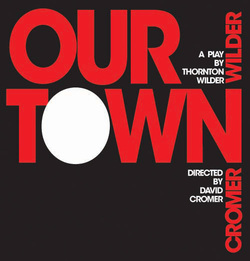
Our Town – Review

A show of hands of those of us who aren’t really the least bit intrigued by yet another production of Our Town.  Look closely and you will see my hand frantically waving in the back.  This Thorton Wilder gem has been staged by well meaning community theatres, eager High School English teachers, a few edgy prison program directors and even a 1980s sitcom.  We all know it backward and forward, and have ceased to see the delicacy of Wilder’s work.  Have I got the remedy for you.

The Barrow Street Theatre has brought the Hypocrites (Chicago) production, with full cast, to New York.  David Cromer (upcoming Brighton Beach Memoirs and Broadway Bound) directs this fresh and modern interpret ation of the 1938 Our Town.  Cromer, not only brings a clean and engrossing production to the stage, he also manages it.  He is most brilliant in the role of the stage manager.

While the cast is engaging and quite talented, it is the staging that is the star of this production.  Set on a thrust stage (which is actually just the floor of the center of the room) the audience is surrounding (and sometimes IN) the action on three sides.  Cromer keeps the houselights up the entire time, dimming them slightly in the third act.  This device is not nearly as distracting as one would think.  Even with Judd Hirsch sitting directly across from me, my attention was focused on the Our Town actors.  This was partly due to the fabulous use of space.  The choir congregates and sings on a wide fly above the stage.  This gives the audience a new place to focus from time to time.  Actors use the thrust floor space as if it is an actual town square.  Actors weave in and out of the audience in the most naturalistic of manner.  There is nothing self conscious or contrived about the device.

The stage manager’s affect and use of cell phone, combined with the modern day dress of the cast, gives the whole production a sense of the present.  While undoubtedly set in the thirties (evident by milk delivered by horse) there was only a sense of modern day small town throughout the production.
Three acts can seem daunting to the average theatre goer, but the evening simply flew by.  This is a production not to be missed.  It will make you think differently about this American classic and will leave you with a sense of wonder about the experience of true creativity.  Mr. Cromer is someone to watch.

 
Leave a comment

Posted by on August 20, 2011 in Uncategorized


Tags: , , , , , , , ,