 Watching the Public Theatre’s production of Othello reminded me of seeing a large art installation in a Chelsea gallery. As I’ve walked round and round various modern configurations that scream an inaudible MESSAGE, I often find myself admiring the artist’s complete and utter self absorption. “Audience be damned” screams the installation, or in this case Peter Sellars, in his direction of Othello. This Othello at the uncomfortable and antiseptic NYU Skirball Center is more of a derivative of Shakespeare’s play, than the play itself. It is recognizable as Othello, but unlike a riveting deconstructionist production, it adds nothing, only takes away from the original. The enormous auditorium stage is stripped completely, exposing the garage door used for load-in, fuse boxes and flies. The entire set consists of chairs (sometimes used for “off-stage” actors, and sometimes not,) two standing microphones and 45 video monitors that seem to serve no purpose whatsoever. Although in case you missed Mr. Sellars’ point, they too are deconstructed. The conceit of the bare stage can work, but it doesn’t here. The space is large and the performances are not. Let us start with the very first word uttered on stage. My spine stiffened and I quickly scanned the audience for signs of communal disbelief. Shakespeare miked? Philip Seymour Hoffman miked? No, no this can’t be. It must be a device, wait and its intent will unfold. There was no intent. It is a large space and for reasons that will remain a puzzlement to us all, Mr. Sellars miked his actors. There is simply no possible way to enjoy the language and live delivery of Shakespeare via a microphone. After that first line, I decided that this was not to be seen as theatre, but as an art installation. As such, this production is not uninteresting, if for no other reason than for seeing the pageantry of unharnessed narcissism. The casting was of particular interest. I am exaggerating, but it seemed that Othello was the only non-African American actor on that stage. I’m all for adventures in color blind casting, but this just does not work. What’s next? An all white Color Purple? Surrounding Othello with people of color, and casting him with a Latino actor, is a great conceit for good dinner party conversation, and should not go beyond that. John Ortiz is Othello, and handles it as well as Mr. Sellars allows. (Sellars’ heavy hand print is on every performance.) Philip Seymour Hoffman as Iago is bipolar and has body issues. Mr. Hoffman spends half of his stage time being placid and the other half; enraged. He is continuously pulling on his sweater, that does fit rather snuggly over his belly (stress eating during nightmarish rehearsals, no doubt.) Mr. Hoffman is a phenomenal talent, we all know that, but none of it was evident here. During his low moments he was clearly recognizable as himself versus Iago. and enraged, he just seemed silly. Where exactly was the rage coming from? The only standout, who seemed to transcend Mr. Sellars’ “no do it like this” direction was Desdemona, (Jessica Chastain.) While she was put through the same absurd paces as her fellow actors, her clear true voice rang out.
The paces that the actors endured included confrontations by cell phone and blackberry, meshing of multiple characters into one, gender switches, a rape scene substituting for a duel, and zero affection between any of the characters. Othello and Desdemonda spent a great deal of time on the video consoles simulating what can only be called “sleep hugging,” giving no indication of any passion but merely conveying exhaustion (perhaps another remnant of the stressful rehearsal period?) There was absolutely nothing between Iago and Othello, which left so many actions baffling and void of any drama. There was no raucous tavern scene, merely a couple of guys drinking beer and no action to speak of, short of the rape (which was horrifying on several levels.)
Adding to the art installation phenomenon was the lighting of this production. Welcome to Othello: The Light Show. The lighting cues were so prominent and misguided that I became convinced they were done by a recent “lighting major” graduate. “Look what I learned!” But alas, I was so wrong. The lighting is by James F Ingalls, a veteran designer. Bizarre video monitors showing basically nothing aside, the constant; full lights, square spots, full lights, filtered lights, staccato was just unnerving. What in the world was the point? I suspect that the point was personal. Audience be damned! If the audience be damned,.than it really isn’t theatre. This production at best would make for an interesting lesson for acting students (taught by a self absorbed autocrat) but at its worst it is a personal indulgence and should be treated as such. As a rule many private behaviors should be done behind closed doors.
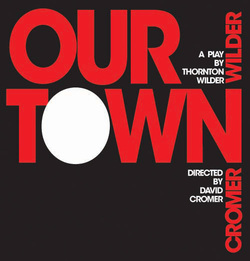 A show of hands of those of us who aren’t really the least bit intrigued by yet another production of Our Town. Look closely and you will see my hand frantically waving in the back. This Thorton Wilder gem has been staged by well meaning community theatres, eager High School English teachers, a few edgy prison program directors and even a 1980s sitcom. We all know it backward and forward, and have ceased to see the delicacy of Wilder’s work. Have I got the remedy for you.




 Here She Is Boys