RSS

Tag Archives: Brenda Tobias

Empty Nesting

nest

Empty nests aren’t what they used to be. In fact you might be hard pressed to find a nest with vacancies. This isn’t exactly news; we’ve been hearing about dismal job markets and diminished economic opportunities for young adults for quite some time now. It’s commonplace to hear of households that include adult children (and even their children.) What is rarely mentioned in these discussions is that it is often quite an agreeable arrangement. Modern parents and children (of all ages except perhaps peak adolescence) enjoy spending time together.

The generations share interests, activities and even clothing. They are often in constant communication and know a great deal about each other’s lives. In generations past this was rarely the case in traditional American families. A child had his/her circle of friends and interests and upon reaching adolescence rebelled against all that his/her parents represented. The politics, music and literature of the younger generation were unrecognizable to that of the older. The clothing, hairstyles and lingo were equally foreign and perhaps infuriating. Who would want to spend time with someone they couldn’t understand? An adolescent’s primary goal was to get out of the house and away from the hopelessly old-fashioned parents. College served that purpose well, as did first apartments (filled with like-aged and minded roommates.)

Something has happened in recent decades to blur the lines between the generations. The most intriguing aspect to the change is that it’s both the younger and older moving towards each other. If we were to jump in a jeep with our binoculars and pursue the average American nuclear family in their natural habitat, we would spot this morphing phenomenon. Parents and children (of all ages) look an awful lot alike. They dress alike, they groom alike, they text alike. The fact that this happens in public proves that everyone is okay with it. Daughters don’t mind (or perhaps even enjoy) their mothers appropriating their dark/cadaver like nail colors, sons enjoy/tolerate sharing their baseball caps with their fathers. From the back (if weight wasn’t a factor) you’d be hard pressed to determine which generation was which. It’s been a long time since we’ve witnessed a unified family look, in nature that is; it happens in Christmas cards all the time. Surely there’s a more recent example of this indistinguishable appearance; but it is Little House On The Prairie that comes to my mind.

If we were to hop out of the jeep and (lawfully) enter homes, we might discover that there is no “adult” space (formally known as the living room) and “child” space but instead “family” space. Unless a parent engages in a delicate or dangerous activity, there is probably no “off-limits” space within the home (for fun, check to see if there’s a lock on the parents’ bedroom.) The music, movies, social media, gadgets, and fitness regimes are most likely shared. This average family probably socializes together and often vacations together. They will attend all school and family events as a unit as well. To the novice jeep rider this may appear novel. But it is actually a very old phenomenon (see Little House reference.) Back when we were forging new territory and had little if any connections to the world, our nuclear family was our world. One’s fortunes and survival depended on the strength of the nuclear family.

It is slightly ironic that in an age of such instant and ubiquitous connectivity we revert back to an isolationist mode of living. But if we take a closer look (back in the jeep everyone) we will see that we are anything but connected to the larger world. When is the last time you had friends over for dinner? How often are you invited over for drinks? When was your last block party, potluck or open house? How many times a week, or even month, do you go out with friends (without children in tow?) How long have you been at your current job? Do you lunch or happy hour with your co-workers? How often do you attend religious or community events? Can you recall the last time you dropped by a friend’s home unannounced?

Some of our disconnection to the larger world is our own doing and choice, but some of it is not. A job isn’t life sentences any longer, nor is marriage. We move (by choice or not) and we start over. We lose contact and perhaps the confidence to make new contacts. We are so electronically plugged in that isolation can feel like a reprieve. Our work life is so heavily in favor of extroversion that off-hours cocooning is a sanity saver. The reasons we choose to enmesh with our nuclear family could be many. The affects are probably always the same; nests are less empty. What is indisputable is that if we stay in the jeep long enough (and refuel a few hundred times) we will see this phenomenon shift once again. In 25 years or so we will start hearing the ancient strains of; “What are you wearing?!” “Turn that noise down!” “That’s not a word!!!”

 
2 Comments

Posted by on August 23, 2013 in Childhood, Cultural Critique


Tags: , , , , , , , , , , , , ,

The Unavoidable Disappearance of Tom Durnin – Review

Unknown

What is rehabilitation and is there such a thing as redemption? Can time served ever neutralize crimes committed? Can a life, interrupted by crime and punishment ever resume a recognizable form? Or is a prison term simply the beginning of the punishment? Steven Levenson’s The Unavoidable Disappearance of Tom Durnin poses these questions with honest, powerful and very real results.

Tom Durnin (David Morse) appears at his son James’ (Christopher Denham) door after five years in prison. Tom is charming and smooth as he convinces his estranged son to temporarily house him. Father and son have much in common as they struggle (quite independent from one another) to get their lives back utilizing similar means. However, it is the wide chasm between them that dominates their relationship. They both grasp, with fits and starts at women to shape their lives. James meets the lovely, skittish Katie (Sarah Goldberg) at a creative writing class. Their attempt at courtship rings painfully true with equal parts endearment and frustration. Meanwhile Tom keeps his eye on the prize of seeing his ex-wife Karen (Lisa Emery). He cajoles, connives and threatens his son and his son-in-law Chris (Rich Sommer) for his ex’s whereabouts. He is unrelenting and there’s no doubt he will get his way. Chris endures much of the bewitching and terrifying negotiations of Tom. Chris is an easy and vulnerable target as he’s agreed to meet with Tom against his wife’s wishes. Tom’s got him, and courts and threatens him in pursuit of a job and his ex-wife.

Tom is charming and scary, and there is no better actor than Mr. Morse than to deftly and winningly play such a character. Tom’s explosions are not simply the result of rage, but are driven by a profound sadness and loss. In Mr. Morse’s hands these episodes send chills down the spine and tears to the eyes. He wants his life back. He’s done his time, he’s apologized and taken responsibility, but there’s no going back. His ex-wife has remarried, after enduring public humiliation and financial ruin. His daughter and her children are lost to him. And it’s not clear if he will ever be reinstated to the bar and move on from his barrista job. In less deft hands, the play might verge on cloying or even twee. But there is no slipping into sentimentality and these characters are fully formed (and beautifully performed.) No one is a villain or a hero; there are no right or easy answers only varying shades of grey. Directed by Scott Ellis, the production is delicately balanced. The fluid staging and the honest performances are the perfect match to the script. The ending is the finest example of Mr. Levenson’s restraint. Everything is poised for a satisfying and definitive conclusion, but instead it all stays very real making it all that much more moving.

The Unavoidable Disappearance of Tom Durning is playing at the Roundabout Theatre

 
Leave a comment

Posted by on August 22, 2013 in Uncategorized


Tags: , , , , , , , , , , , , ,

The Old Friends – Review

Unknown

What constitutes binding ties? Are they marital, familial or just familiarity? Horton Foote looks to untangle this question in the posthumous premiere; The Old Friends. Set in 1965 outside of Houston, Texas six adults are locked in a combustible and static pattern of interaction. The (often alcohol fueled) attacks and schemes are delivered daily. They may be dressed slightly differently from day to day, but they are the same greed, jealousy and loneliness inspired displays. These displays make for some phenomenal scenes and performances but are difficult to absorb.

Julia (Veanne Cox) is married to fabulously wealthy Albert (Adam LeFevre). Her mother Mamie (Lois Smith) lives with them. The play opens with the family awaiting the arrival of Julia’s ne’er do well brother and his wife Sybil (Hallie Foote.) Sybil arrives alone, freshly widowed and destitute. Mamie is distraught but not for reasons one might assume. Her son is dead and so is her plan of living with him (evidently life with her daughter is a virtual living hell, or so we’re told.) Small, stunned, nondescript Sybil is left alone in the living room when tornado Gertrude (Betty Buckley) arrives. In perhaps the greatest character study of pure narcissism ever to hit a stage, Gertrude goes on the most delicious rant about how she’s been treated at the cocktail party. Julia has been hitting on her man Howard (Cotter Smith) who incidentally is the brother of Gertrude’s late husband. There sits newly widowed Sybil looking and being treated like part of the furnishings. She’s better off to be frank, as there is an odd vortex at work here. Unlike Mamie’s reported mistreatment we actually see all the other wretchedness. These people are caught in an interpersonal dance that one might expect on a remote island not amongst people with the means to escape. Julia and Gertrude fight over the same men over and over again. They are not related and have gobs of money. Why are they locked in this mode, dragging everyone in and down with them? It’s not clear.

What is clear is that these parts are written with actors in mind and director Michael Wilson makes the most of that. Betty Buckley’s Gertrude will be the standard for every subsequent performer. It is no easy feat to portray drunkenness and keep a character interesting. Ms. Buckley is riveting and uses her voice (not surprisingly) in the most powerful way. The soft raspy sadness that bubbles up after one too many, the controlled and uncontrolled rage and the lyrical flirtations make for a vocal symphony. Howard (or probably any other human) is no match to her passions and fervor. He is merely there to keep away the loneliness (as we learn in a confession reminiscent of a 3:00 AM Judy Garland phone call) and she will fight to the finish to keep her fear of loneliness at bay. Howard however has been pining for Sybil for years. He seems a bright and interesting guy and it’s hard to see why he’d be holding a torch for such a meek and mousy woman. Perhaps it’s simply the result of thirty years in the presence of Gertrude and Julia. Julia (who seems to go after Howard in some sort of non-sibling rivalry with Gertrude) is loud and boozy as well. She just wants to have a good time and feels everyone is standing in her way. Her wig, physique and mannerisms often hint to Carol Burnett’s poignant portrayal of Eunice. Again, why don’t these people leave? This question hangs in the air as a trip to New York City is cancelled by Gertrude. Why didn’t they just go without her? How does a woman who’s not even related hold the reins so firmly?

We never really discover what the ties are. The ending of the play is so abrupt as to suggest that there are no answers to be had.

The Old Friends is playing (August 20 – September 29) at the Signature Theatre

 
Leave a comment

Posted by on August 21, 2013 in Uncategorized


Tags: , , , , , , , , , , , , , , , , ,

March On

bus

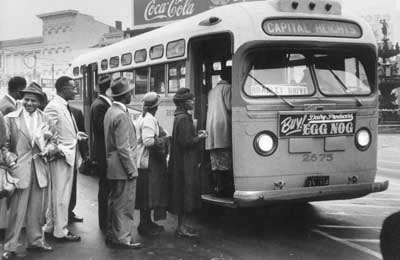
We are on the cusp of the 50th anniversary of the March On Washington. It is the most famous mass gathering to occur in our country. At least 200,000 people showed up to the National Mall on that late August day for a march in pursuit of equality and jobs. The march, twenty years in the making, came to life in 1963 (100 years after the signing of the Emancipation Proclamation.) People from all over the country heard about the march and found their way there. This was before cheap flights, social media and ubiquitous car ownership. It was also during a time in which travel could be challenging for people of color. They arrived, some traveling through the night or for days, anxious of what lay ahead. No one knew what exactly was in store and no doubt some concern for personal safety existed. Families, communities, church groups; people of all ages and colors took that leap of faith and participated in a peaceful day of inspiration and aspiration.

There were specific goals for the march including; job training, increase in the minimum wage, school desegregation, passage of a civil rights bill, and federal prohibition of discrimination. Many of the goals were realized, but what the march is remembered for is much more ethereal. People who were there, ordinarily perhaps quite eloquent, will grasp for words when trying to convey the feelings they had that day. Many of us listened to the iconic Dr. Martin Luther King Jr. I Have A Dream speech in school. The goose bumps and throat lumps hints to what being there must have been. To be standing amongst hundreds of thousands of people with a unified purpose is to be in a heightened state of humanness. To overcome the personal and join together for a higher purpose is one of the greatest gifts of life.

Those of us who weren’t there (or weren’t born yet) may never experience anything of that magnitude. But we too can pursue the power of the collective. We can seek to right wrongs by joining strangers to make some noise. The world and humans being what they are means that there will always be something worth fighting for. Those people climbing onto buses in the wee hours of the morning had no idea that they were making history. They simply wanted to join hands and march for the most basic of civil rights.

MS 2003-36  March on Washington Program - front

 
Leave a comment

Posted by on August 18, 2013 in Cultural Critique


Tags: , , , , , , , ,

The Core Of The Matter

apple

If you’ve been out of your home or watched commercial television you know that it’s Back To School time! As we eek out the last promises of summer, the (retail) world is telling us the party’s over. Soon children across the country will be sent off to “have a great year!” Parents and guardians will demonstrate varying degrees of engagement with classrooms and curriculum. But this year there may be a more unified sentiment as The Common Core curriculum is rolled out. The new national (K-12) standards have already been adopted by New York City; and the recent test scores confirm the early complaints of teachers and parents; the stuff is hard.

The tests evaluate what most K-12 tests evaluate; mathematic and language skills. Governor and school superintendent appointed experts developed these standards. The broad (and obvious) mission is to create a national standard for education. The outcome goal is to prepare children for college. That sounds too logical for discussion, right? Well of course K-12 should prepare an individual for college! Not so fast. First off, for approximately 50% of (admitted) college freshman that is not the case. Almost half of all incoming freshman need remedial work when arriving on campus. Secondly, it is not possible that 100% of K-12 students want or need to attend college.

The early grumblings of parents (most of whom have not yet experienced this new curriculum) suggest the roll out is going to be bumpy. Change is always rocky particularly when it’s been too long in coming. No one anywhere will argue that a high school degree is not what it was 50-70 years ago. Most high school diplomas do represent some level of achievement. But unlike the degree of yesteryear they do not necessarily indicate workplace or college readiness. The amount of remediation that occurs on college campuses (at a very high cost) should be alarming enough for parents and educators to demand tougher K-12 standards. However we do need to demonstrate a bit of caution; keeping in mind that colleges and universities are admitting unqualified students. This fact might indicate a bit more to the story.

Higher education is big business. In 1940 only 5% of American men were college graduates. In 2010 the percentage of Americans with baccalaureate degrees was closer to 40%. Colleges and universities are doing eight times the business they did seventy years ago. New buildings have been built, new colleges have been created, programs and institutes have received large amounts of public and private funding, and people have been hired. If they build it and they don’t come, they don’t survive. Tuition never covers the cost of running a college, but there’s no business to be done without product; and students are the product. So yes, the high school graduate with weak writing, or high school level math skills is admitted. And on the tuition payer’s dime, they take the equivalent of high school level classes. For each remedial class they take they prolong their stay and diminish their electives options. Accepting unprepared students means the institution has the income stream for at least four years (often more.) (For a student who is college ready, and arrives with advanced placement credits, graduating in three years is often a viable option.) Large entry-level courses are far more profitable to offer than smaller seminar style classes. This isn’t to suggest that college presidents and boards are collectively twisting their mustaches in some sort of plot. It is to suggest however, that higher education doesn’t suffer from less prepared students.

Students are harmed however when they graduate from high school without basic skills; such as reading comprehension, writing, algebra and geometry. Few parents want their children spending their school day doing test prep. It is a boring and stressful way to spend a school day and comes dangerously close to ignoring all learning beyond basic skills. But parents do want their children to learn and do well. Raising the standards of K-12 curriculum is a step in that direction. Ideally we want our children to graduate from high school fully prepared for the next step in their lives. They should be ready to enter the workforce, vocational training or college. It is not too much to ask and it is simply what we owe to them.

 
Leave a comment

Posted by on August 16, 2013 in Education


Tags: , , , , , , , , , ,