RSS

Tag Archives: Brenda Tobias

The Hunger Bane

No doubt you’ve heard of Americans flocking to Canada (virtually or really) for inexpensive pharmaceuticals?  There’s nothing necessarily back-alley about it, it’s just that the name-brand legitimate pharmaceuticals are less expensive in other countries.  But it seems that Canada may also be a destination for surgical procedures that are not exactly F.D.A. approved.  People with life threatening diseases (with resources) have often flocked to other countries in pursuit of treatment not available/legal in this country.  However, the recent surge in maple leaf medical tourism is for weight-loss surgery.

Since 2006 Canadians can have a balloon inserted into their stomachs.  (Think of it as angioplasty for your tummy.)  The balloon makes you feel full.  I’m guessing nobody in the lab screamed “Eureka!” when they developed this device.  To my (very) non-medical self, there is nothing necessarily all that different between this and any other inflatable device one would have inserted somewhere.  Unless there’s some sort of high stakes patent wrangling in play, no doubt this procedure will be available in the lower fifty states soon enough.

But should it?  All weight-loss surgeries involve reducing the amount of food the patient can comfortably ingest.  In essence they are the modern-day equivalent of wiring one’s jaw shut.  The theory behind these “solutions” is that people need to be physically blocked from responding to their desires.  Rarely is putting a lock on the refrigerator door a sustainable weight-loss plan.

What would be most helpful to people, either in concert with surgery or not, is learning to cope with the sensation of hunger.  Hunger is not necessarily a cue to eat.  Needing nutrition is a cue to eat.  Someone who is constantly thirsty shouldn’t just be watered, they should be checked for diabetes.  A person who feels constant hunger needs help determining why and learning to manage the sensation.  Beyond the standard analysis of; are you bored, thirsty, sad, lonely? is addressing the feeling of emptiness that might be present.  The world is not a friendly place for the obese.  Clothes, furniture, seats, etc. are all geared towards average sized people.  Prejudice, mockery and serious health consequences lurk at every turn.  In other words, nobody wakes up and decides that what they really want to be is obese.  It tends to just happen.  Over time.

Since the F.D.A. seems to be dragging its feet in approving the balloon method, I’d like to think it’s because they are giving serious thought to reforming the protocols of weight-loss surgery in general.  While it is a slippery slope to mandate counseling before medical procedures, we do have precedent.  Since its invention, a person can not undergo gender reassignment surgery without structured preoperative psychological counseling and clearance.  (No doubt this protocol was created by male doctors who had their own issues about loss.)

If we agree that obesity is a problem, and that people are entitled to pursue good health, than we need to stop offering quick fixes in a vacuum.  There is no such thing as any surgery without risk.  But by ignoring the psychological side of the patient we are adding the risk of failure to the mix.

 
Leave a comment

Posted by on April 11, 2012 in Cultural Critique, Well-Being


Tags: , , , ,

I’ll Take Manhattan*

Metropolis is brimming over with sights and sounds.  Flashing lights, street musicians and traffic meld together to form something close to a hum.  The density of the island means often there is no rhyme or reason to architectural placement.  Soaring glass office towers loom over the Art Deco Radio City Music Hall.  New condominium buildings cast a shadow over original mercantile buildings in the seaport.

The diversity of talent, interest and priorities in the city lead to incongruous surprises at every turn.  Sitting (or more aptly, “wedged”) on a seat in a subway car, feet often need to be lifted to accommodate rolling bottles or discarded lunches. One is surrounded by people at their very worst (which is to be expected in a can in a tunnel from which one can escape every 2 1/2 minutes.) Amidst all this, there is sometimes a poem (versus an advertisement urging one to sue someone else) on the wall.  Often the stations themselves are festooned with mini-mosaics.  On a bad day these reminders of our artistic potential only makes things more confusing (we are a species that can create, and evidently appreciate, such beauty, but we can’t move out of the doorway or help someone with a stroller?)

But it is actually these very incongruities which make for an interesting environment and lead to lovely surprises.  The most magical places in our fair city are practically silent.  This is the ideal time of year to discover a new spot.  Quiet blocks, uptown and down, are lined with brownstones and trees are heavy with flowering blooms.  If you look closely (or have the right app) you can discover who lived in the spot you are standing.  Being amidst beauty or charm is always a boost, but standing on history is flat out encouraging.

As we strive to keep up in life (whatever that means to you) it is inspiring and a bit soothing, to consider those who came before.  So much of what we find challenging or distracting is simply old news. It can feel overwhelming to trod ground that is only new to you, but it makes it a bit easier when you consider all that came before.  Whether wide open space, or concrete canyons, there are endless spots to lose oneself and find something inspiring if even for just a moment.

*Rogers and Hart (1925)

 
Leave a comment

Posted by on April 10, 2012 in Cultural Critique


Tags: , , , , ,

Titanic Shifts

A birthday party for a monumental disaster strikes me as a bit macabre, but a centennial is a centennial and does give one pause.  The disaster that now is known simply as; “The Titanic” has permeated our cultural consciousness for decades now.  Countless books; fictions and non, have been published. Theatrical pieces (including a musical!) have been produced.  Films have been made and remade.  It simply goes on and on.

For some the fascination is that of the magnitude of the loss of life, for others the boldface names on-board, capture the imagination.  Other “fans” are nautically curious, or scholars of the early 20th century class system.  Some are captivated by the less romantic aspects such as the arrogance of insufficient life boats or search and rescue endeavors.  If my imagination is captured by anything (aside from the buoyancy of one Molly Brown) it is that of the shifts in our culture since that fateful voyage.

By looking at the physical construct of the ship, compared to luxury liners of today we can chart the course of some of the ways in which we’ve changed.

Let us start with the super-sizing

  • ships are about 34% larger than the Titanic (let’s just let that figure roll around in our heads for a moment)
  • a typical state room was 120 square feet and is now 282 square foot (and chock-full of amenities unknown to Titanic passengers; such as a bathroom.)

The expectation of creature comforts at least equivalent to what one experiences at home does not seem a new phenomenon.  No doubt, smaller spaces and shared bathing facilities were not all that unknown to people in 1912.  The modern “bigger is better” phenomenon is American in its origin and the (international) tourism industry is now on board with that.

How people use their leisure time and how they interact with others is the most dramatic change one can glean from the facilities of the Titanic

  • A tiny “plunge bath” was the swimming pool of the day.  The tank of seawater was rather brisk and bracing the water was seen as an act of manly fortitude.
  • You can’t swing a water wing without hitting a heated playground of a pool on today’s ships.  They are enormous and fitted with slides and other gewgaws. Esther Williams would risk a head injury emerging from the depths of one of those pools.
  • There were live musicians on the Titanic (and the band did play on) but there were no “shows” or “entertainment”
  • Today’s ships have full-scale auditoriums/theatres.  Mini versions of musicals are often performed, as are all other forms of splashy entertainment.
  • Public spaces on the Titanic were predominately reading and writing rooms and comfortable places to socialize.
  • Bars, discos, casinos, shopping and shore excursions are how people “socialize” on today’s ships.

Of course the fundamental difference was that the Titanic was seen as a means to end.  It was a very nice way to travel.  A cruise on the other hand is seen as the destination itself.  But still, it is interesting to consider that there was a time we considered a morning of written correspondence, followed by a stroll on deck, a meal or two, a little reading and perhaps catching up and/or meeting new people to be a thoroughly entertaining day.  It is safe to say that there are many of us who now do all those things at once in the span of one hour.

 
Leave a comment

Posted by on April 8, 2012 in Style, Travel


Tags: , , , ,

A Moon For The Misbegotten – Review

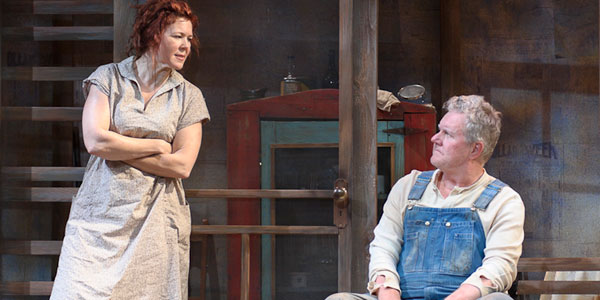
Having never seen Eugene O’Neill’s The Moon for the Misbegotten before, I should not feel as confident as I do asserting that the current production at The Pearl is a reinterpretation.  I don’t mean in a “let’s changed the ethnicity of the cast” or “let’s insert incongruous devices” or “let’s see how much technology we can use” kind of reinterpretation.  Instead I suspect that director J.R. Sullivan chose to tell the story in a new way through casting.  This (excellent) cast is both physically and spiritually slightly against type.

At first glimpse Josie (Kim Martin-Cotten) is a lumbering, smudged and bedraggled farmwoman.  She shifts her center of gravity down and splays her legs as she barrels across the stage.  But when she slows down and we get a good look, she’s quite lovely.  Perhaps, when this play was originally produced (1947) she might be considered a bigger woman, but by today’s standards she has an enviable figure.  Much of the play is centered around her insecurities in her appearance.  By casting a woman as classically pretty as Ms. Martin-Cotten this device seems quite modern.  Her struggle seems all the more real because of its psychological origins.

Her father Phil (Dan Daily) is a large barrel chested man who could be a distant relative to Alan Hale (Sr. or Jr.)  He has an affability that belies his lot in life.  We know from an early conversation between Josie and her fleeing brother Mike (Sean McNall) that daddy can be bombastic.  Dan Daily’s Phil seems more Captain Kangaroo than that which adds another layer of psychological realism.  The adult children experience him in a manner that is theirs alone.

Jame Tyrone Jr. (Andrew May) is Long Day’s Journey Into Night’s Jamie all grown up.  For anyone who’s ever wondered about the effects of addicts raising children, I give you Jimmy.  Mr. May plays Jimmy as a loving and softhearted man with a dark demon deep within.  He presents himself as so socially endearing that his excessive drinking is the only hint of what lies beneath.  Until the earth opens and swallows him.  This nuanced performance is so realistically accurate.  The tormented and deeply tortured rarely advertise their condition.

The theatre (City Center’s Stage 2) adds yet another key ingredient to this production.  A small thrust theatre, with the audience practically on the stage, sustains connectivity for the 3 1/2 hour(!) play.  There is much, of course, that is heart wrenching about this play, but there is much that is very very funny as well.  It is by nature a very heavy play but this production feels fresh and very relevant as well.  There was a girl of about 10, sitting next to me.  She sat stock-still and transfixed throughout the entire production.  As did I.

 
Leave a comment

Posted by on April 6, 2012 in Uncategorized


Tags: , , , , , , , ,

End Of The Rainbow – Review

The Belasco is an ornate wonder of a theatre.  The walls are covered in dark pastoral murals, the ceiling in stained glass coats of armor.  Carvings and drapery cover every other surface.  All of the lushness stands in somewhat stark contrast to the excruciatingly discomfort of the seats.  It’s as if the theatrical experience was forgotten in the act of creating the spectacle.  The Belascon’s current inhabitant; End of the Rainbow might well be suffering the same condition.

The play, by Peter Quilter captures the essence of the final months of Judy Garland’s life.  Quilter understands the contradictions and complications that were at work.  But directed by Terry Johnson, this production isn’t so much a play as it is a version of Beatlemania.  There is far too much tribute singing both in the recreation of the concert performances and (in a bizarre break in character) to stir a rousing ovation at the end of both acts.  Less singing might make this a more interesting play.  The problem however with knowing exactly how something ends is how then to make it dramatic.  Sometimes that can be accomplished with very fine acting.

Tom Pelphrey is spot on as Mickey Deans, Judy’s very young soon-to-be fifth (and last) husband.  Mr. Pelphrey has the unique ability to walk the tightrope between sinister and charm.  (Someday I hope to see him in How I Learned To Drive.)  Michael Cumpsty portrays Judy’s sometime accompanist, Anthony.  His is the most compelling and beautiful portrayal.  The only emotional resonance of the show comes from his two minute speech, downstage in a single spotlight.

Tracie Bennett doesn’t so much play Judy as she does impersonate Miss Garland.  It is terribly distracting to experience a full-length play built around an impersonator.  It is immaterial to assess whether someone is a good Judy Garland impersonator or not.  The fact remains that if anyone could even come close to the magic of the real Judy Garland, we would not still be talking about her (and her completely irrelevant fifth husband) 40+ years later.  Keeping that sad fact in mind, a performer is further ahead to take a page from Meryl Streep’s book, and capture the essence of an icon, not create a pale imitation.  It might sound like a minor issue, but the difference (to an audience) between acting and impersonation is tremendous.

The set of this production (William Dudley) is of the Ritz Hotel (London) and melds beautifully into the ornate theatre.  There is a very charming band set behind a scrim that is revealed to create the concert hall.  There is a bit of awkwardness with the transitions on stage.  A garment rack wheeled onto the stage to indicate a dressing room is silly and seems like a leftover device from a work shopped performance.

I was struck by some of the script’s painful yet accurate insights and think Mr. Quilter could have the makings of a gem, in the right hands.  However he probably needn’t bother.  In its current form, this show will be a huge success.  The audience went wild for Ms. Bennett’s rendition of one of Miss Garland’s worst performances on record.

 
Leave a comment

Posted by on April 5, 2012 in Uncategorized


Tags: , , , , , , , , ,