RSS

Tag Archives: Brenda Tobias

Playing Dress-Up


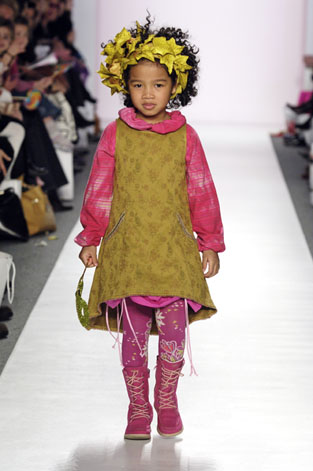
Been shopping lately? Have you noticed how the children’s apparel market has grown? Sizes that included 2T and 6X were once relegated to an upper floor of a department store, suggesting that only after adults clothe themselves would they consider fashion for babies. We now have entire chains dedicated to children’s fashion as well as adult clothiers that have created children’s fashion lines. It’s not as if children of the 1970s and 1980s ran around barefoot and naked. So why the market glut of teeny tiny clothes?

Most children do not do their own shopping and most do not have their own income stream, so presumably big people are buying wee clothes. Now if you are to believe the media and your own bank statements, these are not exactly flush times. Of course these chain stores for the toddling set are not pricey, but the only way they are staying in business is if lots of inventory is being liquidated often. A child’s entire wardrobe does not need to be replaced every season (unless the child has a rapid growth syndrome.) A winter jacket can usually make it through two New Years. Even children without siblings could be wearing second hand clothes. And maybe they do. But if so, why all these shops? It’s hard to believe that stores filled with teeny fashion trends are actually going after the “necessity market.” Fake fur shrugs and sequined mini-skirts speak more to child styling versus child dressing.

In this great country of ours it is usually the female parent who is doing the shopping and dressing of the smalls. Could it be that for some of us, dress up is fun? Could it also be that dressing a little person is easier because of it being baggage free? Anything “mini” is by definition cute. No toddler ever thinks; “Wow those pull-up pants make my ass look huge.” Whether mommy’s behind is bigger than it once was or than desired, it takes a lot more effort to dress oneself than one’s child. There really are no Garanimals for adults, and sticking a color-coordinated bow in our hair doesn’t make an outfit as much as it begs the question; What DID ever happen to Baby Jane? Having an adult sense of style means knowing what suits you and that of course means having some self-awareness.

There is nothing wrong with dressing your little person in short pants and a jaunty derby. But if you are walking by his side in sweats or shapeless dreary apparel, there is a problem. Children are not Chihuahuas and shouldn’t be used as accessories or a way to deflect attention. They learn from example and one of the best lessons they can experience is that their parents are first and foremost people worthy of attention and care.

 
Leave a comment

Posted by on August 16, 2012 in Childhood, Style


Tags: , , ,

Setting A Tone

When is the last time you saw someone dressed? I mean really dressed? Most people (beyond the set of Downton Abby) don’t dress for dinner these days. Certainly, by the looks of things, no one dresses to go into town either. A hat and pair of seasonally appropriate gloves were once practically a requirement for trolling the department stores. Lunching outside the home involved outfitting oneself with care and precision. But time passes and with it goes formality. Dining outside one’s home is no longer an occasion, dining at home is. Traveling, sightseeing or shopping is done with enough frequency to no longer fuss over appearance. Is there something a wee bit unsettling about sitting in a crush velvet Broadway seat next to someone in flip-flops and a tank top? A tad, but it’s really the close proximity to their big gulp slurpie that rankles the nerves. (Will that infernal plastic straw squeak ever end? Are they really going to play with the ice throughout the entire show? Is that neon infused corn syrup abomination going to land in my lap?)

When others treat an occasion with all the frivolity of hanging out in their own background, it tends to dilute the experience a bit. But you will probably still enjoy the show or even dinner if you keep your eyes straight ahead. But what of an occasion at which one must mingle and therefore move one’s eyes? What if our (and practically every society’s) traditions encourage a certain style of dress? What if it is in fact guests that help make an event an occasion?

At any number of weddings this summer, guests have taken it upon themselves to draw focus from the marrying couple. They will do this by over or underdressing, or by wearing white. These are not guests who have dressed in compliance with invitation instructions (i.e., it’s a white wedding for all! beach attire requested! black tie only!) these are guests who a) are not adept at social cues b) have nothing else to wear or c) the airline lost their luggage. (A word about white: even if the bride is not wearing white, even if there is no bride but instead two grooms, it is not a good idea for guests to wear white. Rational or not, other guests will be focused on the woman in white versus the marrying couple.)

Of course these slip-ups are not just reserved for the start of married life, but apply to the end of life as well. While there really is no one from whom to steal focus at a funeral, it’s best to not wear white (unless your tradition suggests otherwise.) Wearing black is no longer required, but somber tones are best. Any flash (sequins, excessive jewelry, statement shoes) should really be avoided, in other words; tone it down. Like a wedding, all attendees are helping to set the tone. And unless the deceased played in the major leagues that tone should not include baseball caps.

Dressing is the only way we humans have of communicating in a blink of an eye and in a universal language. While there are those of us who may long for more formal everyday attire, in the end it’s simply a matter of taste. But attending a wedding or funeral is not about us; it’s how we support people who are important to us. Showing up to a funeral in a strapless white eyelet mini-dress is the equivalent of screaming; “I’m here!!!!” Whereas a navy knee-length shirtdress whispers to the bereaved; “I’m here.”

 
2 Comments

Posted by on August 9, 2012 in Style


Tags: , , , , ,

For Mature Audiences Only

I overheard someone categorize pornography as a form of adultery. You are forgiven if you are having a Scooby Doo “HUH?” moment right now. I’ll talk you through this. Looking at something is infidelity. It’s not cheating on your other books, magazines, websites or films; no, it’s cheating on your partner. With your eyes. Now I’ve seen some sexy eyes in my time, hell I’ve even heard of eye f*&$ing, but come on! We humans are blessed with limited parts in which we receive sexual activities; eyes ain’t one of them. That I know of. Not that there’d be anything wrong with that.

Why do people get so rankled by pornography? Clearly nobody is a fan of the actual business of pornography. Even if participants are consenting adults who are fulfilling their performance dreams, the work environment is not entirely wholesome. (Please note that the use of “participant” is intentional and meant to reinforce the fact that we can’t all be “stars”.) But for most people it’s the viewing of the pornography, rather than the making that really sticks in their craw. And while access to porn has changed the craw sticking is not new. I’ve no doubt some cavewoman came home from sitting through yet another of her children’s organized rock throwing matches to find her husband staring at those disgusting carvings in the bat infested back corner of the cave, and threw the kids’ practice bag at him.

By giving him a serious head injury, she was in fact simply saying; “what about me?” Had she had words to use she might have expanded the thought a bit to; “Why would you want to look at those carved stick figures instead of me? You don’t think there are woman that actually look like that do you” “How could you spend time doing that when you have an actual life going on without you?” “Pay attention to me!”

Of course pornography is not reserved for men only. Women as a rule prefer stories, or as they are more commonly known; soap operas, romance novels, and chick flicks. The visuals (soaps, films) are steeped in fantasy (mostly of the incredible coincidence kind) and the texts (novels) are filled with throbbing, burning, and pressure (not the “see a doctor” kind.) Traditional women’s porn is about sustained mental escapism more than it is about quick and perfunctory physical escapism. Their porn paints absurdly unrealistic physical portraits of men and characterizations that are simply cartoonish. But reading porn, even S&M porn isn’t considered a threat to a relationship.

The most simple conclusion in this heterosexual tale of suspense is that men are not threatened by what they know is fantasy. Could it be that women’s discomfort with pornography stems from their own combustible body issues? Do women spend all day, everyday comparing themselves to real and/or imagined others and then are sent completely ’round the bed by their husband’s response over augmented physical perfection? Are women simply uncomfortable with sexual feelings being separate from emotional connection?

For a woman troubled by her man’s viewing I offer some tips:

  • If it’s repugnant to you, insist the behavior remains private (have him clear his viewing history, or keep magazines in a drawer)
  • If you’d prefer he was playing copy-machine repairman and secretary with you; say so
  • If your sex life is suffering, say so
  • If porn has become a priority (he misses family events, doesn’t come to bed, racks up charges) say something
  • If his behavior is not impacting your life, but simply making you feel bad, don’t run from that feeling. Try taking it apart a bit. Try to determine why you’re rankled and then have a (potentially interesting) conversation with him. Not while he’s looking at porn


1 Comment

Posted by on August 7, 2012 in Cultural Critique, Media/Marketing


Tags: , , , , , ,

How To Build A Better Parent

No one likes to be told what to do. (Just ask a toddler if you don’t believe me.) But that hasn’t stopped anyone and everyone from proclaiming that you are not raising your children in the correct manner. There are books which chastise you for not being more French or feline. Newsstands are chock full of glossy instructional manuals. There was a time when parenting articles were bundled with home economics and fashion articles in ladies’ magazines. That will no longer do. The magazine industry (in all its floundering glory) has produced copious parenting titles. One needn’t purchase a magazine or book however; simply turn on the computer and enter the blogosphere/chat rooms/message boards that long to be heard.

Of course many of these sites are less interested in telling you what to do and much more concerned with daily affirmation. Are you having some doubt about sleeping in the same bed as your baby? Fear not, there are thousands of people out there poised to support your decision. Does using a pacifier make you feel less than? Give it 10 seconds, and someone will vote you virtual mother of the year.

Let’s face it, there’s a lot of noise out there. There are as many people lining up to cut you down, as there are to boost you up. Parenting is a lonely job. There is no boss to hand out an “atta girl” there are no annual reviews or even colleagues. There are hundreds of tiny (and not so tiny) decisions you must make at all times. A little person, even a verbal little person, cannot offer much feedback as to how you’re doing. It takes a village just to quell the loneliness. So naturally, we’re disposed to hearing the chatter (by the end of the day the chatter of adults sounds like a freaking symphony to our ears!) But if there’s any danger in our weakened state, it is that we often only hear what we want to hear. If we are sleep deprived (and shower deprived) and are still being woken up every 3-4 hours by a three month old, we want to hear that we are and will be okay. We probably do not want to hear that we have to let the baby learn to self-comfort. We can’t bear the idea of listening to the baby cry itself back to sleep once let alone every night for a week. Just tell us that we’ll live through this. Well, you will, of course you will, but parenting isn’t really about our survival it’s about helping children grown into healthy, happy, strong adults. However it’s easy to lose sight of that when you haven’t slept for three months.

Put a post-it-note on your computer for when you find yourself shopping online for a perfect parenting book or trolling chat rooms at 2:00 AM. Have the note simply state: “I know what I’m doing” then in tiny script just below “see print-out.” See print-out?

Print-Out:

How To Build A Happy, Healthy, Strong Person

  • Adults are in charge – Flight attendants instruct adults to place the oxygen mask on their own face first for a reason
    • A fulfilling life of your own, outside of your parenting responsibilities is key to allowing your child to grow and to modeling the appeal of growing
    • Adult activities (working, fitness, classes, socializing, dining, bar hopping) should not include children
  • Do only what is necessary for your child
    • A preschooler can pick up his/her own toys. Once children reach school age he/she can make their own breakfast and get dressed. A middle-schooler can do his/her own laundry and cook one night a week. And so on
    • Competence is the primary ingredient in self-esteem
  • Redefine “every advantage”
    • Don’t give your child what you didn’t have, give them what they need
    • Money & stuff is never helpful, life skills and a moral compass are


2 Comments

Posted by on August 5, 2012 in Childhood, Media/Marketing


Tags: , , , , , , ,

Special Education

When people talk about K-12 education, and they do, the one thing they agree upon is that children do better when parents are involved. Charter, public, private fans may diverge on many issues but they all agree that parents need to be engaged. For some people with the luxury of time and mental energy to spare this goes without saying. For others, perhaps single parents or parents struggling with the storm that is life are tempted to snort; “Hey, it’s a miracle I get them to school each day.”

There are no data to suggest whether the children whose parents don’t engage with the school are benefitting less from the K-12 experience. We can’t really measure who voted in school board elections or who reviews homework each night. It stands to reason that these children have the education experience influenced by the more engaged parents (whether it works for them or not.) Even in a school system comprised of entirely one camp of parent, there is a trickle down effect. Trends develop in educational practices that often stem from community influence. In other words; education does not happen in a vacuum.

Our focus on testing is relatively recent. A flip through the archives will remind us of trends such as; phonics, basic thinking, open classrooms, whole language and new math. The focus may have shifted from learning to teaching but it is still reflective of what the (vocal) community considers effective. Another relatively recent phenomenon is the wrangling for special education resources. Special interest groups would love to get their hands on monies allocated to special services. (These groups are predominantly religious schools.) They argue that public special education services don’t take into account the extra-specialness of their children. On the other end of the ability spectrum there are very engaged parents who seek out special services for their average learners. Procuring a “diagnosis” can result in performance enhancing drug prescriptions and special arrangements for test taking.

In essence, a lot of people want their children to be treated as if they’re special. The fact is that nobody is special. We’re all wonderful (in varying degrees) but not special. Nobody is more entitled to K-12 resources than anyone else. One could argue that the children of the less engaged parents need more. Perhaps. Groups (or individuals) waving the “special” banner should remember that when they do so, they are taking something away from someone less vocal.

 
Leave a comment

Posted by on August 3, 2012 in Education


Tags: , , , , ,