RSS

Still Dreaming After All These Years

Getty Images

Fifty years is a long time; a very long time. A 50th anniversary is always worthy of commemoration, and naturally occurs within the framework of modernity. Fifty years ago, on an oppressively hot humid day on August 28th, 1963, hundreds of thousands of people marched for freedom and jobs in an event twenty years in the making. They came on buses, trains and on foot; slept wherever they could or perhaps not at all. They marched through the nation’s capital, towards the mall, not knowing what to expect or how things might end. It was a dangerous time for protestors and in Washington D.C.; imprisonment, beatings and even killings were (and continued) to occur. But they came in their finest, marching and standing in that unrelenting heat all day long.

Fifty years later, in 2013, it took days of events to commemorate all that occurred on that one day. A week’s worth of marches, demonstrations, speeches, and festivities culminated in an all-day rally on August 28th, 2013. Over five hours a schedule of military minute precision brought performers and speakers to the steps of the Lincoln Memorial. Early on the crowd (which stretched from monument to monument) was led by Andrew Young in; Woke Up This Morning With My Mind Stayed On Freedom. This set a communal tone for a crowd diverse in age, background and agenda. Another sing-along that either conjured strong memories or made one think of one’s parents, was Peter and Paul singing Blowin’ In The Wind. Anyone familiar with Peter (in particular, but also,) Paul and the late Mary won’t be surprised to learn that Trayvon Martin’s parents stood with the performers. Many who took the stage were living remembrances of the 1963 March. Representative John Lewis (the youngest speaker in 1963) invoked sentiments repeatedly echoed on the steps; “The scars and stains of racism still remain deeply embedded in American society, whether it is stop and frisk in New York or injustice in Trayvon Martin case in Florida, the mass incarceration of millions of Americans, immigrants hiding in fear in the shadow of our society, unemployment, homelessness, poverty, hunger or the renewed struggle for voting rights. So I say to each of us today, we must never, ever give up. We must, ever give in. We must keep the faith and keep our eyes on the prize.”

Two of Dr. King’s children spoke, but it was Christine King Farris, King’s older sister who surprised and moved the crowd. She referred to herself as perhaps not the oldest person present but certainly the only one who had known Dr. King since he was in diapers. She hadn’t been able to attend 50 years prior, due to a bad flu, but had watched her brother on television and knew something magical had happened. She spoke eloquently, powerfully and personally and the crowd felt they had been invited into the circle. Reverend Bernice King, clearly inheriting her father’s gift for oration, was inspiring; “We are still chained by economic disparities, class inequalities and conditions of poverty for many of God’s children in this nation and around the world. If we are going to continue the struggle for freedom and create true community, then we will have to be relentless in exposing, confronting and ridding ourselves of the mindset of pride, and greed, and selfishness, and hate, and lust, and fear, and idleness, and lack of purpose and lack of love as my brother said for our neighbor.” She ended her remarks at precisely 3:00 PM for the ringing of the bell. The bell, the crowd learned, was salvaged from the Birmingham Baptist Church, a reminder of the extraordinary sacrifices that led us to this day.

The most remarkable aspect of the day’s programming was that of having three United States Presidents on the agenda. Presidents Carter, Clinton and Obama were greeted like rock stars and did not disappoint. They paid homage to the work of Dr. King and the strides of the movement, but as one would expect from world leaders, they also carefully criticized complacency, or worse; backsliding. It is a difficult conundrum, complacency. While it is natural to be reactionary to policies and actions that are blatantly racist, it is challenging to keep the fire burning day to day. When we are no longer daily confronted with signs of “Whites Only” or bus and school segregation, our shoulders lower and we breathe easier. But, as the speakers reminded us throughout the day, there is so much left to do. Poverty, incarceration, immigration, voting rights and equality are very current issues. Progress has been made, but we are nowhere near the finish line.

It is so tempting to lose our focus, to give into distraction. In fifty years we’ve evolved into a nation of perpetual distraction and extroversion. Where the 1963 March was an open and accessible event, the 2013 event was constrained and produced for the media. Enormous television camera towers blocked the view for all but the “ticketed” attendees (an oddity juxtaposed to a day celebrating equality.) Celebrities with no obvious connection to the movement spoke and sang (or lip synched) for the cameras. Two dance groups (in very photogenic costume) performed, an odd artistic choice for any rally with limited views. The singers (except for Peter and Paul) sang gospel music, even though international (and even national) folk singers still abound today. But the 2013 event was packaged for viewers back home. That isn’t necessarily bad, it’s just different. As were the 20-somethings playing candy crush during the speakers, and the thousands of selfie pics being taken throughout the day. But amongst all that noise were young, middle-aged and 1963 alumni, riveted and moved. Heads bowed and bobbed, hands waved in solidarity and to this attendee it looked like hope.
 
Leave a comment

Posted by on August 29, 2013 in Cultural Critique


Tags: , , , , , , , , , , , , , , , , , , , , ,

Stick ‘Em Up!

davy

Every so often a new study posits the link between media violence and real violence. The theory most often is that children exposed to violent themes and games become inured to real violence and thus more likely to commit violent acts. There is a certain logic to the premise but is it really that straightforward? Hasn’t violent play always existed?

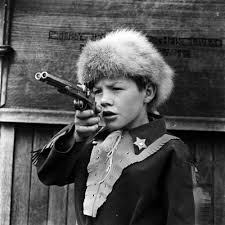
People raised during the earlier days of television were exposed to far more violent images than their moving picture going or radio listening ancestors. A child growing up in the 1950s was immersed in cowboy-shoot-em-up imagery and play. Cowboy and cowgirl costumes (replete with guns and holsters) were not just Halloween costumes; they were toys. Television, movies, books, comic books and creative play was rife with shooting. Even Superman (the television show) had people shooting (and killing) people. Toy soldiers, G.I. Joe and war games have been a part of child’s play since the advent of war. But all of this happened in a distinct child’s world, in which an adult (related or not) was always at the ready to impose adult order. The world belonged to adults and children knew that. They were ever conscious of their place in the adult world and the distinct delineation between being a child and being an adult. Children engaged in unsupervised play and then returned to the structured adult world.

The adult world demanded marked different behavior than that of a child’s world. The language (e.g., slang, profanity,) manners, appearance and attire requirements in the adult world were different from that in the child’s world. Adults maintained the boundaries in various ways. There were many subjects that were not discussed in front of children (little pitchers have big ears; what in the world does that mean!?) Adults socialized without their children and enjoyed other privileges of adulthood (e.g., choosing which television shows were watched, what foods were eaten, which clothes were purchased, etc.) The rigidity of home life was countered with the wildly independent social life of a kid. Play was unsupervised and free-range. Children engaged in activities without parents. They played sports, danced and sang without their parents witnessing every single moment. They were in their world and they were just playing.

Children flourish when they can explore the world safely. Knowing that adults are in charge and are sure as shootin’ gonna tell them what to and not to do, is very comforting. However, if a child is left with a feeling that the adults are not in charge, or worse yet, the child is in control, that child can grown very frightened and insecure. The same child who senses that “no one is the boss of me” not only has a fuzzy sense of fiction and reality (which is an inherent part of childhood development and why children need parents) but also could possibly be left to immerse themselves far too often in violent games and play. There is nothing about holding a plastic gun and aiming it at a screen that is more violent than holding a Davy Crockett pistol against a friend’s head. However there is something numbing about playing alone and obsessively. An interesting treatment in these “violence studies” would to be to have one group of children “Go Outside And Play!”

This dance of control in which parents involve themselves in a child’s world and children are given equal footing in the family may not be the most effective formula for growing strong children. Children flourish when they are given limits. They want to grow up when being a grown-up looks better than being a kid. While there is nothing positive one could say about violent video games, it is short sighted to think any imagery in any form has the power to change collective behavior. Blurring the lines between reality and fantasy, and childhood and adulthood is much more likely to affect change. If in fact the exposure to violent imagery (in games, film, video, etc.) has risen and violence in children and young adults has risen, that is indeed correlation. But to suggest (yet again!) causation and wag our finger at the media makes us look silly and a bit irresponsible.

 
Leave a comment

Posted by on August 25, 2013 in Childhood, Media/Marketing


Tags: , , , , , , , ,

Empty Nesting

nest

Empty nests aren’t what they used to be. In fact you might be hard pressed to find a nest with vacancies. This isn’t exactly news; we’ve been hearing about dismal job markets and diminished economic opportunities for young adults for quite some time now. It’s commonplace to hear of households that include adult children (and even their children.) What is rarely mentioned in these discussions is that it is often quite an agreeable arrangement. Modern parents and children (of all ages except perhaps peak adolescence) enjoy spending time together.

The generations share interests, activities and even clothing. They are often in constant communication and know a great deal about each other’s lives. In generations past this was rarely the case in traditional American families. A child had his/her circle of friends and interests and upon reaching adolescence rebelled against all that his/her parents represented. The politics, music and literature of the younger generation were unrecognizable to that of the older. The clothing, hairstyles and lingo were equally foreign and perhaps infuriating. Who would want to spend time with someone they couldn’t understand? An adolescent’s primary goal was to get out of the house and away from the hopelessly old-fashioned parents. College served that purpose well, as did first apartments (filled with like-aged and minded roommates.)

Something has happened in recent decades to blur the lines between the generations. The most intriguing aspect to the change is that it’s both the younger and older moving towards each other. If we were to jump in a jeep with our binoculars and pursue the average American nuclear family in their natural habitat, we would spot this morphing phenomenon. Parents and children (of all ages) look an awful lot alike. They dress alike, they groom alike, they text alike. The fact that this happens in public proves that everyone is okay with it. Daughters don’t mind (or perhaps even enjoy) their mothers appropriating their dark/cadaver like nail colors, sons enjoy/tolerate sharing their baseball caps with their fathers. From the back (if weight wasn’t a factor) you’d be hard pressed to determine which generation was which. It’s been a long time since we’ve witnessed a unified family look, in nature that is; it happens in Christmas cards all the time. Surely there’s a more recent example of this indistinguishable appearance; but it is Little House On The Prairie that comes to my mind.

If we were to hop out of the jeep and (lawfully) enter homes, we might discover that there is no “adult” space (formally known as the living room) and “child” space but instead “family” space. Unless a parent engages in a delicate or dangerous activity, there is probably no “off-limits” space within the home (for fun, check to see if there’s a lock on the parents’ bedroom.) The music, movies, social media, gadgets, and fitness regimes are most likely shared. This average family probably socializes together and often vacations together. They will attend all school and family events as a unit as well. To the novice jeep rider this may appear novel. But it is actually a very old phenomenon (see Little House reference.) Back when we were forging new territory and had little if any connections to the world, our nuclear family was our world. One’s fortunes and survival depended on the strength of the nuclear family.

It is slightly ironic that in an age of such instant and ubiquitous connectivity we revert back to an isolationist mode of living. But if we take a closer look (back in the jeep everyone) we will see that we are anything but connected to the larger world. When is the last time you had friends over for dinner? How often are you invited over for drinks? When was your last block party, potluck or open house? How many times a week, or even month, do you go out with friends (without children in tow?) How long have you been at your current job? Do you lunch or happy hour with your co-workers? How often do you attend religious or community events? Can you recall the last time you dropped by a friend’s home unannounced?

Some of our disconnection to the larger world is our own doing and choice, but some of it is not. A job isn’t life sentences any longer, nor is marriage. We move (by choice or not) and we start over. We lose contact and perhaps the confidence to make new contacts. We are so electronically plugged in that isolation can feel like a reprieve. Our work life is so heavily in favor of extroversion that off-hours cocooning is a sanity saver. The reasons we choose to enmesh with our nuclear family could be many. The affects are probably always the same; nests are less empty. What is indisputable is that if we stay in the jeep long enough (and refuel a few hundred times) we will see this phenomenon shift once again. In 25 years or so we will start hearing the ancient strains of; “What are you wearing?!” “Turn that noise down!” “That’s not a word!!!”

 
2 Comments

Posted by on August 23, 2013 in Childhood, Cultural Critique


Tags: , , , , , , , , , , , , ,

The Unavoidable Disappearance of Tom Durnin – Review

Unknown

What is rehabilitation and is there such a thing as redemption? Can time served ever neutralize crimes committed? Can a life, interrupted by crime and punishment ever resume a recognizable form? Or is a prison term simply the beginning of the punishment? Steven Levenson’s The Unavoidable Disappearance of Tom Durnin poses these questions with honest, powerful and very real results.

Tom Durnin (David Morse) appears at his son James’ (Christopher Denham) door after five years in prison. Tom is charming and smooth as he convinces his estranged son to temporarily house him. Father and son have much in common as they struggle (quite independent from one another) to get their lives back utilizing similar means. However, it is the wide chasm between them that dominates their relationship. They both grasp, with fits and starts at women to shape their lives. James meets the lovely, skittish Katie (Sarah Goldberg) at a creative writing class. Their attempt at courtship rings painfully true with equal parts endearment and frustration. Meanwhile Tom keeps his eye on the prize of seeing his ex-wife Karen (Lisa Emery). He cajoles, connives and threatens his son and his son-in-law Chris (Rich Sommer) for his ex’s whereabouts. He is unrelenting and there’s no doubt he will get his way. Chris endures much of the bewitching and terrifying negotiations of Tom. Chris is an easy and vulnerable target as he’s agreed to meet with Tom against his wife’s wishes. Tom’s got him, and courts and threatens him in pursuit of a job and his ex-wife.

Tom is charming and scary, and there is no better actor than Mr. Morse than to deftly and winningly play such a character. Tom’s explosions are not simply the result of rage, but are driven by a profound sadness and loss. In Mr. Morse’s hands these episodes send chills down the spine and tears to the eyes. He wants his life back. He’s done his time, he’s apologized and taken responsibility, but there’s no going back. His ex-wife has remarried, after enduring public humiliation and financial ruin. His daughter and her children are lost to him. And it’s not clear if he will ever be reinstated to the bar and move on from his barrista job. In less deft hands, the play might verge on cloying or even twee. But there is no slipping into sentimentality and these characters are fully formed (and beautifully performed.) No one is a villain or a hero; there are no right or easy answers only varying shades of grey. Directed by Scott Ellis, the production is delicately balanced. The fluid staging and the honest performances are the perfect match to the script. The ending is the finest example of Mr. Levenson’s restraint. Everything is poised for a satisfying and definitive conclusion, but instead it all stays very real making it all that much more moving.

The Unavoidable Disappearance of Tom Durning is playing at the Roundabout Theatre

 
Leave a comment

Posted by on August 22, 2013 in Uncategorized


Tags: , , , , , , , , , , , , ,

The Old Friends – Review

Unknown

What constitutes binding ties? Are they marital, familial or just familiarity? Horton Foote looks to untangle this question in the posthumous premiere; The Old Friends. Set in 1965 outside of Houston, Texas six adults are locked in a combustible and static pattern of interaction. The (often alcohol fueled) attacks and schemes are delivered daily. They may be dressed slightly differently from day to day, but they are the same greed, jealousy and loneliness inspired displays. These displays make for some phenomenal scenes and performances but are difficult to absorb.

Julia (Veanne Cox) is married to fabulously wealthy Albert (Adam LeFevre). Her mother Mamie (Lois Smith) lives with them. The play opens with the family awaiting the arrival of Julia’s ne’er do well brother and his wife Sybil (Hallie Foote.) Sybil arrives alone, freshly widowed and destitute. Mamie is distraught but not for reasons one might assume. Her son is dead and so is her plan of living with him (evidently life with her daughter is a virtual living hell, or so we’re told.) Small, stunned, nondescript Sybil is left alone in the living room when tornado Gertrude (Betty Buckley) arrives. In perhaps the greatest character study of pure narcissism ever to hit a stage, Gertrude goes on the most delicious rant about how she’s been treated at the cocktail party. Julia has been hitting on her man Howard (Cotter Smith) who incidentally is the brother of Gertrude’s late husband. There sits newly widowed Sybil looking and being treated like part of the furnishings. She’s better off to be frank, as there is an odd vortex at work here. Unlike Mamie’s reported mistreatment we actually see all the other wretchedness. These people are caught in an interpersonal dance that one might expect on a remote island not amongst people with the means to escape. Julia and Gertrude fight over the same men over and over again. They are not related and have gobs of money. Why are they locked in this mode, dragging everyone in and down with them? It’s not clear.

What is clear is that these parts are written with actors in mind and director Michael Wilson makes the most of that. Betty Buckley’s Gertrude will be the standard for every subsequent performer. It is no easy feat to portray drunkenness and keep a character interesting. Ms. Buckley is riveting and uses her voice (not surprisingly) in the most powerful way. The soft raspy sadness that bubbles up after one too many, the controlled and uncontrolled rage and the lyrical flirtations make for a vocal symphony. Howard (or probably any other human) is no match to her passions and fervor. He is merely there to keep away the loneliness (as we learn in a confession reminiscent of a 3:00 AM Judy Garland phone call) and she will fight to the finish to keep her fear of loneliness at bay. Howard however has been pining for Sybil for years. He seems a bright and interesting guy and it’s hard to see why he’d be holding a torch for such a meek and mousy woman. Perhaps it’s simply the result of thirty years in the presence of Gertrude and Julia. Julia (who seems to go after Howard in some sort of non-sibling rivalry with Gertrude) is loud and boozy as well. She just wants to have a good time and feels everyone is standing in her way. Her wig, physique and mannerisms often hint to Carol Burnett’s poignant portrayal of Eunice. Again, why don’t these people leave? This question hangs in the air as a trip to New York City is cancelled by Gertrude. Why didn’t they just go without her? How does a woman who’s not even related hold the reins so firmly?

We never really discover what the ties are. The ending of the play is so abrupt as to suggest that there are no answers to be had.

The Old Friends is playing (August 20 – September 29) at the Signature Theatre

 
Leave a comment

Posted by on August 21, 2013 in Uncategorized


Tags: , , , , , , , , , , , , , , , , ,