RSS

Titanic Shifts

A birthday party for a monumental disaster strikes me as a bit macabre, but a centennial is a centennial and does give one pause.  The disaster that now is known simply as; “The Titanic” has permeated our cultural consciousness for decades now.  Countless books; fictions and non, have been published. Theatrical pieces (including a musical!) have been produced.  Films have been made and remade.  It simply goes on and on.

For some the fascination is that of the magnitude of the loss of life, for others the boldface names on-board, capture the imagination.  Other “fans” are nautically curious, or scholars of the early 20th century class system.  Some are captivated by the less romantic aspects such as the arrogance of insufficient life boats or search and rescue endeavors.  If my imagination is captured by anything (aside from the buoyancy of one Molly Brown) it is that of the shifts in our culture since that fateful voyage.

By looking at the physical construct of the ship, compared to luxury liners of today we can chart the course of some of the ways in which we’ve changed.

Let us start with the super-sizing

  • ships are about 34% larger than the Titanic (let’s just let that figure roll around in our heads for a moment)
  • a typical state room was 120 square feet and is now 282 square foot (and chock-full of amenities unknown to Titanic passengers; such as a bathroom.)

The expectation of creature comforts at least equivalent to what one experiences at home does not seem a new phenomenon.  No doubt, smaller spaces and shared bathing facilities were not all that unknown to people in 1912.  The modern “bigger is better” phenomenon is American in its origin and the (international) tourism industry is now on board with that.

How people use their leisure time and how they interact with others is the most dramatic change one can glean from the facilities of the Titanic

  • A tiny “plunge bath” was the swimming pool of the day.  The tank of seawater was rather brisk and bracing the water was seen as an act of manly fortitude.
  • You can’t swing a water wing without hitting a heated playground of a pool on today’s ships.  They are enormous and fitted with slides and other gewgaws. Esther Williams would risk a head injury emerging from the depths of one of those pools.
  • There were live musicians on the Titanic (and the band did play on) but there were no “shows” or “entertainment”
  • Today’s ships have full-scale auditoriums/theatres.  Mini versions of musicals are often performed, as are all other forms of splashy entertainment.
  • Public spaces on the Titanic were predominately reading and writing rooms and comfortable places to socialize.
  • Bars, discos, casinos, shopping and shore excursions are how people “socialize” on today’s ships.

Of course the fundamental difference was that the Titanic was seen as a means to end.  It was a very nice way to travel.  A cruise on the other hand is seen as the destination itself.  But still, it is interesting to consider that there was a time we considered a morning of written correspondence, followed by a stroll on deck, a meal or two, a little reading and perhaps catching up and/or meeting new people to be a thoroughly entertaining day.  It is safe to say that there are many of us who now do all those things at once in the span of one hour.
 
Leave a comment

Posted by on April 8, 2012 in Style, Travel


Tags: , , , ,

A Moon For The Misbegotten – Review

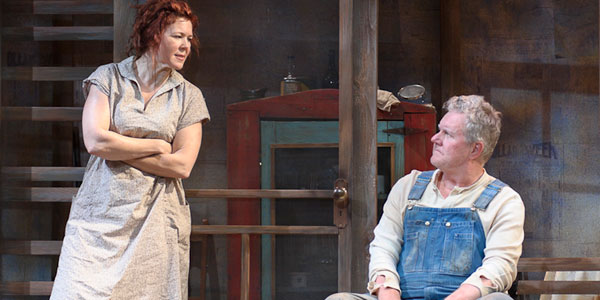
Having never seen Eugene O’Neill’s The Moon for the Misbegotten before, I should not feel as confident as I do asserting that the current production at The Pearl is a reinterpretation.  I don’t mean in a “let’s changed the ethnicity of the cast” or “let’s insert incongruous devices” or “let’s see how much technology we can use” kind of reinterpretation.  Instead I suspect that director J.R. Sullivan chose to tell the story in a new way through casting.  This (excellent) cast is both physically and spiritually slightly against type.

At first glimpse Josie (Kim Martin-Cotten) is a lumbering, smudged and bedraggled farmwoman.  She shifts her center of gravity down and splays her legs as she barrels across the stage.  But when she slows down and we get a good look, she’s quite lovely.  Perhaps, when this play was originally produced (1947) she might be considered a bigger woman, but by today’s standards she has an enviable figure.  Much of the play is centered around her insecurities in her appearance.  By casting a woman as classically pretty as Ms. Martin-Cotten this device seems quite modern.  Her struggle seems all the more real because of its psychological origins.

Her father Phil (Dan Daily) is a large barrel chested man who could be a distant relative to Alan Hale (Sr. or Jr.)  He has an affability that belies his lot in life.  We know from an early conversation between Josie and her fleeing brother Mike (Sean McNall) that daddy can be bombastic.  Dan Daily’s Phil seems more Captain Kangaroo than that which adds another layer of psychological realism.  The adult children experience him in a manner that is theirs alone.

Jame Tyrone Jr. (Andrew May) is Long Day’s Journey Into Night’s Jamie all grown up.  For anyone who’s ever wondered about the effects of addicts raising children, I give you Jimmy.  Mr. May plays Jimmy as a loving and softhearted man with a dark demon deep within.  He presents himself as so socially endearing that his excessive drinking is the only hint of what lies beneath.  Until the earth opens and swallows him.  This nuanced performance is so realistically accurate.  The tormented and deeply tortured rarely advertise their condition.

The theatre (City Center’s Stage 2) adds yet another key ingredient to this production.  A small thrust theatre, with the audience practically on the stage, sustains connectivity for the 3 1/2 hour(!) play.  There is much, of course, that is heart wrenching about this play, but there is much that is very very funny as well.  It is by nature a very heavy play but this production feels fresh and very relevant as well.  There was a girl of about 10, sitting next to me.  She sat stock-still and transfixed throughout the entire production.  As did I.

 
Leave a comment

Posted by on April 6, 2012 in Uncategorized


Tags: , , , , , , , ,

End Of The Rainbow – Review

The Belasco is an ornate wonder of a theatre.  The walls are covered in dark pastoral murals, the ceiling in stained glass coats of armor.  Carvings and drapery cover every other surface.  All of the lushness stands in somewhat stark contrast to the excruciatingly discomfort of the seats.  It’s as if the theatrical experience was forgotten in the act of creating the spectacle.  The Belascon’s current inhabitant; End of the Rainbow might well be suffering the same condition.

The play, by Peter Quilter captures the essence of the final months of Judy Garland’s life.  Quilter understands the contradictions and complications that were at work.  But directed by Terry Johnson, this production isn’t so much a play as it is a version of Beatlemania.  There is far too much tribute singing both in the recreation of the concert performances and (in a bizarre break in character) to stir a rousing ovation at the end of both acts.  Less singing might make this a more interesting play.  The problem however with knowing exactly how something ends is how then to make it dramatic.  Sometimes that can be accomplished with very fine acting.

Tom Pelphrey is spot on as Mickey Deans, Judy’s very young soon-to-be fifth (and last) husband.  Mr. Pelphrey has the unique ability to walk the tightrope between sinister and charm.  (Someday I hope to see him in How I Learned To Drive.)  Michael Cumpsty portrays Judy’s sometime accompanist, Anthony.  His is the most compelling and beautiful portrayal.  The only emotional resonance of the show comes from his two minute speech, downstage in a single spotlight.

Tracie Bennett doesn’t so much play Judy as she does impersonate Miss Garland.  It is terribly distracting to experience a full-length play built around an impersonator.  It is immaterial to assess whether someone is a good Judy Garland impersonator or not.  The fact remains that if anyone could even come close to the magic of the real Judy Garland, we would not still be talking about her (and her completely irrelevant fifth husband) 40+ years later.  Keeping that sad fact in mind, a performer is further ahead to take a page from Meryl Streep’s book, and capture the essence of an icon, not create a pale imitation.  It might sound like a minor issue, but the difference (to an audience) between acting and impersonation is tremendous.

The set of this production (William Dudley) is of the Ritz Hotel (London) and melds beautifully into the ornate theatre.  There is a very charming band set behind a scrim that is revealed to create the concert hall.  There is a bit of awkwardness with the transitions on stage.  A garment rack wheeled onto the stage to indicate a dressing room is silly and seems like a leftover device from a work shopped performance.

I was struck by some of the script’s painful yet accurate insights and think Mr. Quilter could have the makings of a gem, in the right hands.  However he probably needn’t bother.  In its current form, this show will be a huge success.  The audience went wild for Ms. Bennett’s rendition of one of Miss Garland’s worst performances on record.

 
Leave a comment

Posted by on April 5, 2012 in Uncategorized


Tags: , , , , , , , , ,

Why This Season Is Different From All Others

The tulips are up and open in our fair metropolis.  Their brief explosion of color the final reminder that the seasons they are changin’.  Spring, by far the most hopeful time of year, brings new beginnings and religious traditions.  Unlike the winter holidays; Easter and Passover are of equal importance to their respective observers.  Like their winter sister holidays; Easter is the more public holiday and Passover the more private.

Homes are not decorated (visible) for Passover, they are cleaned (invisible.)  While Easter’s children scurry about (in exquisitely gorgeous outfits) to seek hidden gifts and prizes, Passover’s children search inside their relative’s home for the matzo which will be traded for fabulous gifts and prizes.  Outside the White House, the lawn will be festooned with egg gathering children, and probably one of those frightening six-foot bunnies, while inside (this) president will be observing a Passover seder.

Passover, like Hanukkah is celebrated for eight days (in this country) but unlike Hanukkah it has stayed rather true to its roots and intentions.  Shopping malls are dotted with gargantuan bunnies (see above) and plastic eggs hang from limbs across America.  For years the winter version of these kinds of displays “egged” people to erect menorahs in town squares.  Why are there no giant seder plates or dangling matzo balls?  Could it be that preparing for Passover is just too exhausting to be bothered?  Or could it be that Passover is so steeped with significance and beautiful ritual that it needn’t try to compete with anything?

Whatever the reason, how wonderful that once a year so many in this country celebrate such meaningful holidays without competition or euphemisms.  There has yet (to my knowledge) to be a card created, covered in tulips which gently implores; “Happy Holiday.”  So before you bite off the ears of the chocolate bunny, or scrape the bottom of the coconut macaroon can, let me be the first to wish you a Happy Easter or a Good Passover.

 
Leave a comment

Posted by on April 4, 2012 in Holiday


Tags: , , , , , ,

I Can Read The Writing On The Wall*

Universities, public and private, are wrestling with affirmative action. Not just ‘still’ but seemingly more so than ever.  For most colleges, having a well-rounded student body is a priority.  Efforts are made to seek out and (sometimes) care for students that might not find their way to the institution on their own.  There are development programs, public and private, that partner with higher education to help nurture underrepresented students and increase their chances of academic success.  Universities should always look to create a student body that is representative of the world at large.  But the fact that they must go to the efforts they do (to seek them out) suggests that there are qualified students who are not bubbling up to the top.  Once out of K-12 and nurtured in the university, these recruited students do quite well (why wouldn’t they?)  Interestingly, college and university classes and life are far more challenging than anything in K-12.  Ability is not the issue here, preparation is.

What does it say that in 2012 the K-12 playing field is so clearly inequitable that higher education affirmative action efforts not only need to exist, but need to increase?  Yes, there will always be parents who have the means to throw every enrichment opportunity upon their child.  And yes, there will always be children who simply do not have a stellar academic acumen.  But then there’s everyone else, which really amounts to an awful lot of children.  At a time when as a group we believe that higher education is the path to work-life success, can we allow for such disparities in preparation?  Variety and rigor in science and mathematics courses vary widely across school systems.  There are schools at which writing (not penmanship, but writing) is not taught beyond the rudimentary.  High school students are not always assigned a smattering of classics to read.  Now before the eyes start rolling; the reason an educated child needs to be exposed to the classics is not so they have something to discuss with grandma at Thanksgiving, but because it fosters their understanding of the world and culture and is a building block for higher level studies.

There are school systems that have all the technological bells and whistles that property taxes will allow.  That’s fine, and maybe even results in higher comprehension, but it’s the sizzle of the issue not the steak.  Curriculum and teacher talent is at the heart of the issue.  Are there enough excellent teachers at each and every school in this country?  Are there tutoring opportunities, effective guidance counselors, and an atmosphere of optimism?  If we are sincere about wanting all children to succeed and want our nation to have a robust economy, it might be time to stop ignoring the inequities in public education and leaving it to colleges to amend.

*Kodachrome – Paul Simon (1973)

 
3 Comments

Posted by on April 2, 2012 in Education


Tags: , ,