RSS

Going To The Chapel

It’s wedding season!  If you’re lucky you will have received an invitation by now.  Yes, I said lucky.  How can attending a wedding not be enjoyable?  Even the worst weddings are fun, perhaps not in the moment, but certainly in the tales you’ll tell later.  That wedding that took place outside, with no awning, in the blazing sun, in August?  You know, the one where they served cream of mushroom soup?  It makes for a good story, no?  How about the rural taxidermy spectacular at which you played “count the back tats” with your date?  Good times.  Without them would you have ever truly appreciated the Windows on the World pageantry, or the backyard exchange of vows under a weeping willow?

Weddings are a good time not just because you might get to dance and mingle with people you know or like, but also because they are a peek into people’s character.  An invited peek at that!  Posh, homemade, sentimental, calculated, they are all “beautiful reflections of his/her love’s affection.”  A wedding tells us scads about the couple’s heart’s desires.  It used to be that weddings mostly told us about the desires of the bride’s mother.  But times have changed.  People remarry, marry later, marry within the same gender, marry outside of their faith, and marry with children.  More and more, couples are redefining the steadfast guidelines of weddings.

Does a father need to walk a 45-year-old daughter down the aisle to “give her away?”  What if there is no daughter?  What if she’s been given away before?  What if she has two daddies?  Or more.  Does a bride need to cover her face with a veil?  Is a veil even relevant?  Luckily, before we needed to reexamine the tastefulness of throwing rice (symbolizing fertility) to couples in their sixties, the avian lovers made us find something else to throw.  Tossing your wedding remains (i.e., garters, bouquets) to your less fortunate friends is (mercifully) rare these days.  We can assume this is the case because a) no one can remember what a sad little piece of lace wrapped elastic is doing on a woman’s leg and/or b) lining up single friends to receive your cast-offs is not nice.  (Wouldn’t it be much more in the spirit of love and community, to have both partners invite all their exes and hope for love connections amongst the guests?)

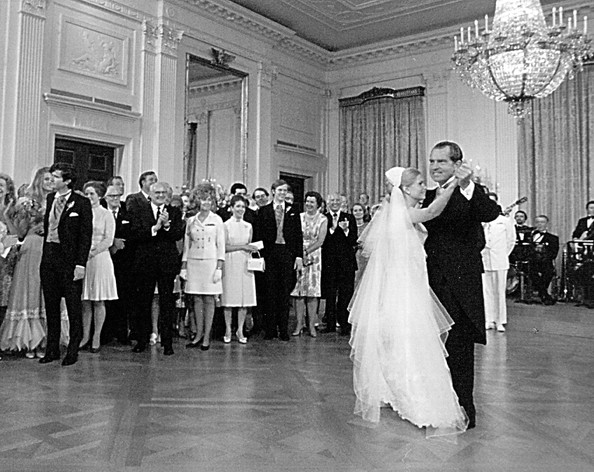
Weddings are archaic and traditions are always slow to change.  There was a brief mini-bubble in the late 1960s/early 1970s when younger people married on mountaintops with an officiant sporting some beads and a ponytail.  But by the mid-1970s the Tricia Nixon wedding was back in style.  The shift in wedding style we are seeing today seems far more lasting.  By virtue of who is marrying, weddings are becoming more personal in design.  There will always be couples that prefer to follow a playbook (cue Wagner, Corinthians reading, candle lighting, receiving line, and we’re out.)  We will give these couples the benefit of the doubt and not suggest they haven’t thought a whit about their wedding, marriage or each other, we will instead call them traditionalists.  But they now seem to be in the minority.  Older couples (in this context “older” means 30+) have hopefully formed many friendships and important relationships throughout their lives.  Their wedding might reflect those in some way.  When different faiths and backgrounds merge, the results can be a beautiful integration of customs.

No one is forced to editorialize wedding traditions more than a couple of the same gender.  Who walks down the aisle?  Who sits where?  Who dances with whom?  The beauty of this process is that it often results in a “why in the world would we do THAT?” conversation.  A conversation that every couple should be having about every assumption at every juncture.  This all bodes quite well for the future.  More thoughtfulness is always a good thing.  Going through life attuned and conscious has a wonderful effect on the world.

As I sip my champagne, careful not to spill on my silk, I will toast to this ritual that by its definition is steeped in hope.  I will feel grateful for the opportunity to learn more about what makes the couple happy and how they feel about each other.  And I will dance, if not to actual music, than in my mind.  I will celebrate presence, consciousness, and of course, love.

 
2 Comments

Posted by on May 25, 2012 in Marriage/Wedding


Tags: , , , , , , , , ,

No Talking Please

There’s something odd about using the words “library” and “exposé” in the same sentence.  Libraries are by definition, quiet and often unassuming places.  Yet, the New York Public Library has found themselves in a bit of a pickle.  It seems that librarians have been given hush money.  No, seriously.  Librarians willing to leave their employee (during budget cuts of the past few years) were given severance if they signed a “no disparagement” agreement.  Forgetting for a moment that we are talking about a prestigious (and massive) institution dedicated to free access to information, wouldn’t you love to make people sign a no disparagement agreement?

Ex-partners, former friends, colleagues, family members, that stranger in the hotel bar?  They could all be forced to say only lovely things about you forever more.  We would become so adept at the no disparagement clause that we wouldn’t even need paperwork anymore, just a knowing look.  Picture cutting off someone in line or stealing his/her parking spot.  You’d simply glance at them and communicate; “When you talk about this, and you will, be kind.”

But back to paying off employees to keep their mouths shut.  There are scenarios when in fact this practice makes all the sense in the world.  You wouldn’t want people leaving certain government offices and blabbing.  It wouldn’t be sporting to leave an industry dependent upon patents and then go squeal.  The same is probably true in industries of money, such as investment banking.  Mum needs to be the word for the sake of fair-ish competition.  But when institutions of intellectual pursuit or information communication have hush clauses, well that might just be a horse of a different color.

The N.Y. Public Library has no competitor of which I’m aware.  Nor does the New York Times (which also uses hush clauses, but not for journalists.)  It seems likely that the motivation to hush former employees is that you are leery of what they may say about the institution.  NYPL is embarking on a renovation that has rankled some (they are transforming the landmark 42nd street research library into a circulation library; a rather dramatic turn of events.)  Hushing former employees in the midst of what could be a contentious business decision speaks to a certain whiff of insecurity.  At the very least, it’s not a wise public relations move.

There are no institutions, really, just people who work in them and make decisions on their behalf.  There are boards, there are patrons, but there is no great wizard.  Regular old mortals make decisions that collectively add up to the policy and mission of an institution.  Outsiders often, understandably, assume that cultural, education or other institutions of thinkology, are populated by the greatest minds our nation has to offer.  Those smarties are there.  They are.  But many times they are not the ones making the majority of the operational and administrative decisions.  Administrators are doing that.  Some of these people are very talented, some are very credentialed, some are even both, and some are neither.

This is not to suggest that anyone at the NYPL is less than stellar.  Not at all.  It is only to remind us that our nation’s greatest academies are only as good as we are.  Innovation is key to the sustainability of some of these institutions.  Leaders must be visionaries and smart, ethical and strong managers must surround them.  A charismatic leader must have people in their inner circle who will tell him/her when he/she is not wearing any clothes.  Hushing librarians (librarians!!!!) in the midst of a contentious building project is the ultimate naked man in the room.

 
Leave a comment

Posted by on May 24, 2012 in Cultural Critique


Tags: , , , ,

He Works Hard For The Money

It would appear that men are doing “women’s work.”  More men are cropping up in ‘pink collar’ jobs.  At first glance one could presume that traditionally ‘pink’ jobs (i.e., health care, home care, etc.) are a growing field and that is where the jobs are.  But a little more digging indicates that there is something larger afoot.

There was a time that the crassness of the business world or the filth of the industrial world was just too horrible for a women to endure.  If she were to work, it should be in jobs that weren’t too taxing to her delicate sensibilities (you know, like caring for people in the throws of debilitating disease.)  She should not have to dirty her hands in factories or investment banking, but instead stay unsullied wiping both ends of children.  Women had little choice but to flock to the pink ghetto, as that was often the only place hiring.  Monolithic institutions had distinct gender rules within.  In a high school, the principal would be a man, the nurse a woman, the lunch aide was female, the janitor male.  A few teachers would be male, after all someone needed to teach science and coach sport.  Hospitals were filled with men and women; in very specific roles: messy and personal was for women, highly technical or requiring heavy lifting went to men.

The bifurcation of our work world has had everything to do with sectors of work not being worthy of the special gifts and talents of men.  Is it that surprising that in the 21st century, men and women do not see their skills as tied to their gender?

For those bypassing higher education, the workplace landscape has changed.  Manufacturing jobs have slipped away and the service industry has grown.  This could explains the rise in male nursing and dental assistants.  But educated men are flocking to teaching.  They say they are more attracted to a satisfying profession (and clearly they define “satisfying” differently than their fathers and grandfathers did.)

How interesting these developments are.  Everything is cyclical, surely it is.  Every generation is convinced they are discovering the world anew or in touch with truths that eluded their parents.  No doubt there will be another swing in society soon.  However the reason that this particular development warrants notice is what it could mean for the work world.  For better or (and who are we kidding) WORSE, when men get involved voices are heard.  When a man does a job, it’s seen as being serious.  Consider funeral homes for a moment.  Is caring for and grooming of the dead somehow less delicate than caring for the small or infirmed?  Is arranging flowers and music, providing tissues and cooing over the bereaved a distinctly masculine trait?  Not in my experience.  Yet, the (traditionally male) profession is seen as not just respectable but admirable.

Male special skills and talents may not differ from those of women, but their power certainly does.  It’s absurd to pretend otherwise.  Having men in professions previously relegated to the pink ghetto will have a powerful ripple effect.

 
Leave a comment

Posted by on May 21, 2012 in Cultural Critique


Tags: , , , , , , , ,

Storefront Church – Review

The Atlantic Theatre has had a recent facelift.  And like a lot of us small unassuming people when having 8.5 million dollars at one’s disposal, they have rendered themselves unrecognizable.  There is a lobby now, and a box office, and that odd musty smell is gone, and that’s nice.  But the house now looks like every other house.  Gone are the oddly pitched bleacher seats, the modest stage and what made the space so unique; the public restroom in the wings.  The stage is now massive, there’s a fly (or perhaps two) and the seats are brand new and set somewhat below the apron.  It looks shiny and new, but it’s lacking in character.

Aptly, the new space is being christened with Storefront Church.  Written and directed by John Patrick Shanley’s, Storefront Church is the final installment in his “church and state” trilogy.  (The first two were Doubt and Defiance.)  Storefront Church would not be recognizable as part of this trilogy, except we are told that it is.  Doubt, about the Catholic Church, and Defiance about the military (both directed by Doug Hughes) were tightly told tales of imposing institutions.  It’s difficult to put the same dramatic significance upon banking.

The story is about faith and the mortgage business.  (That’s “AND” not “IN”) and is as creaky as it sounds.  Issuing a second mortgage to a poor risk doesn’t seem to have the same resonance as that of child molestation or the moralistic labyrinth of the military.  If we are to extrapolate the insidious racism at work in the refinance industry, why is the recipient of the second mortgage married to a white Jewish man?  That may be just too “riddle wrapped in an enigma” for me. The first act is at times a demonstration of the new technical toys at the theatre’s disposable.  The stage crew seemed to be on stage as much as the cast.  (Doubt and Defiance were simply staged powerful pieces.)  There are so many scene changes in the first act that whatever power was there, was part of what got swept up by the crew (I’m not kidding, they come out and sweep the stage while we watch.)  There are (massive) set changes twice, to stage soulful staring on a bench.  A song plays for each of these stareathons.  “Snow” falls for one of them, which may provide a nice wink for The Hunchback of Notre Dame riff, but is distracting as it keeps accidentally falling throughout the play.  (That’s not a technical problem, fake snow always does that.)  The Hunchback reference is interesting but is a bit belabored.  When the play opens on a bug-eyed droopy-lipped Reed Van Druyten (the stunning Zach Grenier) and Ethan Goldklang (the powerful Bob Dishy) is holding the book and talking about it; we get it.  There is one reference in Act II that should stay because it’s funny, but the others?  Well that’s why you shouldn’t necessarily direct your own new work.

Another director might not bring out the beauty that Mr Shanley does in his actors, but he might have also had a little heart-to-heart with the playwright.  The theme of the play is far too vague to burden it with superfluous scenes and lumbering set changes.  This becomes even clearer during Act II.  There are only two scenes and they are perfectly written.  They are clear, powerful, engaging and terribly moving.

The cast includes Tonya Pinkins who (much to the audience’s delight) sings a spiritual.  That voice!  Her role is not large, but she is absolutely delightful.  Giancarlo Esposito (Donaldo) and Ron Cephas Jones (Chester) are incredibly convincing as the Bronx Borough President and Pastor.  Their (lengthy) scene in the first act is clunky and far too esoteric, but they do a splendid job with it.  The wonderfully smarmy Jordan Lage (Tom) rounds out the cast.  You know Tom, you’ve worked with Tom, you want to hurt Tom.

Storefront Church is in previews and will be open June 11 – June 24.  If Act I can more resemble Act II this will be a stunning play.  As it is now, it should be seen for the performances.  It is rare to see a collection of seasoned actors like this in such an intimate space.

 
Leave a comment

Posted by on May 21, 2012 in Uncategorized


Tags: , , , , , , , , , ,

Peter And The Starcatcher – Review

Peter and the Starcatcher is the most innovative, rollicking, sophisticated, silly, magnificent new show to come along in a very long time.  A musical derivation of Peter Pan, this show simply soars.  This is not a musical in the traditional sense.  At most there are four songs, or songletttes.  However, it is the best orchestrated show you may ever see.  Musical punctuation is used at every turn and to great effect.

Before the house lights dim, the audience is tipped off to the treat in store.  The proscenium arch of the Brooks Atkinson Theatre is subtly, yet garishly festooned for the show.  Subtle, because the festooning is styled to blend into the theatre’s decor.  Garish, well because it is.  There are two musicians positioned in the boxes (left and right.) They are surrounded by percussion instruments of every variety (on the right) and keyboard, woodwind and magic soundboard (on the left.)  Yes, there are only two musicians, but they are live and in full view!  The other technical anomaly in play is the extremely judicious use of amplification. It is initially jarring, but the audience can in fact identify who is speaking by following the sound emanating from an actor’s mouth.

The play, by Rick Elice, is smart and funny and simply pun-tastic.  The dialogue is rapid paced and plentiful.  And smart.  Directed by Roger Rees and Alex Timbers, with movement by Steven Hoggett, the wonderful cast is in essence a dance ensemble.  The choreography of the show is simply staggering.  There are no dance numbers.  (A kick line performed by a shabby group of men dressed as mermaids, doesn’t count does it?)  The movement in this show creates a magical world.  Often with little more than a piece of string, artistic lighting (Jeff Croiter) and sound (Wayne Barker,) ideas become realized.  Look it’s a ship, it’s a mirror, it’s a cabin, it’s a crocodile.

Despite it’s brilliance in design, this show would falter without a first-rate cast.  The show teeters between slapstick and sincerity (in the best of ways) and in lesser hands, we would not see the extremes or worse, we would only see one extreme.  This cast works as a seasoned ensemble.  In a show as physical as this, a less unified cast could result in some injuries.  While without this ensemble, there might not be this show; there are two actors who must be singled out.  Celia Keenan-Bolger, who tore up the stage in City Center Encores! Merrily We Roll Along, is the glue that is Molly.  Playing a 13-year-old bright feminist child with a good sense of humor (think Hermione Granger with a playful side) Ms. Keenan-Bolger has us in the palm of her diminutive hand.  She stands her own even against the over-the-top (in the best of ways) Christian Borle as Black Stache.  Mr. Borle’s performance can best be described by picturing a reality in which Ray Bolger and a young Tim Curry could create a biological child together.  There are several extraordinary performances in this cast, but the roles of Molly and Black Stache are large and demanding and are served wonderfully by Mr. Borle and Ms. Keenan-Bolger.

This production is not cheap.  It takes money to make something look plausibly shabby.  But it is not excessive or lavish.  There are no hydraulics or pulleys, yet there is plenty of flying.  It takes buckets of creativity to do more with less than it does to throw money at things.  Until I saw this show, it did not occur to me that you could simulate a bird flying away with four rubber gloves.  I never would have imagined that simple pennants, presumably made of discarded bed sheets, could become a crocodile.  There are dozens of these tiny moments that came from enormous amounts of creativity.  These miniature moments, collectively add up to a Faberge Egg of theatre.  While this is not a children’s show per se, seeing it would be a gift to any child.  In a world where so much is made of so little, to see what little can be made with so much is a gift.

 
2 Comments

Posted by on May 18, 2012 in Uncategorized


Tags: , , , , , , , , , , , , ,