RSS

Progress=Death?

images1

A man was targeted and killed for being gay; in Greenwich Village this week. People are killed all the time of course. But targeting someone because of being gay in the geographical home of Northeast gay liberation is shocking. There will always be people who are threatened by others. But it does seem that anti-gay violence has increased in recent months. Yes, it could be that the stories make the mainstream airwaves now (versus barely a mention in years past.) But the past year’s crime statistics in New York City would suggest that is not the case. Hate crimes have gone up, and presumably some of that hatred is aimed at LGBT people. Why, 44 years (almost to the day) after Stonewall does this violence exist?

How others live their life is of little concern to most people. It is only when our lives (inner or outer) feel weakened or threatened that we pick our head up and look around. Our negative thoughts and feelings about strangers come from our sense of instability. If we are not happy with our lives or ourselves it is (briefly) satisfying to malign others. We can call it bullying or bashing; its genesis is the same, and there is nothing new about it. Bullying/bashing is almost always perpetuated on those who are perceived as weaker. There was a time that by virtue of their position in society and actual laws regarding their personal lives. LGBT people were frequently victimized. A person who may fear for his/her job, housing, family connections, makes an easy target. Bullies could lash out without much fear of repercussion. Who would press charges? Even if charged, would society care? No doubt there were people sitting at home thinking; ‘well if they knew he was gay he must have been doing something ‘gay’ at the time.’ And that, for many people in olden times, was upsetting.

But this is 2013. Studies (for the past decade or two) have consistently shown that younger people (college age) don’t view LGBT people as an anomaly. Many teens now publicly identify as LGBT, in numbers and manner that children of even the 1970s couldn’t have even dreamed. LGBT people are openly serving in politics and the military (both rather straight-laced professions.) With the exception of a religious institution (or the Boy Scouts) it’s difficult to conjure a profession that would (lawfully) oust an employee for identifying as LGBT. It happens, there’s no doubt, but it’s not routine and it’s certainly not legal. LGBT people are now represented in television and film as something other than the object of ridicule. This is no small thing, as there are many subgroups that are still considered an acceptable punch line by virtue of their appearance.

So how could there be violence towards a people who have made such significant strides? Could it be that it is because of those strides that we are seeing this abhorrent behavior? Can it be that individuals who feel dissatisfied with themselves and their lives are as antagonized by the belief that someone is ‘getting what’s mine’ as they were/are by those who are seemingly weaker? Are attacks on people who are finally getting what’s rightfully theirs (civil rights) inevitable? Is it an inherent part of the battle, these innocent casualties that occur as we get closer to victory? Must Freedom Riders always be sacrificed for freedom?
 
Leave a comment

Posted by on May 19, 2013 in Cultural Critique


Tags: , , , , , , , , , , , ,

Education By Degrees

college

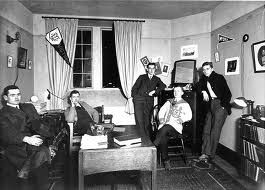
Higher education was once a luxury item for Americans. Families who had the means and/or men, who didn’t need to support their families of origin, went to college. There were no entrance exams or even much to speak of in the way of requirements. If you could find your way there, and were of the ‘right’ background, you could give it a go. There was no such thing as ‘student life’. Oh the students did live, but they did so under their own direction. Boarding houses, spare rooms, and inexpensive restaurants were the origin of the student life species. Slowly colleges and university became more accessible, less religious, and somewhat more diverse. The G.I. Bill may have been the greatest diversification of higher education. People (mostly men) from all backgrounds were now attending college for the first time. This phenomenon created an awareness and glimmer of opportunity for families across the country. College began to seem less of an elitist pursuit and more an intrinsic part of the American Dream.

Fast-forward and we are now experiencing the aftershock of a similar deluge of students. The baby boomers’ children attended college in large numbers. Colleges/universities competed for these tuition paying people by out positioning each other. Monies were spent to upgrade and to market a ‘student life’ experience that would appeal to a generation who lived larger than their ancestors. Concurrently, government spending in higher education ebbed and the stock market did that bad thing. Tuition and student debt rose. A few years before all this, employers began to view a baccalaureate degree as a minimum requirement for almost every job. At face value this would appear reactionary. Well of course a B.S. or B.A. is a requirement! Why wouldn’t it be? After all, everyone has one! But the truth is probably a bit more calculating than that. The fact is that as all this was happening in higher education, K-12 was changing as well. A high school diploma rarely delivers a workplace ready employee. A high school diploma was once an accomplishment in and of itself, and a ticket to secure employment. That 50% of incoming college freshman need remedial work, speaks to the state of a high school diploma. College work has not gotten more difficult, if anything there are curriculums so breezy they would make those boarding house dwellers of yesteryear spin in their graves.

Skyrocketing tuition plus the baccalaureate replacing a high school diploma as a requirement creates a perfect storm of sorts. We are beginning, and will continue to see the formation of two tracks of higher education. Some of us remember (or heard stories) of these tracks in K-12. Certainly we’ve heard of programs in foreign lands that still adhere to tracking. Students who were seen as being more practical than scholars, were steered into technical vocations. Those perceived as having scholarly potential were readied for higher education. There are many colleges across the country that cater to average students. (There is something to say for college being an experience for all learners.) Colleges, in these cases are charging and receiving extraordinary amounts of money to create workplace readiness. These colleges are private as well as public and diverse in their origins and how they deliver degrees. They are doing nothing but fulfilling a need and addressing a reality. Some of these schools have a great alumni network and/or stellar career placement. But what of those that don’t?

We’ve created a very expensive and time consuming way to obtain what we consider a minimum education. The ridiculousness of considering a baccalaureate a prerequisite for all kinds of work is equal to the state of many high school degrees. Public education should be producing young men and women who can write, speak, calculate and think. Colleges (with their enormous expense) should not be taking the place of K-12 public education. 50% of incoming freshman are paying (big bucks) to complete their high school education (via remedial work.) Employers need to rethink what skills are actually needed for each job. They need to beef up their Human Resources offices and return to placement testing. Certificate programs (offered in high schools or in community colleges) should be created in partnership with large-scale employers. It is simply not sustainable, this gerbil wheel we’ve created. There are young men and women spending years and money they may or may not have, because their public education is not all it should be and once was.

 
1 Comment

Posted by on May 17, 2013 in Education, Uncategorized


Tags: , , , , , , , , , , , , , , , ,

Mega Pixel Memories Of The Way We Were

Vatican_Pope_06523

Do you remember home movies? The old silent ones; with the children acting goofy for the camera and the mother shooing away the cameraman/husband. Even if you never saw one of these in real life you’ve seen them in film or television. One of the more lovely and touching is in the film Adam’s Rib; with Katherine Hepburn and Spencer Tracy frolicking around their farm. Knowing just a bit about the actors we feel as if we’re watching an actual home movie. Where have they gone these capsules of family life? One need only attend a child’s recital or traipse through Time Square to know that parents are recording every single moment. But then what? Does the family actually gather around the home screen and watch the footage? The same family who reportedly does not have time for family dinners? Somewhat doubtful, no? Are the moving images sent to family in distant places? Do the videos simply find a resting place on social media? And what of all the moving images taken of stationary objects? What happens to all that statue footage? Has the very act of capturing an event become the end point?

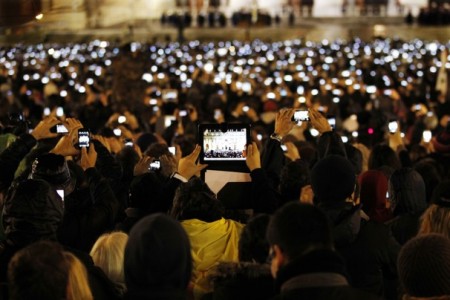
A cluster of people holding up their cellphones is now the universal sign of; “Everybody look what’s going down.” What’s going down could be celebrity in nature and a captured photo or moving image proves you were in proximity. Nowhere is this more evident than in large-scale events. Stadiums are filled with flashing (!) phones. It doesn’t matter that the photo will be so fuzzy as to always need a description attached. It is how we now record (in every way) an experience. It is somewhat reminiscent of tokens once collected; autographs, ticket stubs, crushed cocktail napkins and matchbooks. Scrapbooks, or for the less sentimental or organized, dresser drawers, were once filled with these reminders. One could look at a browned curled remnant of a corsage and conjure a magical evening. The rusty tetanus wielding protest pin reminds us of that chaotic, exhilarating march. A photo or video can evoke those memories as well. But sooner or later what we tend to remember is the photo or the video. Our own mental imagery fades as the recorded image stakes its claim.

And what of the recording? Is it possible to actually have any experience beyond that of cinematographer? Do we actually experience our child’s soccer game, dance performance, birthday party? Or are we simply recording it in the hope of ‘making memories’ for them? What does it mean to ‘make a memory’ and why would we pursue it? Memories are organic. A healthy brain remembers what is meaningful to the individual and (mercifully) often blocks what is too much to bear. The impulse to ‘create memories’ can be a bit creepy. A future memory is not only an oxymoron it’s an abstraction. Being consumed by an abstraction versus being present in the moment is not desirable. How people (including children) are experiencing something in the here and now is far more pressing than anything out in the ether. Being a recorder means disengagement. A court reporter is not participating in the proceedings or even processing any of the analysis. They are recording what others are experiencing (at lightening speed.) A photo or two doesn’t prevent engaging fully in an experience. But chances are a party of eight, photographing each and every course and individual serving doesn’t have the makings of a night to remember.

 
2 Comments

Posted by on May 15, 2013 in Cultural Critique


Tags: , , , , , , , , , , , , ,

The $10 Shirt

tribune-032611-1

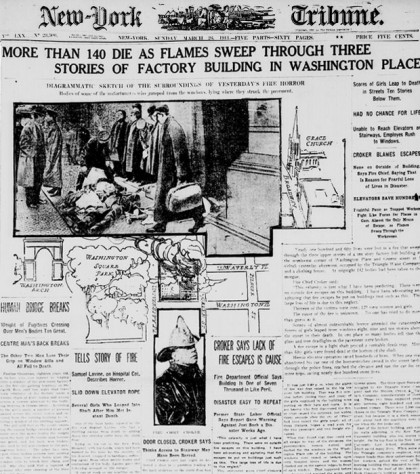
Terrible things have been happening in the garment industry. No, that is not a reference to the return of shoulder pads and high-waist pants. Factories have been collapsing and burning, trapping and killing workers. The most recent of these have been in Bangladesh; a manufacturing hub of preference for many mass-market retailers. The elements which render a locale to be a hub of preference are not surprising; lax regulations, lower wages equaling cheaper costs. Everyone knows this. Everyone has always known this. It’s why garment production moved overseas in recent decades.

Yet each time something dreadful comes to light we (momentarily) consider our $10 shirts. When it’s discovered that our chain store products are sewn/assembled by children, we shake our fists at the celebrity whose name is on the label. When a factory crumbles or erupts in flames, we are as intrigued by the labels left in the ruins as we are the rescue efforts. Perhaps we even sigh in relief upon learning that we don’t wear that particular $10 shirt. But who among us really knows the source of his/her inexpensive goods? Our linen closets, medicine cabinets and pantries are filled with products and packaging from around the globe. One would need to live the most self-sufficient and currency-free existence to never be in contact with something made under inhumane or dangerous circumstances.

There’s a faint buzz beginning about garment labeling. The comparison is being made to the ‘origin of food’ movement. The theory is that people care as deeply about the origin of their food as they do their clothes (and not in a ‘it’s from Paris’ kind of way.) Perhaps there is a similarity between concerns over food as there is clothing. There’s no doubt that there will always be people who care about the origin of their food and the friends the chicken had (before they stick their hand up its rear and remove its giblets.) But we’re talking about a rather privileged segment of the population. They either have the money or psychic bandwidth to perseverate over the ancestry of their produce. They may or may not also be people who purchase a $10 shirt.

Considering that every single garment sold in this country already has a label identifying its country of origin, it’s more likely that manufacturers/chain stores/brands will use a “cruelty free” label as a marketing device. Unless the brand shifts the cost of production (and the manufacturing of these new labels) the price of the goods will rise. It’s not guaranteed. A brand could lower, say employee benefits and maintain the $10 retail price. No matter how you slice it a $10 shirt in 2013 is a mirage. There is no way to manufacture, ship, and sell a shirt for $10, while paying a decent wage. Do any of us need a $10 shirt? Well, the truth of the matter is that yes, many people in this country need a $10 shirt. Could we buy fewer goods at a higher price? Probably, but the more we buy and the frequency of which we buy translates into jobs.

If (insert brand/shop/designer) wants to roll out a splashy marketing campaign about their cruelty-free manufacturing, that’s just fine. But in the end it’s a rather small segment of the population who has the luxury of money or shopping consciousness to respond. We’ve already seen this with designers who eschew fur or other animal products. Their line didn’t really transcend the niche market until they partnered with rock bottom priced chain stores. The animal-free garments might be manufactured with as much respect to human workers as the spared animals, but chances are that most of everything else in the mega-store might not be.

Cheap goods, food, and cars cost. They cost someone somewhere, sometimes with loss of jobs and towns and sometimes with loss of lives. This has been the case since the advent of the industrial age. A $1.00 hamburger and a $10.00 shirt have enormous job, health and economic consequences. They always have and they always will.

 
Leave a comment

Posted by on May 9, 2013 in Cultural Critique


Tags: , , , , , , , , ,

Integrating Sports

stickball

Organized sports have been in the news an awful lot lately, and not in a bowl/pennant/series kind of way. It’s been all about sex. Sexual orientation, sexual (mis)behavior, and gender orientation in team sports has been popping up like kernels in a Jiffy Pop. The accumulated effect of these pops is to force us to look at sports with fresh eyes. Why are teams gender-specific? Well, because (we sputter), because…men are biologically larger. Sometimes they are, and that is an ancient argument that we used to keep women out of the police force, the firehouse and the military.

If a standard of physical skill and strength is set for a team, why does it matter the gender of the player? Organized sports have never been so popular amongst children. Free-range play for every age of child has been replaced by team sports. During the K-12 years, boys and girls are often the same size, and in some cases the girls are bigger. There are unisex teams for children, but usually they only lasts until middle school. Most sports do not legally allow full body tackles. So if a girl/woman has an equal skill to that of a boy/man what is the issue exactly? Why are we hanging onto this gender specific paradigm? We let go of most gender specific curriculum years ago (show of hands for those who remember being tracked into sewing/cooking or mechanical drawing/shop.) The “Boys” and “Girls” engravings on old school doors while quaint are ignored. Title IX opened up an entire world of athletics to girls. And that was good. But it has been almost two generations since the initiation of that progress. Team sports have become as routine an endeavor for girls as ballet once was. So why aren’t boys and girls playing on the same team? Well, (ahem) what of the locker rooms, you ask?

Why in the world do we design locker rooms in which there is no privacy, particularly in schools? Is there ever a life stage more rife with body image issues?! Why do we subject any person to such a thing? Heterosexual, homosexual, pansexual, transgender; everyone deserves a little privacy. That aside, the short answer to the locker room question is; build locker rooms with private showers equipped with a small vestibules (with hooks and shelves.) Lockers can be in a communal setting and dressing/undressing can be done privately.

Any organization, which by definition is for only one segment of the population, cultivates a potentially unhealthy camaraderie. The less diverse a group the more myopic their orientation. A group can easily influence even the most open-minded individual, particularly when they’re coached that there is no “I” in team. It is in closed societies that we often find misdeeds towards others. Opening up the teams to any person with the skills/talents to play the sport will create a better environment for all.

As more young people openly identify as transgender and/or L(esbian),G(ay),B(isexual) we will be faced with privacy and equity issues. And this is good. When we change the way school athletics is handled we will (eventually) see the effect on professional sports. It took years of Title IX to get us to the WNBA, and we certainly have a ways to go in other sports. But it is progress, and that is good.

 
Leave a comment

Posted by on May 7, 2013 in Cultural Critique, Education


Tags: , , , , , , , , , , , , , ,