RSS

Category Archives: Uncategorized

Gentlemen Prefer Blondes – Review

NY City Center Encores! production of Gentlemen Prefer Blondes belongs to the Ensemble, and it’s in very good hands!  Rob Berman’s orchestra is superb and is neatly paired with Randy Skinner’s lush choreography.  This show is filled with dance and cast with actual dancers.  The chorus is actual singers as well.

There is a number towards the end of Act I, “In the Champ de Mars” when the chorus does not use body microphones.  They stand on the edge of the stage and sing out.  It is practically disorienting to hear sound and be able to locate its source.  These singers do not need amplification or tricks of any kind, they are the real thing.  If hearing truly talented singers unplugged isn’t enough to knock your socks off there are Attmore & Grimes.  Yowza.  This tap-dancing duo (in real life as well) perform “Mamie is Mimi” with Megan Skiro (a spit-fire dancer brimming with all kinds of personality.)  It has been a very (very) long time since I have seen this kind of dancing anywhere but in an old MGM movie.  Simply stunning.

While Gentlemen Prefer Blondes (Music: Jule Styne, Lyrics: Leo Rubin, Book: Anita Loos & Joseph Fields) is not the most riveting of musicals, director John Rando made much of it.  There is enough fun and powerful talent in this production that I found myself fantasizing of a dream team of Kristin Chenoweth and Laura Benanti as Lorelei and Dorothy.  Those roles are currently filled with Megan Hilty and Rachel York.  The audience loved them, and Mr. Rando predicted it.  Every number of Ms. Hilty’s was split into three parts, allowing the audience to applaud in triplicate.  Ms. York came in at the end of dance numbers to throw her arms up and receive applause.  I’m not sure Dorothy needs to be a dancer, so it’s best to keep her off the stage and allow the dancer’s their moment.  The audience was so enamored with Ms. Hilty that at one point they wildly applauded her dress.  Yet I found this duo unsettling.  Ms. York almost disappeared as Dorothy (when she wasn’t taking a bow.)  Ms. Hilty’s interpretation seemed more Betty Boop (with blond wig) than Lorelei.  When the second act opens, Dorothy and friend enter in red dresses.  The blond with her seemed so much more toned down than in Act I.  I let out a small sigh of relief.  Then I realized the blond was in fact Mrs. Spofford (Ella Rush) and not Lorelei.

See this show for the dancing and the incredible orchestra.  See this show to remember what songs sound like with out technical tricks.  See this show to experience an Overture and Entr’acte.  None of these elements should be taken for granted.  If you’ve ever experience a Broadway musical at which the conductor is waving his arms to an empty pit (the music being piped in from the basement and locales unknown) you know exactly what I mean.

 
Leave a comment

Posted by on May 10, 2012 in Uncategorized


Tags: , , , , , , , , , , , , , , , , , ,

The Columnist – Review

The Columnist, by David Auburn, is based upon the true story of Joseph Aslop.  The play, directed with breathtaking precision by Daniel Sullivan, spans approximately fifteen years (1954 – late 1960s.)  The storyline is tightly woven into the time periods.  We experience the cold war, the Kennedy administration and; (the elephant in the room) the Vietnam War.

There is a reason this period of time is often used as a backdrop; it is simply riveting.  Movies and television have played with the cultural and political extremes of the period.  There’s no “playing” in The Columnist.  This is a true story.  There seems to be many plays about real people that are little more than monologues impassionedly delivered to the balcony.  This is not one of those.  This is a well-crafted story with three-dimensional characters.  The play works so solidly that you needn’t know the people were real.  (Clearly many in the audience had no framework for “real” as the murmuring explanations of the Kennedy assassination would indicate.  Really?  How many times did the actors declare it was November 1963?!  What are they teaching in high school?)

John Lithgow is Joseph, perhaps it’s more accurate to write that “he plays Joseph” but to this viewer he was Joseph.  Mr. Lithgow is entirely comfortable in the skin of a man not entirely comfortable in his own skin.  Joseph is a popular columnist (syndicated in 190 newspapers – are there still 190 newspapers in this country?)  He is well-educated and talented conservative columnist with the ears of the nation’s leaders.  He also prefers the company of men, leading to a blackmailing incident that is a bit of a thread throughout the play.  Joseph does marry; a lovely widow and perfect hostess for his many parties; Susan (the dreamy Margaret Colin.)  Ms. Colin is almost unrecognizable as Susan, not physically; she’s as beautiful as ever.  She is every inch the Susan as Mr. Lithgow is Joseph.  Their family unit is rounded off by Joseph’s brother Stewart (Boyd Gaines) and Susan’s daughter Abigail (Grace Gummer.)

Mr. Gaines has a wonderful role in Stewart.  His interactions with David Halberstam (Stephen Kunken) allow us to see the wheels turning and the guards shifting.  Stewart, unlike his brother, relishes intimate connections.  (We suspect Joseph hosts Robert McNamara and Westmoreland partly to avoid personal dinner table chitchat.)  It is on Mr. Gaines’ face and in his posture that we see the weight of life’s events.  Ms. Gummer on the other hand becomes lighter and freer as she grows into a turbulent time.  She (brilliantly) evolves from a child to a woman.  Her relationship with Joseph creates some of the more joyous moments of the play.

There is a school of thought that cautions that it’s never good news for a play when it’s the set that is mentioned.  Rubbish.  The dramatic seamless transitions of time and space are intricately linked to the magic of John Lee Beatty.  “Seamless” is the operative term as so many shows introduce their lumbering sets with the sound of pulleys, wheels or grunting stagehands.  The Columnist set is brilliantly used to support the play and the actors.  The same is true for Rocco Disanti’s projection design.  A favorite moment is when the overhead typed words melted into falling snowflakes.

The Columnist is perfectly performed and produced (by Manhattan Theatre Club) and is a breath of fresh air in the “true politics and figures as characters” category of theatre.  The story is compelling and the tempo never falters.  The play does not however pack much of an emotional wallop.  There is a moment, delivered without any sentimentality by Ms. Gummer that creates a bit of a lump in the throat, reminding us of this absence.

The Columnist is at the Samuel J. Friedman Theatre until June 24th.

 
2 Comments

Posted by on May 9, 2012 in Uncategorized


Tags: , , , , , , , , , , , , , , , , , ,

The Lyons – Review

The Lyons is an incredible one-act play conjoined to an impaired second act.  Linda Lavin is simply magnificent as Rita Lyons, a woman (literally) waiting for her husband Ben (Dick Latessa) to die.  Some of the most riotous sidesplitting moments come from the sparring between the two.  Mr. Latessa is wonderfully cast and plays Ben with such candor and sensitivity.  Rita’s dialogue is peppered with such bon mots one can only wonder of the ruin in lesser hands.  But under Mark Brokaw’s direction, Ms. Lavin’s interpretation is simply perfect.  When a play seems to have such perfectly timed humor it’s difficult to review.  If the summary is completely accurate, readers will have a skewed expectation that the reviewer did not have.  How then do you communicate the sophistication and spot on accuracy of the very funny dialogue, without potentially disappointing an audience?  Well, once the curtain rose in the dainty Cort Theatre for the second act, that particular conundrum ebbed.

While Ben and Rita’s adult children (Curtis and Lisa) appear in the hospital room in the first act, their parents are still there to do the heavy lifting.  Curtis (Michael Esper) and Lisa (Katie Jennings Grant) are ‘adult children’ in the truest sense.  They have victimized themselves to the point of utter infantile dysfunction.  (No doubt much will be said about this play (by Nicky Silver) being about a dysfunctional family.  I did not see any signs of a family not interacting effectively.  The adult children have ruined their lives but that does not make the family itself dysfunctional.)  The actors are solid interpreters of very dull characters.  Both “children” are on the other side of 30.  Curtis is incapable of ever having a romantic relationships; ever.  He’s also never supported himself, but that’s almost beside the point.  Lisa is an alcoholic with a self-destructive streak to beat the band.  She seems to have some sort of savior impulse that does not extend to her family and does not seem to have an organic root.  Damaged characters can be interesting, (Ms. Lavin’s previous gig in Other Desert Cities proves that.) These two people are not an example of that particular genre.  Drawing them the way Mr. Silver has, does evoke a response in the audience.  But as it is frowned upon to get up on stage and perform a duo of “snap out of it” smacks, there’s no outlet for the frustration.

The second act opens with a scene in an empty (for sale) apartment.  It is a long awkward scene (following an intensely paced and hysterical first act) that takes far too long to make a minor point, which could have been made off-stage.  According to the Playbill, there is normally a scene preceding this scene; depicting Lisa at Alcoholic Anonymous.  Omitting entire scenes seems a radical move during previews, but no doubt it’s been done before.  In its place (it seems) is a walk-on by dead Ben.  Never a fan of the dead returning for an encore, I found this very jarring.  The Lyons is a starkly realistic play and there’s really no room for ghosts.

It is comforting that the final scene takes place in the hospital room of the first act.  We are reminded of the promise of that first hour.  It must be said that The Lyons has a very satisfying ending.  Surrounded by a different audience I might have actually leapt to my feet and whooped.  The fact that the second act is (currently) in such disarray, should not stand in the way of seeing this play.  Simply to see Linda Lavin and Dick Latessa spar and jar is worth the trip.  It is safe to say that no one will ever play this role like Ms. Lavin does.  She is simply remarkable.  There are beautiful moments and resonating truths throughout the play.  Quite frankly, The Lyons is like most of us; it could use a little improvement.

 
2 Comments

Posted by on April 12, 2012 in Uncategorized


Tags: , , , , , , , , , , ,

A Moon For The Misbegotten – Review

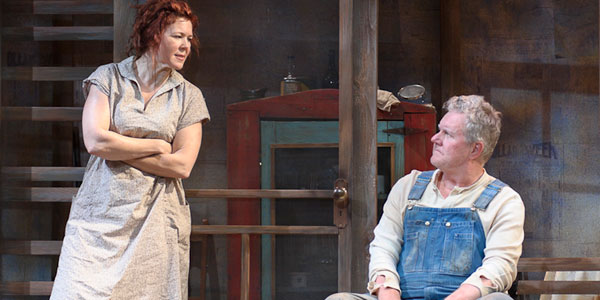
Having never seen Eugene O’Neill’s The Moon for the Misbegotten before, I should not feel as confident as I do asserting that the current production at The Pearl is a reinterpretation.  I don’t mean in a “let’s changed the ethnicity of the cast” or “let’s insert incongruous devices” or “let’s see how much technology we can use” kind of reinterpretation.  Instead I suspect that director J.R. Sullivan chose to tell the story in a new way through casting.  This (excellent) cast is both physically and spiritually slightly against type.

At first glimpse Josie (Kim Martin-Cotten) is a lumbering, smudged and bedraggled farmwoman.  She shifts her center of gravity down and splays her legs as she barrels across the stage.  But when she slows down and we get a good look, she’s quite lovely.  Perhaps, when this play was originally produced (1947) she might be considered a bigger woman, but by today’s standards she has an enviable figure.  Much of the play is centered around her insecurities in her appearance.  By casting a woman as classically pretty as Ms. Martin-Cotten this device seems quite modern.  Her struggle seems all the more real because of its psychological origins.

Her father Phil (Dan Daily) is a large barrel chested man who could be a distant relative to Alan Hale (Sr. or Jr.)  He has an affability that belies his lot in life.  We know from an early conversation between Josie and her fleeing brother Mike (Sean McNall) that daddy can be bombastic.  Dan Daily’s Phil seems more Captain Kangaroo than that which adds another layer of psychological realism.  The adult children experience him in a manner that is theirs alone.

Jame Tyrone Jr. (Andrew May) is Long Day’s Journey Into Night’s Jamie all grown up.  For anyone who’s ever wondered about the effects of addicts raising children, I give you Jimmy.  Mr. May plays Jimmy as a loving and softhearted man with a dark demon deep within.  He presents himself as so socially endearing that his excessive drinking is the only hint of what lies beneath.  Until the earth opens and swallows him.  This nuanced performance is so realistically accurate.  The tormented and deeply tortured rarely advertise their condition.

The theatre (City Center’s Stage 2) adds yet another key ingredient to this production.  A small thrust theatre, with the audience practically on the stage, sustains connectivity for the 3 1/2 hour(!) play.  There is much, of course, that is heart wrenching about this play, but there is much that is very very funny as well.  It is by nature a very heavy play but this production feels fresh and very relevant as well.  There was a girl of about 10, sitting next to me.  She sat stock-still and transfixed throughout the entire production.  As did I.

 
Leave a comment

Posted by on April 6, 2012 in Uncategorized


Tags: , , , , , , , ,

End Of The Rainbow – Review

The Belasco is an ornate wonder of a theatre.  The walls are covered in dark pastoral murals, the ceiling in stained glass coats of armor.  Carvings and drapery cover every other surface.  All of the lushness stands in somewhat stark contrast to the excruciatingly discomfort of the seats.  It’s as if the theatrical experience was forgotten in the act of creating the spectacle.  The Belascon’s current inhabitant; End of the Rainbow might well be suffering the same condition.

The play, by Peter Quilter captures the essence of the final months of Judy Garland’s life.  Quilter understands the contradictions and complications that were at work.  But directed by Terry Johnson, this production isn’t so much a play as it is a version of Beatlemania.  There is far too much tribute singing both in the recreation of the concert performances and (in a bizarre break in character) to stir a rousing ovation at the end of both acts.  Less singing might make this a more interesting play.  The problem however with knowing exactly how something ends is how then to make it dramatic.  Sometimes that can be accomplished with very fine acting.

Tom Pelphrey is spot on as Mickey Deans, Judy’s very young soon-to-be fifth (and last) husband.  Mr. Pelphrey has the unique ability to walk the tightrope between sinister and charm.  (Someday I hope to see him in How I Learned To Drive.)  Michael Cumpsty portrays Judy’s sometime accompanist, Anthony.  His is the most compelling and beautiful portrayal.  The only emotional resonance of the show comes from his two minute speech, downstage in a single spotlight.

Tracie Bennett doesn’t so much play Judy as she does impersonate Miss Garland.  It is terribly distracting to experience a full-length play built around an impersonator.  It is immaterial to assess whether someone is a good Judy Garland impersonator or not.  The fact remains that if anyone could even come close to the magic of the real Judy Garland, we would not still be talking about her (and her completely irrelevant fifth husband) 40+ years later.  Keeping that sad fact in mind, a performer is further ahead to take a page from Meryl Streep’s book, and capture the essence of an icon, not create a pale imitation.  It might sound like a minor issue, but the difference (to an audience) between acting and impersonation is tremendous.

The set of this production (William Dudley) is of the Ritz Hotel (London) and melds beautifully into the ornate theatre.  There is a very charming band set behind a scrim that is revealed to create the concert hall.  There is a bit of awkwardness with the transitions on stage.  A garment rack wheeled onto the stage to indicate a dressing room is silly and seems like a leftover device from a work shopped performance.

I was struck by some of the script’s painful yet accurate insights and think Mr. Quilter could have the makings of a gem, in the right hands.  However he probably needn’t bother.  In its current form, this show will be a huge success.  The audience went wild for Ms. Bennett’s rendition of one of Miss Garland’s worst performances on record.

 
Leave a comment

Posted by on April 5, 2012 in Uncategorized


Tags: , , , , , , , , ,