RSS

Category Archives: Uncategorized

We Live Here – Review

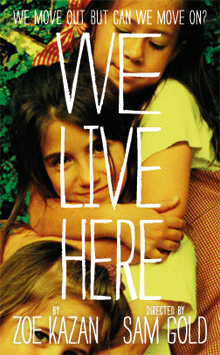
We Live Here, by Zoe Kazan (granddaughter of Elia,) and directed by Sam Gold is in previews at The Manhattan Theatre Club.  Set in a beautifully designed (John Lee Beatty) New England home on the eve of a wedding celebration, family secrets and raw anguish are revealed.

The play opens with the mother (an almost unrecognizable Amy Irving) opening her daughter Ali’s wedding gifts.  To save her the trouble.  A brittle, insecure, youngest daughter Dinah (Betty Gilpin, daughter of Jack Gilpin) arrives to almost zero acknowledgment by her mother.  Supposedly, mommy is simply overwhelmed by the details of the small family wedding.  The bride Ali (Jessica Collins) arrives with her fiance Sandy (Jeremy Shamos) whom the parents suspect is gay.  He enters carrying lilacs.  There is a marked tension and dislike between the sisters, who are 11 years apart.  Daddy (Mark Blum) beloved peacemaker and Greek philosopher, rounds out the family.

While still in the throws of awkward family reunion and meeting the fiance, young Dinah’s older boyfriend Daniel (Oscar Isaac) arrives.  He is not exactly every parent’s ideal.  Daniel is faculty at Julliard, where Dinah studies piano.  He is also the ex-boyfriend of Ali’s deceased twin sister.  Small town, that New York City, eh?  This stretch of realism in the plot is barely noticeable however.  There are much more gaping distractions on hand.

The first act is definitely the stronger of the two, but the script could use (more?) time in workshop.  While there are exquisitely crafted moments (due in large part to the brilliance of Mr. Gold) and very believable dynamics, there are equal amounts of misses.  There are very lofty writing aspirations at play (pun intended.)  Bobbing and weaving around the mythology of Adromeda, is not interesting.  It should either of been fleshed out or dropped as a theme.  (My vote is for “dropped” as it’s an odd device in a play about identical twins.) The backdrop of the wedding, while utilitarian, is flawed in its execution.  This is a family of New England intellectuals preparing for a small wedding.  They would not be engaged in (last minute) handwritten, place cards, (last minute) dress fittings, (last minute) slide shows.  Slide shows?  The fiance is a Guggenheim winning portrait artist.  Slide shows also don’t particularly jive with the mother (last minute) selecting which flowers (from their own garden) they will use for the wedding.  All of these silly incongruities would not be so distracting if it weren’t for the fact that they are a warning.  The number one rule for any writer (particularly one in their 20s) is “go with what you know.”  Throughout the play, we have the distinct feeling that the playwright is only in passing acquaintance with her characters.

Dinah’s anorexia is considered “cured” yet, her bridesmaid dress (purchased very recently) no longer fits.  She also does not eat.  Yet, she talks about her “recovery” in a very (unintentionally) fictionalized manner.  It’s very hard to believe much about her, when her most defining characteristic is unconvincing.  Is she or isn’t she?  It’s not that she doesn’t know, it’s that the playwright never decided.  We believe she would want to be invisible and therefore develop anorexia, but the psychosocial accuracy is missing.

We discover that Althea’s twin sister Adromeda killed herself (it was implied earlier) after Ali slept with Daniel (back in high school.)  The means not entirely justifying the ends for you?  Well, it seems that Andromeda had stopped taking her Lithium and had been locked in the piano room for days, and her parents chose this exact time to leave all the girls alone for the weekend.  Still not convinced?  Well, it seems the family KNEW she had stopped taking her Lithium, but were pleased she was writing music again, particularly in time for the college application process.  Okay, maybe they are crazy enough to have a slide show at a small family wedding.

To think that I had thought it irresponsible to send a daughter off to Julliard in the throws of an eating disorder.

A flashback is used to tell us Daniel and Ali slept together.  It wasn’t needed, but it did add a wonderful haunting element; having the relentless piano playing of Andi (behind closed doors.)  The flashback device is used as the transition for a tipsy Ali and Daniel getting on his motorcycle together.  The inevitable accident occurs.  Ali is only banged up, but (very briefly) noted is that the cellist Daniel, has seriously damaged his hand.  The moments after Ali is brought home from the hospital are almost unbearably sad.  The writing and acting of the parents is simply excruciating.  My heart just broke for them and their pain.  Sobbing and sniffling, I thought “yes!, go with what you know!”  Clearly Ms. Kazan, has a true gift, demonstrated by those real, raw moments on the stage.  What she and the play need(ed) was some serious work-shopping, and a merciless editor.  Why does the fiance travel (on the eve of his wedding!) with his easel and paints?  Why are gifts being sent to the parents when the couple already lives together?

The ending to this play with real potential, was very disappointing.  Sandy leaves Ali.  Maybe.  Why?  Because she slept with her sister’s boyfriend in high school?  Because she rode on a motorcycle with him?  It’s not clear.  Why is the last scene, the sisters snuggling together promising to be there for each other forever?  We never find out why they had such a distant relationship.  We never find out why the family treats Dinah’s musical gifts (Julliard!) as a whim.  As we wait on the edge of our seats for these illuminations, the play actually ends with the line; “Look the sun is rising.”  Sigh.

 
Leave a comment

Posted by on September 26, 2011 in Uncategorized


Tags: , , , , , , , , , , , , , , , , , ,

Romeo and Juliet – Review

I just love a theatre festival, a wonderful alchemy of “theatre” and of “festival.”  The most fabulous of these happenings occur somewhere that is lovely all on its own (ex.: Niagra on the Lake, the Berkshires, etc.)  Add to this an actual company of creative artists and a laid back simulated outdoor performance (note: I do not enjoy theatre in the actual outdoors as I find it inconducive to subtlety) and you have the making of a very special experience.  I have seen wonderful new works premiered at festivals as well as unique interpretations of traditional works.  Directors have more artistic leeway off of the great white way, and the audience is often the beneficiary of this freedom of expression.

Last night I was mesmerized by Daniela Varon’s (dir.) interpretation of Rome and Juliet at Shakespeare & Co. (Lenox, MA.)  I don’t know if I’ve every seen a fully staged professional live production of this work.  This would explain why, for the first 30 minutes or so, I kept thinking; “This Shakespeare fellow does a wonderful interpretation of West Side Story.”

A thrust stage and a balcony (not for what you would think) were used within an inch of their life.  Many of the younger characters wove in and around the audience at times.  This device was used lightly and brilliantly and never felt contrived or desperate (in that “stand-up comic using the audience for material way.”)  Set in a non-specific time, with no video, and very minimal audio, the audience was free to project their own framework onto the story.  The costumes aided in that they were predominately all white.  The white cotton costuming provided a perfect canvas for all of the bleeding as well.  There was a colossal burst of color and extraordinary costuming for the dance at the gym masquerade ball scene.

I am hesitant to single out any of the performances as there were so many riveting and enjoyable actors.  I do feel compelled to mention that I simply could not take my eyes off of Riff Mercutio.  He was very funny and physical and flat out magnetic.  Ms. Varon directed this R&J in such a fresh and exciting manner.  I had no idea this play could be so funny.  Yes, of course it’s tragic, but some of the dialogue is extremely amusing.  I particularly enjoyed directing Juliet (Susanna Millonzi) to periodically act just like a 14 year old!

Now dear reader, if you will permit me to get meta for a moment.  I have always been schooled to understand R&J as a tale of the ultimate tragedy of warring families.  Minimally, the play is a cautionary tale of why we should not try to keep our teenagers from dating those we find undesirable.  Well call me practical penguin, but I’m now thinking it is a cautionary tale about mis-communication.  Those kids didn’t die because their families didn’t get along.  They died because Doc the friar did not get the message to Romeo in time.

Oh, and in Romeo and Juliet?  Chino dies.

Note: I found it telling that there were at least a dozen children in the audience, some barely at the multiplication table age, who sat silent and spellbound throughout the three hours.

 
Leave a comment

Posted by on August 25, 2011 in Uncategorized


Tags: , , , , , , , ,

Follies – Review

 
I knew upon entering the utilitarian Marquis Theatre that my instincts were right about seeing FolliesThe theatre, located in a Las Vegas styled Marriott, is hardly known for its charm.  But there it was, draped in dingy, droopy, graying muslin.  The draping was so authentic, most did not know it was not part of the theatre.  The set, (Derek Mclane) so realistically evoked a decaying vaudeville theatre, that I knew attention had been paid.Now I must interject that the only Follies I have seen was an Encores! (staged concert) version.  I may not be the most reliable reporter of the event.  Follies, while not a hit when it opened in 1971, is a wonderful mix of poignancy, period styling, and Zigfield Follies/Busby Burkeley pageantry.  The songs (Stephen Sondheim,) you would recognize many, are gorgeous, and there is more than one show stopper.  Follies holds an additional, while rare, distinction; it is an incredible showcase for women of a certain age.The premise is a reunion of the Weissman Girls before the closing of a theatre.  The Weissman Follies spanned “the years between the world wars” and the reunion is set in 1971.  A younger cast is employed to evoke the performers past selves.  This would be when I start gushing about the costumes (Gregg Barnes.)  I was reminded of those scenes in The Women and That Touch of Mink.  You know, when the ladies sit in a comfortable seat and watch the fashion show while mentally choosing what they’ll buy?  The 1920s and 1930s costumes were dreamy, as were the 1971 gowns.  Mary Beth Peil (Women on the Verge, The Good Wife) was ravishing in a form fitting black stretch gown and cascading gray hair.   Elaine Paige was equally gorgeous on the other side of glamor in an electric blue satin gown trimmed in mink.  But enough about the clothes.  For now.What a cast!  The two couples at the center of the storyline; Buddy and Sally and Ben and Phyllis, are played respectively by; Danny Burstein, Bernadette Peters, Ron Raines and Jan Maxwell.  Danny Burstein is always fun to watch (if Bert Lahr and Wallace Shawn had a singing and dancing son it would be Danny Burstein) but he is far too young for this role.  The problem with a show about aging, and one that announces the characters age from time to time, is there is not a whole lot of wiggle room in chronologically blind casting.  Bernadette Peters suffers from this fallout as well.  At one point she declares herself “49” and there is sputtering in the audience.  I feel certain they meant no harm, it was just so outrageous.  Ron Raines is not served well by a declaration of his being “53” either.  Both Mr. Raines and Ms. Peters are in their 60s, a fact that is only highlighted by pairing them with Mr. Burstein, who is in his 40s.  Ms. Maxwell is probably the only principal who is the right age.  If one can suspend reality (which needs to include the premise that a 5’2” Ms Peters could ever be a show girl,) this whole thing should not be such a problem.  Although I find it interesting that during a time of such enormous weight given to appearances, that we choose to overlook the obvious for the slightly more subtle which is fame.This would be the time to shout a big hurrah, that Mr. Raines is on the Broadway stage.  He is a veteran concert and regional performer, and known to some for his daytime television work (Guiding Light.)  His voice is so old school rich and reverberating, it took my breath away.  He’s a bit easy on the eyes as well.  He was a delightful match for Ms. Maxwell, who tore the place up with her “Could I Leave You.”  The lack of chemistry between Mr. Raines and Ms. Peters was perfect for the story.  I know I am in a very small minority in never seeing Ms. Peters’ stage appeal.  I adored her in the Steve Martin films, but find her voice to be thin and nasally.  Her role is not huge, but I was left wondering how incredible it would have been to hear “Losing My Mind” sung by Tyne Daly.  I had little time to sulk, as I had the transcendental experience of hearing Miss Elaine Paige sing “I’m Still Here.”  I still have chills and a lump in my throat.  Now in between all these rich, gorgeous songs brimming with pathos, are some of the best performances you will see on stage.  “Who’s That Woman?” is a tap, chorus line, number performed by most of the women.  While most of the principal cast are not dancers, Terri White is.  She plays Stella Deems and tears up the stage in this number.  Holy moly!  (Ms. White may be familiar to readers of the New York Times.  She was profiled a couple of years ago while performing in Finian’s Rainbow.  At 60 years old she found herself homeless.)   Her performance needed an Encore desperately.  I would not be surprised if one is added (the show is currently in previews.)I suspect that this might not be the quintessential Follies.  My guess is that a more appropriate casting of Sally and Buddy would launch this production into the history books.  That said, it is without a doubt a must-see!

 
Leave a comment

Posted by on August 20, 2011 in Uncategorized


Tags: , , , , , , , , , , ,

Death Takes a Holiday – Review

In the hands of a deft director (Doug Hughes) skillful musicians and excellently cast actors, Death Takes a Holiday is a simply wonderful experience.  The new (Rondabout Theatre) musical is staged at the very compatible (425 seat) Laura Pels Theatre.  The intimacy of the theatre is perfectly suited to this delicate production.  The set (Derek McLane) is rather reminiscent of the recent revival of Ragtime, which ostensibly was a concert version of the musical.  (I was not surprised to learn that Mr. McLane did in fact design Ragtime.)  I am left with a bit of a chicken and egg question in wondering if Mr. McLane was hired to lend an air of a staged concert to this production, or if this production feels like a staged concert due to the set.  Regardless, the device works.  The orchestra(-lette) is set behind a scrim in the fly.  While it is always nice to see the musicians (no matter how few there are) the upstage fly is the perfect placement in this theatre.  With the (diminutive) orchestra upstage, the actors should be perfectly comfortable without microphones in a theatre this size.  But alas, no.  More than once I was reminded of the Lena Lamont mishaps in Singin’ in the RainPerhaps taping the body mic to the forehead rather than the side of the face, would help?  Perhaps it is time I simply gave up this cause?

Even with the excessive amplification, there is a lovely old fashioned quality to this musical.  I am a huge fan of simplicity and a City Center Encores devotee.  I am not bothered in the least by the lack of dance in this musical.  I suspect some ticket holders might be disappointed, but I am of the “less is more” and “if you can’t do it well, don’t bother” school.  I’d much rather see a lovely performance of honest portrayal than a casserole of all things to all people. 

The book, by Peter Stone (1776, Titanic) does not alter the original storyline or add superfluous sidelines.  (There were two incongruent attempts at lewdness with which Mr. Stone should not have sullied himself.)  In the film to musical genre, it is as straightforward (in the very best sense) as The Light in the Piazza was/is.  Maury Yeston (Titanic, Nine, Grand Hotel) wrote the lyrics and music, and clearly is also no stranger to the movie – musical genre.   There are a few absolutely delicately pretty songs in the show.  Nothing one would necessarily hum, but quite nice.  I did have an issue with the scoring of the music.  Many of the numbers are written in a far too expansive range.  Nothing would have been lost by bringing down the excessive high notes.  The actors, rarely hit them, and when they did it was with effort and flop sweat.  It was distracting to the audience and made me wonder what was motivating Mr. Yeston.  The best musical numbers are those with the household staff.  Their humor and vocal prowess were an absolute delight.  There is also a number, performed sitting on the apron, by the three youngest female characters, that is very memorable.  The three part harmony is splendid.

The casting of this production seems to be a nod to the past as well.  There are boldfaced theatre names (Matt Cavenaugh and Rebecca Luker) but no US magazine veterans.  Mr. Cavenaugh’s role is tiny, which I found surprising, considering his recent lead roles (West Side Story, A Catered Affair.)  Ms. Luker’s role was much more significant.  Oh, to hear her sing!  Even in a mostly forgettable song.  Had it not been for her solo, I would have considered the entire cast all quite very good singers.  She transcended them all.

The performance I saw was the first in which the lead had dropped out.  He was the same actor who was a recent no-show for opening night.  The cause stated is laryngitis.  One has to wonder about the preparation younger actors are receiving.  More often than not, I have witnessed no-shows at matinees (and they are always the under 35 set,) leading me to wonder about their physical preparation for 8 shows a week.  I am also at a loss as to how an amplified, rather subdued score (it’s no Phantom!) can be so straining.  I do not wish to sound unsympathetic.  Truly.  I simply wonder if more is owed this generation of performers.

Digression aside, I thoroughly enjoyed this show.  Even without an overture, I knew in the first 5 minutes that it was going to be a good time.  I love seeing new things, and what a joy to see something lovely and devoid of gimmick.  There were no mindless repetitive thumping bass lines, no screaming lyrics and no sound effects.  There were instead; honest portrayals of human beings, with a score that continually worked to move the story along.  Much is made of bright and shiny these days.  Even more is made of everyone’s 15 minutes and spotlights.  We are often in pursuit of perfection, in material objects, in others, etc.  In musical theatre there is an embarrassment of perfectionBut for every Gypsy or Showboat, there is a Starlight Express, and in between, there is a whole lot of real estate.  I am very happy to live in the neighborhood of Death Takes a Holiday.

 
Leave a comment

Posted by on August 20, 2011 in Uncategorized


Tags: , , , , , , , ,

Unnatural Acts – Review

I have been meaning to see The Classic Stage Company’s production of Unnatural Acts, (based on the true story of Harvard University’s persecution of homosexual students) since the play opened.  That I chose to see it on the eve of New York State issuing the first marriage licenses to gay couples, is somewhat poetic.

Unnatural Acts takes place at Harvard University in 1920.  It is based on actual records which were uncovered at the end of 2002 by a Harvard student.  The records, of a tribunal and subsequent persecution of 38 students, is compelling for its layers of inhumanity.  The university’s rather flaccid response and comment to the discovery of the records, only compound the impact of the story.

The play was conceived by its director, Tony Speciale and written by the members of the Plastic Theatre (who comprise most of the cast.)  This is a true ensemble piece as demonstrated by the absolute fluidity of story, staging and character.  The actors are so perfectly cast as their characters, it is difficult to imagine anyone else embodying the roles.  The thrust stage transforms into various Harvard locales, and once, through a genius use of lights above the fly, a train station.  The story is told in a riveting dramatic manner, never resorting to sentiment.  From the moment the stage lights come up, we know it is 1920 and can feel all that that implies.   We watch the young men perform their toilette while discussing their friend’s recent death (he was found dressed in a suit, in his childhood bedroom, gassed to death.)  Their varying reactions and relationship to one another tells us so very much about the pressure to conform.  The subtlety in the layers of social class in the ivy league setting are timeless and lend a very modern feel to this very period piece (the actors even have 1920’s haircuts.)

So much could be said about the story itself, about the implications of institutionalized bigotry and the absence of reparation.  However, space and attention span, sway me to discuss the production itself.  Unnatural Acts is the closest thing to a musical, without music, you will ever see.  Exquisitely choreographed, the actors are positively fluid.  The second scene actually has 8 men on stage moving in slow motion at a party.  Couples transition into real time as we hear their conversation.  It is a real party, but slowed down.  Every detail and facial nuance is entirely authentic.  Every piece of this production is up to the scrutiny of slow motion.  Even set changes are beautiful to watch. 

The final scene is the most musical of them all.  I was reminded of the power of Bill T. Jones’ Spring Awakening classroom scene.  The sounds and movement were so incredibly powerful.  I regretted sitting in the first row of a thrust theatre, as there really is no way to hide the hiccuping sobs.

I simply cannot remember having seen something this flawless and powerful.  This play has been extended (for the third time) only through July 31st.  I urge you to have this experience.

 
Leave a comment

Posted by on August 20, 2011 in Uncategorized


Tags: , , , , , ,