RSS

Category Archives: Media/Marketing

U.(nidentified)F.(acebook)O.(bjections)

How many times have you read “Facebook” and “privacy” in the same sentence?  It’s not just me, right?  So what exactly is stoking this anxiety?

For decades, I have been bristling (and acquiescing) to being asked for personal information at every turn.  Doctor’s offices, insurance companies, banks, jobs; you name it.  They all want one thing from me; my personal information.  Identifying numbers and dates have been flying around unprotected forever.  There was a time when college identification cards were emblazoned with the student’s social security number.  Personal checks often had the account holder’s driver’s license number printed on the front (to avoid that pesky step of a cashier copying down a customer’s most identifying number at each purchase.)  It was routine in many high schools and colleges to post test results in hallways with “only” the identifier of a social security number.

So what is it exactly that makes some people feel stalked by Facebook?  To establish an account you need to provide a name and an email.  That’s about it.  There’s no financial information and certainly no call for any identifying numbers.  You may choose to provide your birth date, but you needn’t.  I can only assume (and yes I am aware of how dangerous that can be) that the perceived invasion of privacy centers around the actual behavior while on Facebook.  All those “Like” buttons and photo sharing may result in some huge database of T.M.I.?  And then what?  Since data collection (of such mundane points) could only be useful from a marketing standpoint, is it a fear of adverts?  I don’t know about anyone else, but my (real) mailbox and email inbox have been brimming with adverts (tailored just for me!) for about twenty years.  My reactions range from annoyance, to hurt pride (“really, teeth whitening offers?”) to grabbing my coat and going shopping (hey, sometimes they do get it just right.)

To be clear, I am not a lover of pop-up ads or commercials (shout out for the DVR, you beautiful little genius, you!!) but like death and taxes, they’re going to happen no matter what.  Close the pop-up box, delete the message, avert your eyes.  Facebook is free, and free costs.  Think of the adverts as a pledge drive.

But then again, we know what happens when one assumes.

 
2 Comments

Posted by on February 5, 2012 in Media/Marketing


Tags: , , , , ,

We’ll Always Be Bosom Buddies

“Make new friends but keep the old, some are silver and the others gold.”  Did you sing this in music class too?  No doubt my little girl hand clutched my bestest (at that moment) friend’s hand, as we sang with all our might.  Once we enter the “adolescent years” friendships explode and burn like Jiffy Pop kernels.  Alliances and stand-offs occur at every turn.

But then things (hopefully) normalize as we get older.  We travel through adult life wearing many more hats than we did as students.  We are workers, alumni, community members, spouses and parents.  As we take new jobs or join new gyms, we shyly look for people with whom we might click.  It’s exciting to discover a kindred spirit, particularly as we become even more individually defined.  (Let’s face it, it’s a lot easier to find a classmate who shares your obsession with Harriet the Spy and Kit Kat bars, than it is an adult with whom you care to have lunch.)  Sometimes a work friend is just that; someone with whom to share frustrations and gossip and maybe an occasional lunch.  On the rare occasion a friend discovered in the workplace shares your sensibilities throughout your life.  The same is true for friends found at the school gate, house of worship, or neighborhood.  If you are lucky, there will be people in your life who transcend place.

Something most of us could never have foreseen is the impact of social media.  The generation that created it could not even have predicted how it would impact those of us long passed paying off our student loans.  Why would they?  For them it was a great way to connect with age and class-mates.  For those of us of a certain age it means our past has found us.  On our own terms of course.  If someone would had told me, ten years ago, that I would be in touch with the girl who taught me fractions, well, I would have looked at them as I looked at her when she tried to explain the difference between fourths and fifths.  There are friends I have thought of throughout the years.  Some I even Googled periodically.  But today, through the magic of Facebook, like a good military commander, I can report that almost every person is accounted for.  Almost without exception, most are doing wonderfully in their lives, and that is a joy to know.  I have been reminded of the longevity of intellect and creativity.  That girl who was so quick and so funny?  She’s gotten even better.  The woman at work who had more style than should be allowed?  Nothing’s changed, and her daughter seems to have inherited it.

But what about all those found friends with whom a mutual interest in Wacky Packs, Dr. Pepper lip balm and the claymation of Mr. Bill, were the ties that bind?  Is there much to discuss (on Facebook or in person) beyond, “Hey, there you are!”  After a few awkward versions of “So, you’re like a grown-up now” is there anything left to say?  Any connecting points whatsoever?  What if it’s worse than that?  What if through the public broadcasting of Facebook you discover your schoolyard chum is a bigot or invokes the name of their favorite deity far more frequently than your comfort level allows?  What if they post photos of babies dressed as flowers or puppies playing football?  Is the fact that you grew up within a mile of each other enough to sustain a friendship, even one in the virtual world?  For better or worse, “unsubscribe” is as effective as not returning calls.  I am almost never a fan of letting things go unsaid, but what is the point of a conversation that starts with; “I wish I never knew these things about you.”  Luckily those incidences are a just a tiny fraction of the larger friendship pie; their denominator being larger (see! I did catch on eventually.)  The vast majority of found friends are a gift I simply never could have foreseen.  It has created a fluidity and continuity of life for which I am so grateful.  When the very best part of your past can be part of your present; well, what a wonderful world it is.

 
5 Comments

Posted by on February 2, 2012 in Cultural Critique, Media/Marketing


Tags: , , , , , ,

Wessonality

I hear that taxi receipts are going to be emblazoned with advertising soon.  In theory, that passes the laugh test, no?  For anyone who has ever been handed a mangled 2-inch receipt with blurry ink, it sounds ridiculous.  Unless it’s an ad for a better receipt mechanism, we might want to rethink this initiative.

Advertisers for the most part are hitting the right note in placement.  The industry has matured and is adept at following (and even predicting) trends.  Traditional platforms are still in the game, but new media has prompted creative delivery initiatives.  With our hand-held devices, web-based platforms and the like, we are bombarded with new forms of ads.  Only the most rural of us leave our homes without entering a technicolor world of advertising.  Those taxis about to get the smudgy receipt ads?  Most of their roofs are festooned with a large (illuminated) table tent of an ad.  Almost all cabs now have advertising (posing as network news) playing on a monitor in the backseat.  There really isn’t much to malign about the ubiquity of advertising.  If it hurts anyone, it’s the product/client not the user/consumer.  How in the world do you make yourself heard above all that noise?

One of the oldest ways to get noticed is celebrity endorsement.  Since there were celebrities there was celebrity endorsement.  If anyone had thought to market apples, I’m guessing they would have approached Eve.  Throughout the years most endorsements and advertisements have been quite obvious.  But what happens when advertising not only becomes more ubiquitous but more embedded?  What happens when a celebrity is famous for selling themselves as a brand (versus being a performer?)  There is a potential for conflict of interest as well consumer confusion.

Let us take a recent example of Paula Deen, a woman whose gimmick has been selling mayonnaise and butter laden dishes.  She is a southern woman who got her start making sandwiches for local workers.  With no culinary training but an innate understanding of showmanship, she is a perfect example of today’s celebrity brand.  She announced her (three year old) diabetes with her drug company endorsement in hand while declaring that her diet has nothing to do with her disease, thereby protecting her brand.  When asked on air if she was a paid spokesperson for the drug company she retorted; “I’m compensated just like you are.”  Well, not exactly.  The newsreader is being compensated by the network to do a good job for the network (and probably to cross promote the network’s other programming.)  Not many people watching the show think he is doing it for free.  The issue with not declaring (in a big black box) that “Miss Paula Deen is a paid spokesperson for this company” is that we are not the most educated of consumers. Sometimes public health has to trump capitalism.  Our country is just getting heavier.  Miss Deen has a loyal rural and southern following who may very well be suffering from diabetes themselves.  To hear a (very healthy looking) famous person declare that “diabetes has nothing to do with what you eat and if you take this lovely drug like I do there’s nothing to worry about,” is troubling.  Miss Deen is allowed to sell whatever she chooses, and the drug company is allowed to hire whomever it pleases.  Hence, the black box.  The drug company could also do themselves a big public relations favor by prefacing all their messaging with “maintaining a healthy weight is proven to have a positive impact on diabetes management.”

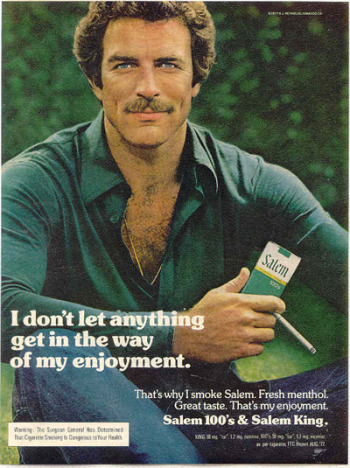
Users/consumers are becoming increasingly inundated with advertising, and may be a bit numb.  A million years ago, the novelty of Judy Garland selling Max Factor was so unique the consumer would think; “Look it’s Judy Garland selling Max Factor!” (and most fans knew that Max Factor was the make-up artist for the movie studios.)  Now that everyone is famous and ads are everywhere, being intuitively savvy is a challenge.  The harm is not to the product or advertisers but to the consumers.  Regulating advertising to protect consumers is not new.  You may remember when some paperback books had full-age cigarette advertisements.  Liquor and cigarette advertisements were once on television all the time.  Public health concerns change over time and in my estimation will always trump profit.  A simple black box hurts no one, not the product and not the paid spokesperson.  All it will do is remind the consumer that they are in fact experiencing an advertisement.

 
3 Comments

Posted by on January 20, 2012 in Cultural Critique, Media/Marketing


Tags: , , , , , , , , ,

Wired Act

The other day a tweet arrived asking followers how they cope with the stress of a wired world.  I believe that the word “stress” was suggesting negativity in this instance.  My reply suggested that my wires are not my strings.  I find my wired (or more accurately; my “wireless”) world to be quite liberating.  I can control my communications and information far more than I ever did or could in the past.

In olden times, if one wanted to exchange information or pleasantries with a friend (in real time) one had to place or receive a call while both people were at home and near a phone (phones were often stationary devices.)  Calls often went on for extended periods of time as call waiting was yet to be invented.  One could romanticize this phenomenon or point out how it eroded actual social experiences and rendered relationships to nothing more than disembodied voices squawking at each other.  The telephone heralded the end of social calls and meaningful discourse.  It was the Facebook of its time.

No doubt, print and newspapers heralded the end of the town square and civic discourse.  Fine.  Progress is change, and change is uncomfortable.  Do I bristle at having to learn yet another platform or version of what was working perfectly fine thank you very much?  Of course.  But suggesting that having more access to information and people is stressful?  Well, that’s just irritating.  We aren’t fitted with some sort of Woody Allen Sleeper helmet (yet.)  If it’s all too overwhelming, turn it off.  But to suggest that our (current) advances in technology are anything beside access to information or communication is just silly.  There is nothing to demonize here.  Facebook didn’t create bullies, nature created bullies.  Technology did not erode teenagers morality or their sense of self.  It just broadcasts it.

Are there one (or two) generations who have a radically different attention span than their elders?  Most definitely.  Imagine what the attention span was of a generation raised on horse and buggies?  Personally, I’m more concerned about a generation who ends every sentence with a question mark.

I credit the (current) state of technology with the connectivity I now enjoy with extended family.  Elementary school friends, I assumed I would never again see, are back in my orbit.  It is a very satisfying feeling this sense of the continuity of life.  In fact, it is the opposite of alienating.  Technology quenches my thirst for research (and by “research” I mostly mean; “where do I know that actor from?”)  While they will have to wrestle my actual newspaper from my cold (deceptively strong) hands, I love that I don’t have to wait until morning to know what is happening.  The curated news streaming on my twitter feed was once only available to diplomats and really wealthy people.

All of the (literal) bells and whistles are muted on my devices.  They exist to serve me.  They allow me to feel connected to the world.  And the torch wielding villagers are not going to convince me otherwise.

 
1 Comment

Posted by on January 7, 2012 in Media/Marketing


Tags: , , , , , ,

A Bully Plan

There is nothing good to say about bullying.  The very definition (picking on those weaker) is anathema to humanitarianism.  Exposing bad behavior is almost always a good thing.  However there is a fine line between discussing an issue responsibly and throwing a buzz word (in this case “bullying”) over everything.

Tossing buzz words around is irresponsible.  We saw this happen with the word “stress” about a decade or more ago.  Stress became synonymous with anxiety and is now only deemed as negative.  “I’m stressing” became an actual expression.  Between us, there is nothing negative about stress.  Positive excitement is stressful to the body and mind as well.  Is bullying ever good?  Certainly not to my mind.  But suggesting that an adolescent girl killed herself because of bullying…on Facebook, is absurd.  It diminishes her troubles and pain (whatever their genesis) and demonizes the abstract.  Suggesting that she was a victim of her computer and that her screen drove her to death is a wretched portrait to paint of a troubled teenager.  In fact, suggesting that anyone was driven to end their life due to bullying smacks of complacency.

No doubt, as adults we may not remember the turmoil of adolescence.  Everything was Very Important and permanent and fraught with drama.  Rarely were we our best selves.  Our identities only existed as they were reflected back to us by our cohort.  What an awful time it was.  Adolescents (particularly girls in the middle school years) can be pretty nasty as they claw their way to relevance. When we layer this anthropological phenomenon with the current social climate, things can get dire.

Most of us did not grow up in an age of digital cameras and instant (permanent) exposure.  We probably did not grow up in a world of celebrity (for no apparent reason) suggesting we should all live in the spotlight, behave badly, always be styled and airbrushed and party like it’s…you get the idea.  We probably didn’t grow up during a time when college was seen as a given, and the only path to income, yet was academically and financially unattainable to many.  Many of us did not grew up with parents simulating aircraft above our heads.  We were independent-ish and expected to manage our own social and even academic world.  (Note: personal responsibility is the key ingredient for self-esteem.)

Adolescence+increased external pressure+diminished internal resources can add up to a troubled teen.  Luckily, their world is populated by adults.  Teachers, nurses, administrators, coaches and guidance counselors see the good, the bad and the ugly.  Parents are in the best position to see the unhappiness in their child.  Many do and struggle with how best to care for their child.  Depression, either clinical or non-clinical sadness, is frightening in a population known for their lack of impulse control.  A teenager who has lost interest in pleasurable activities, and/or has changed his/her sleeping/eating patterns should be seen as in crisis.

Bullying can most certainly push a vulnerable teenager over the edge.  So can a bad grade or a romantic break-up.  However, when the media hauls out bullying experts our limited attention shifts to the external.  It is the at-risk adolescent that warrants the attention, not the behavior of others.  A healthy and supported teenager will not log on to Facebook if it brings unhappiness.  A healthy and supported adolescent, no matter how quirky, will not be driven to self-harm by the comments of others.  Bullying will always exist, empires were built on it.  Where we need to focus is on those adolescents who need support.

 
Leave a comment

Posted by on January 4, 2012 in Childhood, Media/Marketing


Tags: , , , , , ,