RSS

Category Archives: Cultural Critique

Hoarders

firehouse

Reality television is at best a cracked lens on society. The percentage of toddlers wearing hairpieces, spray tans, dentures, and artificial nails is in actuality quite small. Most women don’t call themselves housewives, implant faces and bodies beyond recognition and parent so abysmally. Whether the people who participate in these shows are mentally healthy or not is an interesting question. Voguing for a camera (and hoping to land fame, fortune and book deals) is not currently classified as a mental illness. For the official-certified-it’s listed in the DSM-V, display of mental illness you need to turn to the addiction sub-genre of reality show.

That there is an audience at all to watch people struggle with a mental illness is itself disturbing. But evidently there is, and the proof is the shows focusing on obesity, drug and alcohol addiction and hoarding. You’ll note that there are no shows about mental illness that have a less quantifiable or compelling visual behavior. There’s yet to be a “Watch The Narcissist” show, and to be fair it’s probably due to the redundancy factor. There’ll never be a “Depressed Divas” show as depressed people are never entertaining. A “BiPolar Bonanza” would demand a far too attentive director and shooting schedule (dammit his mood just shifted, where is the camera!) We, the audience, are not very interested in mental illness per se, what we like is wacky behavior. And if that behavior stems from a syndrome all the better. We love nothing more than hearing from a person with questionable credentials (‘therapist’ needs a modifier to mean anything) spout psychobabble about the behavior. The hoarding shows center around this very phenomenon. We see a ‘therapist’ gently talking the hoarder into parting with the petrified pet. In the next scene she actively listens to distraught and frustrated family members and explains ‘the process’ to them. We sit in our over-accessorized homes, eating chips and dip out of a chip and dip bowl, as we wear our ‘tv watching’ outfit and snort over the wasteful accumulation. “That’s f*&^ed up” we say as we accidentally tip over the tower of DVDs.

This interest in wacky behavior doesn’t just guide free cable programming decisions. It also seems to guide political policy and expenditure. There are currently 85 communities across this country that consider hoarding to be a serious public health hazard. Hoarding, of course is not necessarily a health hazard. No one has been physically harmed by a Madame Alexander doll or Thomas Kinkade collection. Possibly a more apt description for the kind of behavior with which the authorities are concerned is ‘filth’. There’s a method that’s been used since the dawn of filth for such scenarios; it’s called condemning. There are no soft-spoken ‘therapists’ or understanding fire chiefs necessary. If a home poses a genuine risk to the public, shut it down. Anything else is utterly disingenuous. Hoarding and living in filthy squalor is only the presenting behavior. There’s a reason people engage in barricade building. Convincing someone to part with a few carcasses and some urine soaked newspaper may make the helpers feel better, but dollars to dozens and dozens of donuts, that home is going to fill the hell up again. And why shouldn’t it?! What business is it of anyone’s how someone else chooses to live? This is when someone pipes up and says “It’s a public heath issue”. Is it? Not always. If the person lives rurally it’s not. If it really and truly is then shut it down. But wait, what’s to become of the hoarder? Well, if we really believe that the person is a danger to themselves and others (and if they’re not we have no business bothering them) than they need to live in a protected environment.

That homes are being cleaned out, very slowly and often at taxpayer expense, by community officials is troubling. On its surface it appears that we care about our most fragile neighbors. If that is even remotely true why aren’t the same resources being used to remodel shantytowns? Surely people living in doorways, under bridges and in tunnels are also worthy of a clean dwelling. It stands to reason that people living on the street, presumably without access to health care also pose a public health hazard. It is always better to err on the side of helping, but it is the responsibility of the strong to be clear about who exactly they are helping and why. Wrapping ourselves in rhetoric to impinge on someone’s autonomy is not helping anyone but ourselves.

 

Tags: , , , , , , , , , , , , , , , ,

Please (Don’t) Stand By

Unknown

An awful violent attack occurred in London yesterday. A soldier was massacred in a very public and calculated manner to make a political point. No doubt attacks with this level of brutality happen around the world all the time. But that it happened in London, a country not embroiled in a homeland war, captures attention. That the attack was structured and played out to garner as much social media attention as possible adds to the awareness. The men who hacked a soldier to death lingered at the site in an effort to broadcast their motive. Cell phone cameras and London’s extensive close-circuit televisions obliged the murderers.

Video captures what appears to be a street painted red, the murderers, with bright red hands holding cleavers, spew forth their message. The images will sear and scar. But there is something beyond the horror in the tableau. There is a woman, of a certain age, talking with a blood-covered man. She stands close enough to him (knifing distance if you will) to be in serious danger. He is still holding his cleavers as he tells her why they did what they did. Beyond them you can see clusters of people looking on and holding up their phones. But this woman stands alone with an attacker. Ingrid Loyau-Kennett had gotten off the bus hoping to aid the murdered soldier and found herself face to face with a murderer. She immediately set upon disrupting whatever he intended to do next and distracting him until help arrived. Later, when asked why she would put herself in such danger she seemed baffled. Why wouldn’t she do what she did? When a reporter insisted “But you could’ve been killed.” She replied; “Better me than a child.” There were no children in her care at the moment. She was in no immediate danger when she got off the bus. She could have kept walking, or stood on the sideline taking photos or video. Instead she inserted herself into clear and present danger because she felt it was the right thing to do.

It is a stunning thing to do and one most of us never would or could attempt; walking directly into the path of crazy and danger. How many times have we rationalized our way out of inserting ourselves into far less lethal circumstances? How many times have we seen an adult manhandle or berate a child, and kept walking? Have we passed a visibly confused or distraught person assuming someone else will help? If we live anywhere that’s inhabited with other people, we probably make these kinds of decisions weekly if not daily. And they are decisions. Walking past a person in need is no less a decision than approaching a blood soaked cleaver wielding murderer. Turn your phone camera on someone rather than lend a hand (or walk away) is a decision.

The brutal murder of an innocent person can never be justified or excused. But if we can look at the actions of Ms. Loyau-Kennett as a personal guiding light, we can make the world slightly better. We will never be rid of crazy or rage, or calculated killings, but we can care more. The next time we see a situation that catches our eye and creates an uneasy feeling in our stomach, we can ask ourselves what would Ms. Loyau-Kennet do?

 
Leave a comment

Posted by on May 24, 2013 in Cultural Critique


Tags: , , , , , ,

Progress=Death?

images1

A man was targeted and killed for being gay; in Greenwich Village this week. People are killed all the time of course. But targeting someone because of being gay in the geographical home of Northeast gay liberation is shocking. There will always be people who are threatened by others. But it does seem that anti-gay violence has increased in recent months. Yes, it could be that the stories make the mainstream airwaves now (versus barely a mention in years past.) But the past year’s crime statistics in New York City would suggest that is not the case. Hate crimes have gone up, and presumably some of that hatred is aimed at LGBT people. Why, 44 years (almost to the day) after Stonewall does this violence exist?

How others live their life is of little concern to most people. It is only when our lives (inner or outer) feel weakened or threatened that we pick our head up and look around. Our negative thoughts and feelings about strangers come from our sense of instability. If we are not happy with our lives or ourselves it is (briefly) satisfying to malign others. We can call it bullying or bashing; its genesis is the same, and there is nothing new about it. Bullying/bashing is almost always perpetuated on those who are perceived as weaker. There was a time that by virtue of their position in society and actual laws regarding their personal lives. LGBT people were frequently victimized. A person who may fear for his/her job, housing, family connections, makes an easy target. Bullies could lash out without much fear of repercussion. Who would press charges? Even if charged, would society care? No doubt there were people sitting at home thinking; ‘well if they knew he was gay he must have been doing something ‘gay’ at the time.’ And that, for many people in olden times, was upsetting.

But this is 2013. Studies (for the past decade or two) have consistently shown that younger people (college age) don’t view LGBT people as an anomaly. Many teens now publicly identify as LGBT, in numbers and manner that children of even the 1970s couldn’t have even dreamed. LGBT people are openly serving in politics and the military (both rather straight-laced professions.) With the exception of a religious institution (or the Boy Scouts) it’s difficult to conjure a profession that would (lawfully) oust an employee for identifying as LGBT. It happens, there’s no doubt, but it’s not routine and it’s certainly not legal. LGBT people are now represented in television and film as something other than the object of ridicule. This is no small thing, as there are many subgroups that are still considered an acceptable punch line by virtue of their appearance.

So how could there be violence towards a people who have made such significant strides? Could it be that it is because of those strides that we are seeing this abhorrent behavior? Can it be that individuals who feel dissatisfied with themselves and their lives are as antagonized by the belief that someone is ‘getting what’s mine’ as they were/are by those who are seemingly weaker? Are attacks on people who are finally getting what’s rightfully theirs (civil rights) inevitable? Is it an inherent part of the battle, these innocent casualties that occur as we get closer to victory? Must Freedom Riders always be sacrificed for freedom?

 
Leave a comment

Posted by on May 19, 2013 in Cultural Critique


Tags: , , , , , , , , , , , ,

Mega Pixel Memories Of The Way We Were

Vatican_Pope_06523

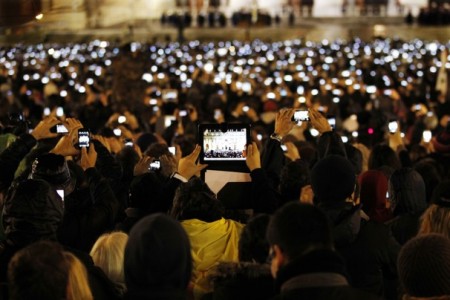
Do you remember home movies? The old silent ones; with the children acting goofy for the camera and the mother shooing away the cameraman/husband. Even if you never saw one of these in real life you’ve seen them in film or television. One of the more lovely and touching is in the film Adam’s Rib; with Katherine Hepburn and Spencer Tracy frolicking around their farm. Knowing just a bit about the actors we feel as if we’re watching an actual home movie. Where have they gone these capsules of family life? One need only attend a child’s recital or traipse through Time Square to know that parents are recording every single moment. But then what? Does the family actually gather around the home screen and watch the footage? The same family who reportedly does not have time for family dinners? Somewhat doubtful, no? Are the moving images sent to family in distant places? Do the videos simply find a resting place on social media? And what of all the moving images taken of stationary objects? What happens to all that statue footage? Has the very act of capturing an event become the end point?

A cluster of people holding up their cellphones is now the universal sign of; “Everybody look what’s going down.” What’s going down could be celebrity in nature and a captured photo or moving image proves you were in proximity. Nowhere is this more evident than in large-scale events. Stadiums are filled with flashing (!) phones. It doesn’t matter that the photo will be so fuzzy as to always need a description attached. It is how we now record (in every way) an experience. It is somewhat reminiscent of tokens once collected; autographs, ticket stubs, crushed cocktail napkins and matchbooks. Scrapbooks, or for the less sentimental or organized, dresser drawers, were once filled with these reminders. One could look at a browned curled remnant of a corsage and conjure a magical evening. The rusty tetanus wielding protest pin reminds us of that chaotic, exhilarating march. A photo or video can evoke those memories as well. But sooner or later what we tend to remember is the photo or the video. Our own mental imagery fades as the recorded image stakes its claim.

And what of the recording? Is it possible to actually have any experience beyond that of cinematographer? Do we actually experience our child’s soccer game, dance performance, birthday party? Or are we simply recording it in the hope of ‘making memories’ for them? What does it mean to ‘make a memory’ and why would we pursue it? Memories are organic. A healthy brain remembers what is meaningful to the individual and (mercifully) often blocks what is too much to bear. The impulse to ‘create memories’ can be a bit creepy. A future memory is not only an oxymoron it’s an abstraction. Being consumed by an abstraction versus being present in the moment is not desirable. How people (including children) are experiencing something in the here and now is far more pressing than anything out in the ether. Being a recorder means disengagement. A court reporter is not participating in the proceedings or even processing any of the analysis. They are recording what others are experiencing (at lightening speed.) A photo or two doesn’t prevent engaging fully in an experience. But chances are a party of eight, photographing each and every course and individual serving doesn’t have the makings of a night to remember.

 
2 Comments

Posted by on May 15, 2013 in Cultural Critique


Tags: , , , , , , , , , , , , ,

The $10 Shirt

tribune-032611-1

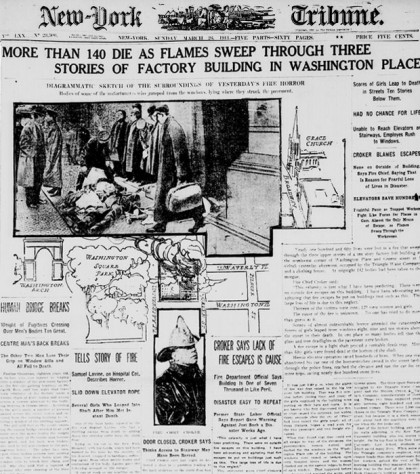
Terrible things have been happening in the garment industry. No, that is not a reference to the return of shoulder pads and high-waist pants. Factories have been collapsing and burning, trapping and killing workers. The most recent of these have been in Bangladesh; a manufacturing hub of preference for many mass-market retailers. The elements which render a locale to be a hub of preference are not surprising; lax regulations, lower wages equaling cheaper costs. Everyone knows this. Everyone has always known this. It’s why garment production moved overseas in recent decades.

Yet each time something dreadful comes to light we (momentarily) consider our $10 shirts. When it’s discovered that our chain store products are sewn/assembled by children, we shake our fists at the celebrity whose name is on the label. When a factory crumbles or erupts in flames, we are as intrigued by the labels left in the ruins as we are the rescue efforts. Perhaps we even sigh in relief upon learning that we don’t wear that particular $10 shirt. But who among us really knows the source of his/her inexpensive goods? Our linen closets, medicine cabinets and pantries are filled with products and packaging from around the globe. One would need to live the most self-sufficient and currency-free existence to never be in contact with something made under inhumane or dangerous circumstances.

There’s a faint buzz beginning about garment labeling. The comparison is being made to the ‘origin of food’ movement. The theory is that people care as deeply about the origin of their food as they do their clothes (and not in a ‘it’s from Paris’ kind of way.) Perhaps there is a similarity between concerns over food as there is clothing. There’s no doubt that there will always be people who care about the origin of their food and the friends the chicken had (before they stick their hand up its rear and remove its giblets.) But we’re talking about a rather privileged segment of the population. They either have the money or psychic bandwidth to perseverate over the ancestry of their produce. They may or may not also be people who purchase a $10 shirt.

Considering that every single garment sold in this country already has a label identifying its country of origin, it’s more likely that manufacturers/chain stores/brands will use a “cruelty free” label as a marketing device. Unless the brand shifts the cost of production (and the manufacturing of these new labels) the price of the goods will rise. It’s not guaranteed. A brand could lower, say employee benefits and maintain the $10 retail price. No matter how you slice it a $10 shirt in 2013 is a mirage. There is no way to manufacture, ship, and sell a shirt for $10, while paying a decent wage. Do any of us need a $10 shirt? Well, the truth of the matter is that yes, many people in this country need a $10 shirt. Could we buy fewer goods at a higher price? Probably, but the more we buy and the frequency of which we buy translates into jobs.

If (insert brand/shop/designer) wants to roll out a splashy marketing campaign about their cruelty-free manufacturing, that’s just fine. But in the end it’s a rather small segment of the population who has the luxury of money or shopping consciousness to respond. We’ve already seen this with designers who eschew fur or other animal products. Their line didn’t really transcend the niche market until they partnered with rock bottom priced chain stores. The animal-free garments might be manufactured with as much respect to human workers as the spared animals, but chances are that most of everything else in the mega-store might not be.

Cheap goods, food, and cars cost. They cost someone somewhere, sometimes with loss of jobs and towns and sometimes with loss of lives. This has been the case since the advent of the industrial age. A $1.00 hamburger and a $10.00 shirt have enormous job, health and economic consequences. They always have and they always will.

 
Leave a comment

Posted by on May 9, 2013 in Cultural Critique


Tags: , , , , , , , , ,