RSS

Category Archives: Cultural Critique

If You Can Make It There

gottadance

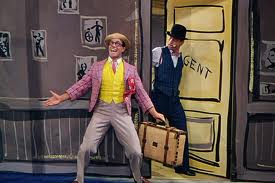
Dozens of wonderful movies have been made about making it in New York City. Heroes and heroines flock to the big city seeking understanding and/or excitement. Often they hail from small towns with nothing more than a suitcase and a dream. They emerge from buses and trains into a bustling mysterious brightly lit metropolis. They pound the pavement for a room and a job, knocking on countless slamming doors (a la Gene Kelly; Gotta Dance! Gotta Dance!) They find a room, perhaps even an efficiency or worldly roommate. They get a job and make it all work. They won’t quit ’til they’re a star!

Movies about the big adventure that is NYC aren’t really made anymore. NYC appears quite frequently in film but less as a place to conquer, and more as a posh playground. They still come from small towns and less glittery cities. But the heroes and heroines of today are more likely to find shelter in a 2,000 square foot loft than a room in a boarding house. Young women don’t share an “interview dress” but news of sample sales. And it’s been a few decades since a call girl found it entertaining to window shop at Tiffany. The scrappiness is gone. The roughing it and hard knock pursuit of a brand new start of it is a thing of the past; and for good reason.

You’d be hard pressed to find a legitimate boarding house in NYC. There are efficiency apartments still holding on, but they’re most decidedly not for out-of-towners. If there are buildings which house nothing but theatrical agents, even Gene Kelly wouldn’t be allowed past security. It’s a different city than it was 80, 70, or even 20 years ago. It is a town less about cab drivers answering back in language far from pure, than it is about gentility. Searching for grittiness can become a scavenger hunt. There is a gloss to the city that doesn’t sleep. Our heroines of yesteryear would not know what to make of bicycle paths, pedestrian malls, man-made beaches and midtown pop-up swimming pools (that are nothing more than oversized dumpsters). For the out-of-towner arriving to make their fame and fortune, these sights might be comforting and not the least surprising. Their perceptions of NYC, gleaned from television & film will be confirmed; it is a luxury cruise ship! The food is copious, the entertainment splashy and every need is easily fulfilled.

Of course there is still a grittiness to be found in the city, and there are still wonderfully diverse foods and entertainment. But it gets harder and harder to live an urban life beyond the homogenization. With each passing year the city becomes more a place for tourists and less for residents. People come from all over the world to see the prescribed sights. The intensity of the city and its lights might be exotic but the ads, retail and amenities are very familiar. A person could come to NYC; complete their tourist attraction checklist while eating, drinking and sleeping in very familiar places. But what of that young man or woman arriving with three bucks, two bags, one me? How do they find their way in a town priced at tourist levels, no longer as welcoming to the young yearning to be free? What does it mean to a city, and a world capital to no longer be the incubator of extraordinary young talent? The world will always welcome bankers and engineers, but what of artists?

NYC will never (willingly) go back to its hardscrabble ways. The tourism dollars are simply too good to turn down. But it is possible to recapture the opportunities and promise of the big city. Dotted throughout the island are examples of how. There is (at least) one subsidized residence for actors. There are small-business incubators supported by the city. There is even health insurance for freelancers. Gathering these meager resources and augmenting them to support artists and innovators would be a great legacy for a mayor. City sponsored art projects, theatres, and music would open the door for those Ruby Keelers and Gene Kellys and who knows whom else. The only way to ensure true diversity is to actively support success. It’s really up to you New York, New York.


 
Leave a comment

Posted by on August 4, 2013 in Cultural Critique


Tags: , , , , , , , , , , , , , , , , , , ,

Stuck In The Middle With You*

Unknown

We don’t like to discuss social class, period. Perhaps it’s a relic from our British independence. When Americans talk about class what we’re really talking about is money. We believe that if you have a place to live and that place is not a castle, you are middle-class. Everyone is middle-class; it’s like being above average. For some the designation is a badge of honor, for others it’s a disingenuous humility. Periodically an elected official or government agency will declare what the economic threshold is for middle-class. Sometimes they even include the ceiling on the perimeter. It really doesn’t matter as everyone wants to call themselves middle-class.

What we deign to call ourselves is hardly significant. Clearly it’s important to us, but doubtful that it’s important to anyone else. Introduce yourself at parties as a stay-at-home actress/scrapbooker/snackatarian and note how quickly the interviewer resumes talking about themselves. When classifications matter is when they’re used to make larger points or policy. By viewing economic class as an ideal rather than a reality we risk working against our own best interests. Recently we’ve begun to embrace discussing the economic upper-class; we now call them the 1%. But we still shy from identifying or discussing the working-class. During the most recent presidential election we used terms such as “working families” which is close, but mostly just conjures child labor. We also have started using the term “working-poor” which has more to do with a livable wage and full-time employment opportunities than an economic class. There are wage, tax, healthcare and many other public policies that potentially affect the working class more than any other group.

It’s not that surprising that we’ve evolved to this point. There was a time when we discussed class irrespective of income. People came from a working-class background, or they were middle or upper-class. However, we used the terms with hushed voices and a bit of self-consciousness. We are a culture obsessed with the outcomes of these delineations but hesitate to discuss the cause. We spend a great deal of time trying to make our country abide by social middle-class values but don’t label them as such. (Ironically the United Kingdom, the mother ship of the class system, views middle-class values as something to be avoided.) It’s interesting that in a society that enjoys talking about the melting pot, diversity and inclusion, we feel rather strongly that everyone should really embrace the same values. It’s why we all identify as middle-class. Americans are averse to the social class system (but we do obsess about the Royal family. It’s all so confusing this relationship we have with the homeland.) We see class not as static, as do our friends across the pond, but as something we transcend. We are a pull yourself up by the bootstrap kinda country. Where you’re born in not where you are to stay (unless it’s at the top.) Therefore when we talk about class we tinge it with aspiration. It’s like calling someone a “bride-to-be” or “rising senior.” It’s about where you’re going not where you are.

But what you call yourself and how you see yourself are two different things. How you identify, at a party or elsewhere, is immaterial, but it matters a great deal politically. Too many of us support candidates and parties who are most definitely working against our best interest because we want to identify with them. Some candidates intentionally make themselves very relatable to the working-class but are no friend to the policies that (disproportionally) affect the group. There is an old adage that you should dress for the job you want (not the one you have.) When it comes to voting; you should vote for where you are, not where you hope to be.

*Stealers Wheel (1972)

 
2 Comments

Posted by on August 2, 2013 in Cultural Critique


Tags: , , , , , , , , , , , ,

Eyes On The Prize

Joey

Most people don’t have lengthy attention spans or an endless capacity or thirst for data. There’s an awful lot of information to process on a daily if not momentary basis. So we can be forgiven for grasping at headlines as if they were articles (or “reading book reviews like they was books,” to quote Madame Rose.) Quite frankly a lot of what’s buzzing around us doesn’t warrant more than a cursory glance; quinoa’s in, bulgar’s out, cycling to nowhere is in, aerobics is out, and so on and so on. But then there are those big & important things that may be too large to ponder or tackle on a regular basis; issues that mercifully may not affect us on a daily basis.

Until your life and home are threatened by nature you might not get too riled about climate change. And even then, quite frankly, the most pressing (and perhaps only) issue is reclaiming your equilibrium. If you don’t experience prejudice and/or marginalization on any kind of regular basis you might not give biases all that much thought. When a story reaches media blitz proportion you may find more school gate/dinner party conversation about racism/sexism/bigotry than you would ordinarily. But when the headlines ebb and the talking heads shift their focus to another bright and shiny topic, the volume of those conversations probably lowers. It’s tempting (and completely understandable) to look at our biracial president, our recent strides in gay rights, and think “right, well I’m glad all that’s done with.” And that would be wrong.

There is far more danger in assuming things are okay and consequently turning our attention elsewhere than there is in not recognizing a social ill as a problem. Thirty or forty years ago mainstream America was (generally speaking) accepting that perceptions needed to change. In the 1970s civil rights began to find its mainstream footing. It no longer was acceptable to use certain words in public (at least in the Northeast.) This is hardly the hallmark of equality but it is a very strong indication of the public’s embarrassment at their overt bigotry. It would be another couple of decades before a similar semantics change occurred in regards to the gay community. One need only pour through some pop culture to confirm that “gay minstrel” was alive and well during the Reagan years. You’d be hard pressed in the 21st century to see African Americans or gay men and women as punchlines. Rest assure however, there are still plenty of ethnicities, religions and orientations that are ridiculed or “minstrelled”.

When it comes to the black or gay experience you might just think that all is mostly well. That is, if you weren’t affiliated with either of those groups. Most of us, no matter where our head is in proximity to our rear end, suspect that racism is alive and if not exactly well, at least on some form of life support. You can’t live anywhere (except perhaps off the grid) and not know (or at least suspect) that the color of one’s skin affects the perceptions of others. Simply turning on the television or picking up a magazine will confirm this. You may (that’s may) see male celebrities with a rich dark skin tone, but you rarely will see a woman with anything darker than a mocha skin tone. Pop culture may not be good for much, but it does paint a picture of our collective taste/desires.

You might also think that all is great on the gay front. People are marrying; coming out all over the place and letting kids know it gets better. But they’re also getting arrested in Louisiana for agreeing to have sex with undercover police officers. And the California federal appeals court is deciding if gays can be barred from a jury. This issue has come up because a drug company (defending a drug used in the treatment of AIDS) wanted to bar a juror who seemed gay. Clearly a gay man could not be neutral about drug companies, corruption, unethical medical practices or corporate greed. After all, are such “gay” issues. The assumption that a gay man (versus anyone with an ounce of compassion or a shred of decency) would feel strongly about AIDS and our storied history with the disease is absurd. But there you have it. Our legal system (that system we rely upon more and more to make very important decisions for our society) can view people as nothing more than their most visible characteristic.

We have come a long way baby, no one can reasonably argue that. But there is a danger in letting our guard down now. Things have changed enough on the surface that we can slip into a complacency that hinders progress and may in fact turn time back. We are so close to what we can be. Just consider how far we’ve come in only forty+ years. In 1967 interracial marriage was so rare as to be the entire story line of a Spencer Tracy/Katharine Hepburn movie. It was a serious and moving message movie. There was a little bit of levity of course; like when the “Negro” groom offers proof of the naivety of the Caucasian bride: “she feels that all our children will be president of the United States!” A laugh line has become a wonderful reality. But we must be very careful to not see that and other equal rights strides as an end point. Our work is not done here.

 
Leave a comment

Posted by on July 30, 2013 in Cultural Critique


Tags: , , , , , , , , , , ,

Procreation Politics

womens-health

The news of the United States Senate discussing a limit on abortion is going to stir up conversation. By now we’re all pretty clear that some people do not approve of abortion. Those people should either never have one or never impregnate someone. Many other people consider it a choice with restrictions. Then there are others who don’t consider other people’s choices any of their business. In recent years any political discussion of abortion seems geared to appeasing a specific populace and there is usually a religious subtext.

However when discussing a term limit (in this case of 20 weeks gestation) it is a conversation about science and economics not about religion. Science is a wonderful thing and many of us owe a great deal to advances in medical research. Never before has the natal experience been so orchestrated and monitored. We now can manufacture zygotes that grow into fetuses that become babies. We can monitor and test for far more diseases and defects than we really care to consider. Many of these screenings occur at different stages in a pregnancy. Some maternal or fetal crises develop at any time (including into delivery.) It can be rather late in a pregnancy that an extreme fetal anomaly is detected. It is devastating news to receive and simply unthinkable that a woman would have no choice but to soldier on for perhaps five more months. With much of the fertility interventions we have now, multiples are not an unusual occurrence. Multiples always carry a higher risk both to the woman and the other fetuses. What happens when one fetus is threatening the life of the others in utero? How is the decision made to “protect the unborn” then made? It is also essential to keep in mind that a woman’s health can be jeopardized at any stage of a pregnancy.

If the health of the fetus or mother is not in jeopardy there are limited reasons a woman would seek an abortion after 20 weeks. Many of those reasons would cease to exist if we had safe, affordable, accessible abortions any and everywhere in this country. There will always be women who come to the decision later in the pregnancy (for varying reasons.) But for the most part, if abortion were as available as sonograms in this country, later abortions would be less of an issue. By making abortion accessible we’d also help to lower any stigma a woman might feel.

Having a later term abortion is never desirable for anyone involved. It involves a pregnancy that is visible, presumably a difficult decision process, and a more complicated procedure. You’d be hard pressed to find a woman making a casual decision about such a thing. That alone is reason enough for politicians to get over regulating women’s bodies and step up to improving women’s healthcare. It is outrageous that in the 21st century, people with resources can make (and shelve) all the zygotes they wish while people with limited resources must rely on the whims of their elected officials to control their procreation.

 
2 Comments

Posted by on July 28, 2013 in Cultural Critique


Tags: , , , , ,

Taking A Shot At Racism

Stop

Race matters. It always has and it always should. People have a great affection and interest in celebrating their race and/or ethnicity. Pretending that differences don’t exist is absurd and offensive. But attributing value according to race/ethnicity is abhorrent. We have a long history of doing this in this country and anyone thinking that it is only historic is kidding themselves (or lives under a rock); the shade of one’s skin and often the branch of one’s religion still dictates where you can go and how far. One need only look at celebrities for proof. While the music industry has always been more liberal in whom they will exalt, movies and television have not. Anglo features (particularly in women) are a prerequisite for stardom. Fundamentalist Christians are acceptable, but observant Jews or Muslims are best served to keep it on the down low. Scientologists of course are always welcome.

Hollywood is hardly a relevant sample set, but it is an indication of a nation’s preferences. We could easily get down into the weeds and point out to the lack of Asians in leading roles (or roles that don’t involve a lab or mathematical prowess.) But suffice it to say that we are a people a bit flummoxed. It’s difficult (if not impossible) to dictate mindset. We can certainly address behaviors and have done so forever. We can write Declarations, laws, and policies to control behaviors. But we can’t change how people think or feel. We also can’t ever know how people think and feel. We can know what they say (which may correlate to their feelings) and we can know what they do. The very thought of attempting to change how people think or feel is overwhelming and disheartening; it is the equivalent of digging in loose sand. We could be at it forever and never know if we’ve gotten anywhere. But we can look around and spot where we can make a quantifiable difference in behavior.

We know that African Americans are victims of violence at a much higher rate than any other group. According to the FBI, the homicide rate for “blacks” is three times what it is for “whites”. Of these homicides, 82% were shot and killed with guns. These are astronomical numbers and yet where is the outrage? When 20 children are gunned down in their rural school we are outraged (and send money.) Of the over 7,000 African Americans shot to death (in 2007) over 600 were under the age of 18. Yet we are relatively silent. Where are our community and national leaders on this subject? How is gun control not being framed as a race issue?

No matter how strongly one feels about gun rights, there is no disputing the numbers. Guns kill and disproportionately do so with African Americans. We have a society in which anyone can get their hands on a gun (and anyone really can) and we’ve enacted laws which allow for using them on people. Knowing people as we do, this is ludicrous. We will never entirely change how people think or feel but we can make it very hard for them to act on those feelings. It is intolerable that the NRA has more influence than the NAACP in this country. It is unacceptable for us to not demand real and meaningful change. All the grandstanding and tepid gun laws and initiatives are a slap in the face to those of us who fervently want to believe that all men are created equal.

 
1 Comment

Posted by on July 17, 2013 in Cultural Critique


Tags: , , , , , , , , , ,