RSS

Category Archives: Cultural Critique

Still Dreaming After All These Years

Getty Images

Fifty years is a long time; a very long time. A 50th anniversary is always worthy of commemoration, and naturally occurs within the framework of modernity. Fifty years ago, on an oppressively hot humid day on August 28th, 1963, hundreds of thousands of people marched for freedom and jobs in an event twenty years in the making. They came on buses, trains and on foot; slept wherever they could or perhaps not at all. They marched through the nation’s capital, towards the mall, not knowing what to expect or how things might end. It was a dangerous time for protestors and in Washington D.C.; imprisonment, beatings and even killings were (and continued) to occur. But they came in their finest, marching and standing in that unrelenting heat all day long.

Fifty years later, in 2013, it took days of events to commemorate all that occurred on that one day. A week’s worth of marches, demonstrations, speeches, and festivities culminated in an all-day rally on August 28th, 2013. Over five hours a schedule of military minute precision brought performers and speakers to the steps of the Lincoln Memorial. Early on the crowd (which stretched from monument to monument) was led by Andrew Young in; Woke Up This Morning With My Mind Stayed On Freedom. This set a communal tone for a crowd diverse in age, background and agenda. Another sing-along that either conjured strong memories or made one think of one’s parents, was Peter and Paul singing Blowin’ In The Wind. Anyone familiar with Peter (in particular, but also,) Paul and the late Mary won’t be surprised to learn that Trayvon Martin’s parents stood with the performers. Many who took the stage were living remembrances of the 1963 March. Representative John Lewis (the youngest speaker in 1963) invoked sentiments repeatedly echoed on the steps; “The scars and stains of racism still remain deeply embedded in American society, whether it is stop and frisk in New York or injustice in Trayvon Martin case in Florida, the mass incarceration of millions of Americans, immigrants hiding in fear in the shadow of our society, unemployment, homelessness, poverty, hunger or the renewed struggle for voting rights. So I say to each of us today, we must never, ever give up. We must, ever give in. We must keep the faith and keep our eyes on the prize.”

Two of Dr. King’s children spoke, but it was Christine King Farris, King’s older sister who surprised and moved the crowd. She referred to herself as perhaps not the oldest person present but certainly the only one who had known Dr. King since he was in diapers. She hadn’t been able to attend 50 years prior, due to a bad flu, but had watched her brother on television and knew something magical had happened. She spoke eloquently, powerfully and personally and the crowd felt they had been invited into the circle. Reverend Bernice King, clearly inheriting her father’s gift for oration, was inspiring; “We are still chained by economic disparities, class inequalities and conditions of poverty for many of God’s children in this nation and around the world. If we are going to continue the struggle for freedom and create true community, then we will have to be relentless in exposing, confronting and ridding ourselves of the mindset of pride, and greed, and selfishness, and hate, and lust, and fear, and idleness, and lack of purpose and lack of love as my brother said for our neighbor.” She ended her remarks at precisely 3:00 PM for the ringing of the bell. The bell, the crowd learned, was salvaged from the Birmingham Baptist Church, a reminder of the extraordinary sacrifices that led us to this day.

The most remarkable aspect of the day’s programming was that of having three United States Presidents on the agenda. Presidents Carter, Clinton and Obama were greeted like rock stars and did not disappoint. They paid homage to the work of Dr. King and the strides of the movement, but as one would expect from world leaders, they also carefully criticized complacency, or worse; backsliding. It is a difficult conundrum, complacency. While it is natural to be reactionary to policies and actions that are blatantly racist, it is challenging to keep the fire burning day to day. When we are no longer daily confronted with signs of “Whites Only” or bus and school segregation, our shoulders lower and we breathe easier. But, as the speakers reminded us throughout the day, there is so much left to do. Poverty, incarceration, immigration, voting rights and equality are very current issues. Progress has been made, but we are nowhere near the finish line.

It is so tempting to lose our focus, to give into distraction. In fifty years we’ve evolved into a nation of perpetual distraction and extroversion. Where the 1963 March was an open and accessible event, the 2013 event was constrained and produced for the media. Enormous television camera towers blocked the view for all but the “ticketed” attendees (an oddity juxtaposed to a day celebrating equality.) Celebrities with no obvious connection to the movement spoke and sang (or lip synched) for the cameras. Two dance groups (in very photogenic costume) performed, an odd artistic choice for any rally with limited views. The singers (except for Peter and Paul) sang gospel music, even though international (and even national) folk singers still abound today. But the 2013 event was packaged for viewers back home. That isn’t necessarily bad, it’s just different. As were the 20-somethings playing candy crush during the speakers, and the thousands of selfie pics being taken throughout the day. But amongst all that noise were young, middle-aged and 1963 alumni, riveted and moved. Heads bowed and bobbed, hands waved in solidarity and to this attendee it looked like hope.

 
Leave a comment

Posted by on August 29, 2013 in Cultural Critique


Tags: , , , , , , , , , , , , , , , , , , , , ,

Empty Nesting

nest

Empty nests aren’t what they used to be. In fact you might be hard pressed to find a nest with vacancies. This isn’t exactly news; we’ve been hearing about dismal job markets and diminished economic opportunities for young adults for quite some time now. It’s commonplace to hear of households that include adult children (and even their children.) What is rarely mentioned in these discussions is that it is often quite an agreeable arrangement. Modern parents and children (of all ages except perhaps peak adolescence) enjoy spending time together.

The generations share interests, activities and even clothing. They are often in constant communication and know a great deal about each other’s lives. In generations past this was rarely the case in traditional American families. A child had his/her circle of friends and interests and upon reaching adolescence rebelled against all that his/her parents represented. The politics, music and literature of the younger generation were unrecognizable to that of the older. The clothing, hairstyles and lingo were equally foreign and perhaps infuriating. Who would want to spend time with someone they couldn’t understand? An adolescent’s primary goal was to get out of the house and away from the hopelessly old-fashioned parents. College served that purpose well, as did first apartments (filled with like-aged and minded roommates.)

Something has happened in recent decades to blur the lines between the generations. The most intriguing aspect to the change is that it’s both the younger and older moving towards each other. If we were to jump in a jeep with our binoculars and pursue the average American nuclear family in their natural habitat, we would spot this morphing phenomenon. Parents and children (of all ages) look an awful lot alike. They dress alike, they groom alike, they text alike. The fact that this happens in public proves that everyone is okay with it. Daughters don’t mind (or perhaps even enjoy) their mothers appropriating their dark/cadaver like nail colors, sons enjoy/tolerate sharing their baseball caps with their fathers. From the back (if weight wasn’t a factor) you’d be hard pressed to determine which generation was which. It’s been a long time since we’ve witnessed a unified family look, in nature that is; it happens in Christmas cards all the time. Surely there’s a more recent example of this indistinguishable appearance; but it is Little House On The Prairie that comes to my mind.

If we were to hop out of the jeep and (lawfully) enter homes, we might discover that there is no “adult” space (formally known as the living room) and “child” space but instead “family” space. Unless a parent engages in a delicate or dangerous activity, there is probably no “off-limits” space within the home (for fun, check to see if there’s a lock on the parents’ bedroom.) The music, movies, social media, gadgets, and fitness regimes are most likely shared. This average family probably socializes together and often vacations together. They will attend all school and family events as a unit as well. To the novice jeep rider this may appear novel. But it is actually a very old phenomenon (see Little House reference.) Back when we were forging new territory and had little if any connections to the world, our nuclear family was our world. One’s fortunes and survival depended on the strength of the nuclear family.

It is slightly ironic that in an age of such instant and ubiquitous connectivity we revert back to an isolationist mode of living. But if we take a closer look (back in the jeep everyone) we will see that we are anything but connected to the larger world. When is the last time you had friends over for dinner? How often are you invited over for drinks? When was your last block party, potluck or open house? How many times a week, or even month, do you go out with friends (without children in tow?) How long have you been at your current job? Do you lunch or happy hour with your co-workers? How often do you attend religious or community events? Can you recall the last time you dropped by a friend’s home unannounced?

Some of our disconnection to the larger world is our own doing and choice, but some of it is not. A job isn’t life sentences any longer, nor is marriage. We move (by choice or not) and we start over. We lose contact and perhaps the confidence to make new contacts. We are so electronically plugged in that isolation can feel like a reprieve. Our work life is so heavily in favor of extroversion that off-hours cocooning is a sanity saver. The reasons we choose to enmesh with our nuclear family could be many. The affects are probably always the same; nests are less empty. What is indisputable is that if we stay in the jeep long enough (and refuel a few hundred times) we will see this phenomenon shift once again. In 25 years or so we will start hearing the ancient strains of; “What are you wearing?!” “Turn that noise down!” “That’s not a word!!!”

 
2 Comments

Posted by on August 23, 2013 in Childhood, Cultural Critique


Tags: , , , , , , , , , , , , ,

March On

bus

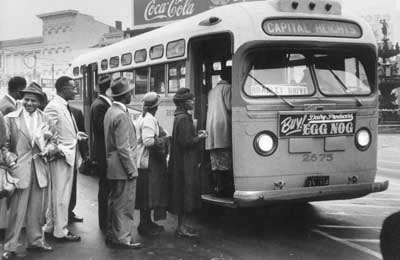
We are on the cusp of the 50th anniversary of the March On Washington. It is the most famous mass gathering to occur in our country. At least 200,000 people showed up to the National Mall on that late August day for a march in pursuit of equality and jobs. The march, twenty years in the making, came to life in 1963 (100 years after the signing of the Emancipation Proclamation.) People from all over the country heard about the march and found their way there. This was before cheap flights, social media and ubiquitous car ownership. It was also during a time in which travel could be challenging for people of color. They arrived, some traveling through the night or for days, anxious of what lay ahead. No one knew what exactly was in store and no doubt some concern for personal safety existed. Families, communities, church groups; people of all ages and colors took that leap of faith and participated in a peaceful day of inspiration and aspiration.

There were specific goals for the march including; job training, increase in the minimum wage, school desegregation, passage of a civil rights bill, and federal prohibition of discrimination. Many of the goals were realized, but what the march is remembered for is much more ethereal. People who were there, ordinarily perhaps quite eloquent, will grasp for words when trying to convey the feelings they had that day. Many of us listened to the iconic Dr. Martin Luther King Jr. I Have A Dream speech in school. The goose bumps and throat lumps hints to what being there must have been. To be standing amongst hundreds of thousands of people with a unified purpose is to be in a heightened state of humanness. To overcome the personal and join together for a higher purpose is one of the greatest gifts of life.

Those of us who weren’t there (or weren’t born yet) may never experience anything of that magnitude. But we too can pursue the power of the collective. We can seek to right wrongs by joining strangers to make some noise. The world and humans being what they are means that there will always be something worth fighting for. Those people climbing onto buses in the wee hours of the morning had no idea that they were making history. They simply wanted to join hands and march for the most basic of civil rights.

MS 2003-36  March on Washington Program - front

 
Leave a comment

Posted by on August 18, 2013 in Cultural Critique


Tags: , , , , , , , ,

Let The Games Begin

photo by Lefteris Pitarakis

photo by Lefteris Pitarakis

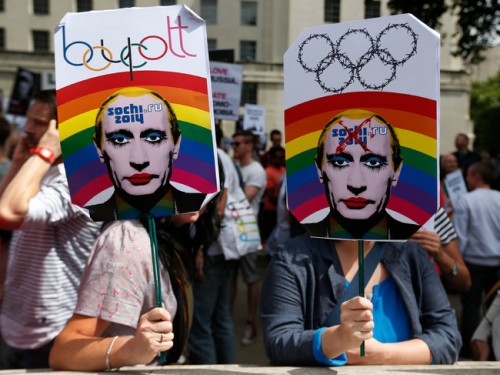
When people join forces & lift up their voices attention is often paid. The volume of the outcry has a direct correlation to the media coverage, and that is how it should be. For the past few weeks people have begun to rise up in response to Russia’s propaganda law (enacted in June 2013.) This law is meant to curb public talk of homosexuality. The fact that Russia has a propaganda law is not only not surprising, it almost seems intuitive; for those of us of a certain Boris and Natasha age. The other 50% of the population is a bit gob smacked, and why not? The last few years have been a freight train of gay rights momentum. We are living through one of the most radical civil and human rights transitions this country has ever had. It’s little wonder that we expect Russia to get on board.

The timing of all this is a delicious; direct to film, perfect storm of brouhaha. What exactly were the conversations Mr. Putin had with his advisors? “How do we put our Olympic hosting on the map? You know, Mr. Putin, the Queen parachuted into the London Olympic stadium. What can you do?” It’s a very odd choice to make for a country that repealed it’s law against “gay” sex in 1993 (the U.S. did not abolished sodomy laws until 2003.) It’s a bizarre law in its nature and its timing; but a great windfall for a movement. Calling for a boycott of an international event is a great way to make some noise. Actually boycotting the event is a horse of a different color.

Politics and/or human rights records are not a factor in participating in the Olympics. It is not an event designed to bring like-minded countries together, but to bridge those gaps through shared interests. Where the Olympics are hosted seems to create an unavoidable focus on the misdeeds of a country. The United States participated in the 1936 Berlin Olympics(!) and boycotted the 1980 Moscow (summer) Olympics. But the host country is such a minor concern to the athletes and all participants. Thousands of people (of all backgrounds and orientations) have worked their entire lives for these games. A boycott will mean that they, and the necessary attention to this issue, will not appear at the games and on televisions across the world.

Calling for a boycott may put sufficient pressure on Mr. Putin to repeal his shiny new anti-gay propaganda law. If not, let the noise reach a fevered frenzied pitch! Encourage athletes to visibly show their solidarity. Show up to the games in droves and wave the rainbow flag, the whole world will be watching. Plan colorful protests in cities across the land to coincide with the opening ceremonies; attention will be paid. Making a collective noise is the most powerful of civic endeavors. We can capture the eyes and ears of the world without breaking the hearts of the athletes.

 
2 Comments

Posted by on August 12, 2013 in Cultural Critique


Tags: , , , , , , , , , , , , , , ,

Modern Family

Music

“De Blasio Takes His Modern Family On The Campaign Trail” blares the headline. My heart skipped as I searched for the photo (or at least mention) of Rosie the Robot. After a sip of coffee I came to my senses and instead sought mention of adult children living at home, or surrogate, biological and adoptive parents living as one big happy family. Finding none of these, I briefly considered that perhaps the newspaper was sensationalizing a large family filled with triplets, quadruplets or more! Blurry eyed but caffeine fueled, I found none of these.

It would seem that the newspaper of record considers a family of more than one race/ethnicity to be “modern”. In 2013. Mr. De Blasio appears to be of European descent (with a name that backs up that theory) and his wife appears to be African-American. His son, featured in a recent ad, sports (brace yourself) an old school, pick in the back pocket, Afro. How terribly terribly modern! In 1963.

This is a New York City political season (and race) filled with more marital horror stories than ever. On a local level we’ve transcended Gary Hart and Bill Clinton, in the lying, adultery and arrogance. And there are the wives, one of them a protege (in apparently every sense of the word) of Mrs. Clinton. They stand by their husbands (at least while the cameras are rolling) and sport huge bubbles of balance sheets (of what’s most important to them,) over their heads.

Perhaps this is what makes the De Blasio family so modern? Look a married couple in which the wife hasn’t endured public humiliation! Perhaps De Blasio’s family is modern compared to his strongest competitor; Christine Quinn? Ms. Quinn’s wife is a lawyer (snore.) They were married by a judge in the most traditional of ceremonies (yawn.)

This headline is not unfortunately just the result of some “old white guy” on the editor’s desk. Other major and generally liberal, media have remarked on De Blasio’s son’s hairstyle. A more optimistic person would think these comments stem from enjoying the throwback of a fluffy symmetrical Afro. It would be nice if newsreaders were flashing back to The Mod Squad and the uber coolness of Link. But even if that was the case, why don’t we look at women with their ubiquitous stick straight blown-out hair and flashback to Julie? And why don’t shaggy haired Caucasian young men remind us of Pete? It is much more likely that these newsreaders view the Afro as some sort of statement.

This is New York City not Sweden (which by the way is not entirely made up of pale blondes.) Every color, size, shape, religion and orientation resides here. For decades this city has, if not welcomed, than sheltered, people and families who did not fit their hometown mold. This is one of the places racially mixed couples flocked to in the early days (when it was still illegal in some places.) So how in the world could there be anything modern about an interracial couple in NYC in 2013?

 
Leave a comment

Posted by on August 8, 2013 in Cultural Critique


Tags: , , , , , , , , , , , , , , , , , , , , ,