RSS

Category Archives: Childhood

The People On The Bus

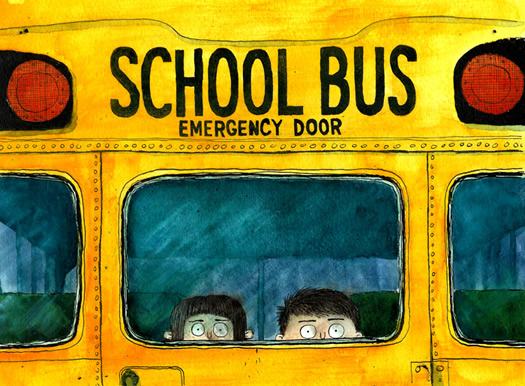
I never had to ride a bus to school, and that was a blessing.  To this day I’m still a little wary of them.  Rare class trips confirmed that they were the ideal breeding ground for my anxiety; an enclosed space with mysterious and opaque social rules and customs.  Where you sat and with whom was evidently meaningful to other riders.  On those rare trips I knew enough to stay clear of the back of the bus.  Even as a very small person I sensed that no good could come from being so far away from an adult.  As a younger child those seats seemed very high and quite conducive to hiding bad behavior.  Bad behavior has always frightened me.

A story of a bus matron (which we did not have on our class trips) being verbally abused by children does not surprise me.  Children are people.  Some people are lovely some are disgusting and some fall somewhere in-between.  What does seem inconceivable to me however is that this behavior would have continued for any amount of time.  It stands to reason that at least a handful of children on that bus are little versions of me.  They were frightened by the behavior.  The thought of getting on that bus every morning made their stomachs hurt.  They told their parents.  They asked to be driven to school.  They explained that they’re bad kids on the bus.  There is no vow of secrecy or non-disclosure agreement on the bus.  These are not members of organized crime.  They’re just kids that happen to live along the same bus route.  Someone (if not many) told.  Kids tell.

Following that theory (and it is just a theory, devoid of any factual support whatsoever) could it be that the parents did nothing to stop it?  Once we get past our shock, it does sound plausible, no?  Don’t we tend to assume that things are not our business?  Don’t we usually duck and dive under a bush to avoid any form of confrontation (unless it’s from the confines of our car and involves obscene gestures, or through anonymous comments on the web?)  Despite all government pleading, how many times do we really see something and say something?  Do we “suffer” through a broken streetlight, or wonky elevator?  Or do we fill out a maintenance report?  Do we gape, horrified at teenage girls pulling their tops up on the side of the highway?  Or do we explain how those photos they’re taking might someday limit their options in life?

Hopefully we speak up.  Hopefully we’ve been on the planet long enough to understand the dangers of silence.  Hopefully every day we choose to tip the balance away from disgusting and towards lovely.

 
Leave a comment

Posted by on June 23, 2012 in Childhood, Cultural Critique


Tags: , , , , , ,

Skout: It’s Not For Boys & Girls

There is no ignoring a headline of 3 child rapes being linked to social apps.  Child rapists have successfully posed as teenagers on Skout and attacked children.  It’s awful, it’s disgusting, it’s devastating, but demonizing social media is shortsighted.

Perhaps I am too literal, but I’m not entirely comfortable categorizing software application whose sole purpose is to bring strangers together as “social” media.  It’s not just the semantics that trouble me, it’s that the category of social media or networking is far too large and vague now.  (As technology grows, our language needs to keep up.  It’s too tempting to make sweeping generalizations otherwise.)  Skout, to my understanding, is an app that children over the age of 13 can legally use to find strangers.  Why?  What could possibly be the reason for such a thing?  What corporate brain trust decided that the teen market was a must-have for this app?  Were the decision makers reassigned from the Joe Camel ad campaign?  Has the dream machine behind flavored vodkas and wine coolers moved on to software marketing?  Have we really in fact allowed corporations to now actively lure children into talking to strangers?

What kind of teenager do we think would be interested in meeting strangers on-line?  Would it be strong, stable children with solid social networks and adult relationships?  I’m guessing not.  Teenagers are nothing if not acutely socially aware.  They know who’s in and who’s out at any given moment.  The adolescent social world shuns strangers.  It is likely that a teen would only seek out strangers if he/she felt alienated by the real social world or had a propensity towards risky behavior.  So let’s make an app available for that!

I worry that this story will cause the villagers to take up arms.  Not against Skout, which seriously needs a trip to the woodshed, but against the bogeyman of social networking.  Should children have access to social networking sites (whose intention are to connect people to those they actually know?)  I’m not sure it’s necessary, but then again I don’t think children need to sport fake sleeve tattoos, so I might not be the best judge. What would be wonderful is if the news of these attacks on children prompts family conversations.  Strangers are people you do not know.  The fact that a friend knows them doesn’t make them less strange.  Someone you’ve heard of is not a friend (that’s why Beyonce isn’t returning your calls.)  I would go so far as to suggest that an adult is not a friend either.  An adult might be a teacher, coach, therapist, tutor or friend of a child’s parent, but not a friend of the child.  But then again, I think putting a toddler in high heels, a sequin dress and fake fur jacket is a slippery slope.

It’s always tempting to blame an outside force, particularly a consumer product.  In this case it actually is appropriate to enforce changes to the product.  But let’s resist the urge to demonize everything we find unfamiliar.  Let’s not run to blanket our airwaves with every child “expert” or media “expert” exposing catchy, yet utterly vague sound bites about children and social networking.  Let’s do our best to remember that technology isn’t the issue, human beings are the problem.  Child rapists by definition will seek out children.  Our job is not to hide our children; our job is to pay attention to who they are and what they need.  We need to know about their world and how they are living in it.  Unless they actually paid for their phone and monthly bills (insert; ‘ha ha ha’) parents have every right/obligation to access the phone on a regular basis.  A child who knows he/she is not living in a secret alternate world from their parents is more likely to make good decisions.  Part of what we teach our children is how to live in the world not how to hide from it.  There will always be dark and dangerous forces in the world.  Strong children with well honed coping tools grow into resilient and successful adults.

 
1 Comment

Posted by on June 13, 2012 in Childhood, Media/Marketing


Tags: , , , , , , ,

The Best Defense Is An Offense

Reports of inappropriate relations with children seem to be on the rise these days.  Why is that?  The more hopeful explanation is that children (and their parents) are savvier and have more ease discussing such issues than those who came before them.  This would suggest that incidents have not increased, but the reporting of them has.  The more frightening explanation however is that more troubled and/or very immature adults are around our children now.

Pedophilia is not the only classification, as it is all boundary crossing behavior we are discussing.  An adult, in a position of authority, who treats a child as an adult is on a slippery slope and is shirking their duties and responsibilities.  A teacher befriending a child is not necessarily a cause for alarm, it can be though if the teacher is immature and doesn’t embrace his/her role as an authority figure.  A sport coach or scout leader who takes a special interest in one or two children may also cause concern.  This is not a ‘boogie man’ “the sky is falling” call to arms.  It has always been the case that we need to keep a critical eye on adults who choose to spend time with children.

A physical relationship with a child has no shades of gray.  It is inexcusable and intolerable and we should be doing far more to prevent its occurrence.  We can not send children to school or camp, wrapped in armor.  Instilling them with a fear of adults is a huge disservice and ineffective (as some abuse is at the hands of other children or teenagers.)  But there are things we can do.

  • We can make our children strong
    • A child with strong self-esteem is less likely to be singled out for attention
    • A child should know how to stand up and say in a loud clear voice; “NO”
    • A child with an empathetic and loving adult in their lives, who spends time with them and is available emotionally is far less likely to respond to the adult attention
  • All employees need to be screened
    • Psychological tests must be given to all employees whose majority of work involves children
    • Medical professionals, teachers, coaches, school bus drivers, custodial staff need all be screened
    • Testing will measure two different outcomes; pedophilia and maturity
      • A cut-off point for maturity would need consensus but any indication of pedophilia would reject a candidate from the pool

Corporations screen applicants all the time.   We already enforce tests for many professions.  You can’t (legally) work in a kitchen until you’ve passed the health and safety test.  The school bus driver has a special license to get behind the wheel.   A clinically designed psychological test should not be seen as an infringement but as a requirement.  Is it uncomfortable to consider a doctor or a dentist inappropriately touching a child?  Absolutely.  Does anyone want to consider how many people go into child-centric professions because of their psychological flaws?  Heavens no.  But ignoring it won’t make it go away.  That’s what children think.  The first step to really protecting our children is to act like adults.

 
Leave a comment

Posted by on June 9, 2012 in Childhood


Tags: , , , , , , , , ,

I Can Do That*

Summer is almost here and soon the children will be set free.  Lockers and cubbyholes will be cleaned out and juice box stained mortarboards discarded.  Those with (state recognized) diplomas will bid a final adieu to attendance, directives issued by bells, homeroom and gym class.  They are skipping into the sun off to great adventures.

But what of those children between juice box and Starbucks?  What does the summer hold for them?  No doubt there is a population spending their summer as free-range children.  They spring forth from the house after a hearty breakfast and are not seen again until their next feeding.  They scamp, scurry, swim, and explore with other children.  There are evenings of lightening bug hunting (and teary mornings when the bugs are discovered on the bottom of the jar, decidedly dead and unilluminated.)  There are lawn sprinklers and ice cream trucks and chalked sidewalks.  Then there’s reality.  Even if there are real live children somewhere, hopefully named; Molly, Stewart, Daisy and Marvin, having this halcyon summer, most children are not.  The majority of children are simply not free-range.

Their summer days, by design, or necessity (of finance or parental mental health) are structured.  There are children who respond very positively to structure of course.  A camp that allocates hours and days to prescribed activities can be heaven for some children.  For them it is comforting to awake thinking; “It’s Tuesday it must be lanyard day.”  For other children, they flourish best in the wild.  (It’s the difference between a cultivated orchid and a wildflower.)  These children need the uncertainty of an unscheduled day to find their footing.   They can be wildly physical children who love nothing more than to whirling dervish their way into an exhausted heap of sweat and dirt at day’s end.  They can also be dreamy, quiet children, whose idea of perfection is a quiet spot and a stack of Nancy Drews.  Hopefully every child gets what he or she really does need to be happy and strong.

Somewhere between names being written in underwear, and swimming goggles being unearthed (why were they in the broken bread machine?) there is an opportunity to shake things up a bit (even if it’s in the car on the way to the mall to get that style of shorts that ‘everyone is wearing and I can’t go to camp without them or I might as well just give up any hope of ever having any friends ever in my whole life, would that make you happy?!’)  There are approximately 8 weeks in a child’s summer (I know, in our addled sentimental grown minds we think of it as sprawling, languid months, but it’s not.)  What if every child learned 8 tasks of adult life this summer?  Before the cries of “isn’t the summer reading list enough chore for my child?” let me assure you that kids think adult stuff is interesting/fun (unless we’ve been moaning and carrying on about it in their presence for years.)

There is a life skill lesson appropriate for any age.  Pre-schoolers love the chance to fold laundry or sort light from dark.  Six-to-twelve year-olds can be involved in every aspect of getting food into the house and onto the table.  If there’s a family car, the younger can learn about keeping it clean, and the older can learn about keeping it going.  Thirteen-to-eighteen year-olds can learn just about anything; how bills get paid, how insurance works, how local politics impact the family, what parents really do for a living.  This last life lesson should not be confused with ‘take a child to work day’ that in many workplaces has been turned into “work as amusement park” day.

Understanding more about how the world works and what being adult really means helps a child make informed decisions as they grow.  Learning to do something (i.e., balance a checkbook, make a potato salad, change the oil) is exactly how self-esteem is built.  Swimming medals and ‘color war’ certificates make a child happy.  But knowing you can do something that is a necessary part of being an adult makes the world more exciting and less daunting for a child.

A Chorus Line (1975) – Edward Kleban & Marvin Hamlisch

 
4 Comments

Posted by on June 8, 2012 in Childhood


Tags: , , , , , , , ,

Words Can’t Bring You Down*

“What are your thoughts on bullying?” I was asked the other day.  There’s no simple answer is there?  While not a fan of bullying, I also don’t think it’s the black plague.  We need to be careful not to label all behavior that is less than kind as bullying.  Labeling behavior as bullying does not encourage conversation and understanding but leads to “zero tolerance” policies that can have illogical and arbitrary consequences.

I don’t know if incidents of bullying have increased.  How can we know when we’re not entirely clear what bullying is?  Here’s what bullying is not; having a disagreement, calling another person a name, or excluding someone from an activity.  Bullying certainly is causing a person harm, waging an ongoing campaign of physical intimidation, and inciting ostracization or teasing.  As soon as children are old enough to engage socially (around 3 years old) they begin to create groups.  Even in kindergarten children begin to identify whom to tease.  Their target can appear to be a mirror image of the group.  They are not necessarily weaker than others.  They may be singled out for the brand of sandwich bag they bring to school.  This is how it can start.

There have always been (and undoubtedly always will be) children who behave dreadfully to other children.  There are children who are not emotionally well, and are capable of simply inconceivable acts.  But then there are children, who are, well they are children.  They show poor judgment and above all, live for the acceptance of their peers.  They find themselves caught up in a behavior that fills them with shame and even more shamefully, a little pride.

What concerns me is how children are handling being the target of less than kind behavior.  I worry that children are reacting in intense and fatal ways.  A child committing violence (to themselves or others) because they felt bullied, is not normal.  Even for an adolescent.  I worry that all children are not as strong as they once were.  (For really what is a bully but one who feels inadequate?)  I worry that we have cultivated a generation (or more) whose lives are more external than internal, leaving them feeling fragile and teetering when the world no longer applauds.

When we hold graduation ceremonies for preschoolers, kindergartners, or hell, anything below high school, we are sending an esteem-crushing message to our children: “Doing the bare minimum may be your greatest accomplishment, yeah for you!”  We are also teaching them that their worth is intrinsically tied to applause.  Every activity now has an audience.  When they play, their parents are on the sidelines or actually coaching them along.  Every recital is videotaped and shown.  In short, their lives are excruciatingly public from their first framed sonogram.

There is no internal strength that is derived from an external life (just look at the personal life of any celebrity past or present.)  Self-esteem is not cultivated through “Best Snack Provider” trophies or “Honor Student” bumper stickers.  Self-esteem is created by the self.  It is grown through mastery.  When a child navigates new terrain, on his/her own, he/she glows with the accomplishment.  When a child problem solves or conquers a fear, they grow stronger.  Praise (real or empty) does not create self-esteem, independence does.  Praising a preschooler for “good waving!” is the gateway to a lifetime of empty praises.  Children are not stupid.  They know the difference.  We build strong children by encouraging increasing amounts of independence.

A child who feels a true sense of worth, who feels they are good at something, is much less likely to pick on someone else.  He/she is also much less likely to be devastated by being picked on.  We need to take (physical and/or psychological) violence against children very seriously.  We need to equally take seriously how our children are responding to such acts.  We are a culture that loves to treat symptoms and ignore causes.  How do I feel about bullying? I feel that the stronger (adults) need to acknowledge and redress their cultivation of the weaker.

* Beautiful: Linda Perry (2002)

 
2 Comments

Posted by on June 1, 2012 in Childhood


Tags: , , ,