RSS

Category Archives: Childhood

Flying Solo


If you’ve been out in public during the past ten years you may have noticed that there are few “adult” domains dotting our landscape. I don’t refer to the “Live” “Nude” Times Square of decades past. I refer instead to any and everywhere. The stroller set has infiltrated your local coffee shop and bar (hey after a long day playing in a sanitized million dollar soft-edged heat-proof playground, you’d need a stiff drink too.) Restaurants whose white tablecloths and staggering bills once signaled and adult oasis, now have nuggets of processed foods on the menu (because after all small children do enjoy fine dining they just don’t enjoy actual food.) No doubt much of the free-range high pitched squealing you experience (in restaurants, bars or Holocaust memorial museums) is mostly due to a parent not wanting to deny themselves anything of their pre-parenting life. It would seem that some people skipped the “What to EXPECT when you’re expecting” chapter. Life should continue unaltered save for many more accessories.

But what of the scenario in which the presence of one’s own child ruins the experience of the parent. Clearly ruining other people’s experience is a great motivator, but what if your own child negates your pleasure. No, we’re not venturing into “family bed” territory. Instead we’re looking at high-end travel. Not private plane, private island, private ecosystem travel. Just ordinary 5-star travel. Why would a person choose to fly first-class with a child younger than school age? If we assume both are healthy and that the child(ren) are not actual owners of the airline; what in the world would compel an adult to fly first-class with a small, squealing, squirming child? It can’t be the free food, children don’t seem to eat real food. (Oh for the love of all decency, don’t tell me they now serve nuggets in first-class!) It’s almost certainly not the free booze, although it could be that warm wet towel. The parent’s experience could not be improved by being in first class. Unless the flight attendants actually relieve the parent of the child, how is the parent enjoying the benefits of first-class? Is it merely the mustache twirling delight in having ruined everyone else’s first-class experience? Doubtful.

Once the aircraft has taxied to the gate and the fasten seat belt sign has been turned off, where are the little tykes staying? Are they off to visit relatives or perhaps moving into their new home? No, they’re off to the 5-star hotel/resort with zero child-centric amenities. Their parents will play running, screaming games of hide and seek in the plush penthouse level hallway at 10:30 PM. These adults will encourage the practicing of door slamming (“good boy!”) throughout the early morning hours. And we are left wondering why. Why would anyone choose to spend so much money to not enjoy the quiet, the plushness, the afternoon tea, the romance and the restorative nature of a very posh hotel? Why in an area dotted with chain hotels and motels catering to children and their nugget ways would anyone think that children should be in a place created for the pleasure of adults? Is it merely an extension of the ‘not being denied’ anything of one’s pre-parenting days? Does it matter not a whit that you spent the money and didn’t actually have the experience for which you paid? Is it an insistence of not lowering one’s standards just because one has decided to parent? (Note: Entitlement isn’t really a standard; it’s more of a pervasive and toxic behavior.) Could it be something even slightly more disturbing? Could it be that the child/infant is an adult security blanket? The world and/or social gatherings are far less daunting when you can dress up a little person and spend the day deflecting. That motivation would certainly explain the appearance of children/babies at funerals and weddings. “Pay no attention to the adult behind the baby!” It’s enough to make a person miss the security blankets that were smoking and sedatives.


 
4 Comments

Posted by on October 15, 2012 in Childhood, Travel


Tags: , , , , , , , , ,

Kramer vs Kramer vs Consumerism

There are films that never lose their emotional wallop, despite how many times you’ve seen them. Steel Magnolias, The Color Purple, Stella Dallas and An Affair To Remember come to mind. There is no element of surprise in the viewing; in fact the memorized dialogue and outcome are part of the pleasure. But the way in which the stories are crafted pull the viewer in for the punch. Of course there are reasons to revisit a dramatic film besides an opportunity to use tissues and visine. Films can tell us an awful lot about how we lived or thought. A film is fantasy of course, but it is a reflection of a director, screenwriter or producer’s viewpoint. Attitudes portrayed about gender, race, sexuality and religion are often an accurate reflection of the time. A film shot in the early 1970s will not only look very early 1970s but sound it too. Women might be referred to as “girls” or “honey,” bottoms might be patted. Generally, if non-white actors appear it’s to make a point. The storyline probably has nothing to do with any of these details, but the details are telling nonetheless.

You might remember the film; Kramer vs Kramer. (For those who don’t; it was a cutting-edge tale of divorce and custody starring Dustin Hoffman and Meryl Streep, set in New York City.) The emotional wallop of the film doesn’t diminish with time. Much of what will rip you to shreds is the incredible performance of (8 year-old) Justin Henry. You’d have to be made of stone to not crumble at the raw hurt and anger on his face. Meryl Streep’s eyes do most of her talking. She has perhaps twenty lines and expresses pages and pages of dialogue with her eyes. The viewer understands everything about these people and their anguish. But there is also (now) a story on the periphery of that story. The year is 1979 and times were decidedly different. The family is middle class (daddy works in advertising.) They are educated people living in a two-bedroom high-rise apartment uptown. The child attends a neighborhood school and they frequent Central Park. Sounds rather timeless, no? It’s what you don’t see that is so telling. The family (before they weren’t one) is living comfortably on one salary. There is no car, there is no private school and there is no luxury. The child’s bedroom has been hand-painted with clouds by the creatively frustrated mother. (In 1979 this was considered somewhat decadent.) However, there is no Pottery Barn kid’s furniture or matching bedding and window treatment. There are some books, some toys, and later a framed photo of mommy. The chaos that ensues with mommy’s departure is linked to the time period. There are no babysitters or nannies on call or even in existence. (Nannies were still for the posh or the British.) Daddy must master grocery shopping and food preparation as take-away was not ubiquitous and children did not dine out. Luckily for daddy there are no play-dates (there is only play) and there are no enrichment programs or team sports for a first-grader.

Now no one would suggest that the late 1970s were halcyon times. The demise of the marriage in question hinged on the fact that the wife felt marginalized. She left her husband and child to “find herself” (aka get some analysis and a job.) But had the marriage worked, and had she felt able to go out and get a job, their lifestyle wouldn’t be that much different. There’d be an after-school babysitter no doubt. But the minimalistic consumption wouldn’t alter. Sure, she might need some work clothes, but shopping wasn’t a legitimate hobby in the 1970s. New appliances would’ve only been purchased if every attempt at repair had been exhausted. There were no strollers being sold for the same price as a moped. In short, they would have had more money and more time (not running from expenditure to expenditure) than they would today. Something to contemplate while watching the film and choking back the tears


Tags: , , , , , , , , , , , , , , , , ,

We Are Family

There are many ways to make a family and some of them involve legality. The broadest definition of a family is that of more than one person committed to building a life together. You can imagine the many variations that live within that parameter; parentless siblings, romantically connected adults, friends, one adult and children, generations of the biologically related. Within those examples are even more variations; adopted siblings, romantically connected adults of varying genders, religions, races, ages, abilities, one adult and adopted children, donor/surrogate children, foster children. Generations of the biologically related can include any or all of the categories just mentioned. That’s a whole lot of variation.

Yet for all of our ‘we are the world”liness we are not all that comfortable with uniqueness. It’s not necessarily a shortcoming on our part. We can only process so much information. We are wired to take in information quickly and make instantaneous decisions (‘is that a friendly lion coming toward our cave or a hostile hungry lion?’) We have room for subtlety and idiosyncrasy with our friends and family; but the world at large is just too large. So we look for categories, boxes, and classifications to avoid a mind that would thrill a hoarder. And it wouldn’t matter a smidge until something goes awry.

When a family breaks up there can be a lot of rubble. If the latter part of the 20th century taught us anything; it’s that families can dissolve. For better or worse (pun intended) and for the most part, people no longer need each other for survival. However, through the beauty of human nature; new families can be created. Complicated? Not really, or not until the 5th grade teacher assigns the archaic “family tree” assignment to her class. Family is what you make it and its level of fluidity is what you choose.

Lovely sentiment but what about those step-children left behind in the prior marriage? What of your child’s step-grandparent who is now not? Who gets invited to what? Who gets to see photos or updates? What if the ex-spouse has remarried and there are new steps? Do they get invited? The first step is to drop the label maker. I’m not going to get all Carol Brady and suggest that the only steps in this house are the ones in the living room. But I will offer that when it comes to determining what and who is important to us; labels only obscure. What matters is how you feel, how the children feel and how a new spouse/partner feels (and NOT necessarily in that order.) What we want for our children is for them to have the love of as many people as they possibly can. We want them to have consistent and reliable relationships with people who are not necessarily related to them. It’s one way they grow strong roots. If there has been heinous behavior (i.e., violence, or criminality) by any ex-family member it should be taken into consideration. But overall whatever works for everyone* most involved is just plain okely dokely. (By “everyone” I do not mean the child(ren) are allowed to insist their parents behave as if they never split up and spend all holidays and recitals as a unit.)

Life can be messy, chaotic and at times horrific. Having people who love you and feel obligated to take you in is what makes it all manageable. Yes, the broader we define something the more complex it gets. And no, there isn’t a greeting card to send on Mother’s Day to the woman who is now partnered with your ex-step-parent. But that’s a good thing isn’t it? Do any of us (in our heart of hearts) want to think of ourselves as able to be reduced to a mass market sentiment?

 
3 Comments

Posted by on October 4, 2012 in Childhood, Marriage/Wedding, Well-Being


Tags: , , , , , , , , , , , , , ,

The Selflessness Mystique

How many times have you heard someone described as ‘selfless?’ It’s always meant as a compliment and often attributed to someone who may have gone unnoticed. There’s a chance the term is attached to men, but most likely it’s a woman who’s received the ‘praise.’

It’s interesting that anyone would ever consider having an absence of self to be a virtue. In some cases it might just be a matter of semantics. Perhaps what they really meant was not selflessness as much as generous of spirit or empathetic. True selflessness conjures the most depressing of images: an individual whose only sense of purpose is external, who expends all of their creative energies on the perceived needs of others. How is neglecting oneself ever virtuous? Any person over the age of 15 or so, in their most honest bravest moment, will admit that it’s always easier to focus on others than oneself. It’s why teenagers lose themselves in the lives of boy/girlfriends. Some of us never grow out of that impulse.  Showering others with attention takes boatloads of physical energy but not a whole lot of emotional energy. Listening to one’s inner voice and having it guide our life’s path is work. It takes focus, daring and fortitude to know who we really are and what we want.

There’s one undertaking that is forever being linked with ‘selflessness’: Motherhood (like the flag and apple pie) is a loaded term. Popular culture is rife with images of aproned women scrubbing floors to provide their child with a better life. Mothers are spoken of in hushed reverent terms usually reserved for saints. Nobody talks about fathers that way. Fathers are not perpetually giving (unless we’re romanticizing their wallets.) If they are thought of at all it’s as disciplinarians or buffoons. There is no glowing light that surrounds them. Nobody has ever chastised a curser with the phrase; “Do you kiss your father with that mouth?!”

Newsflash: women are not necessarily encouraged to have a strong sense of self. They are (in 2012!!!) lauded for being behind the scenes making other people’s lives happen. They are, if you will, the woman behind the curtain. This of course is part of the lingering backlash to the second wave of feminism. It’s understandable that woman are continuously being pushed back in time as they make real strides in the world and economy. The marketing of 6-inch heels, girdles, fake hair, and means to Barbie bodies, doesn’t happen in a vacuum. Conspiracies, even passive ones, do exist. It’s somewhat predictable that as women outpace men in 4-year degrees television programming of the ‘girls gone wild’ ilk has increased. It makes sense.

What doesn’t make sense is why women are such willing players. How did a generation (or two) raised during the Title lX years aspire to be the water-girl? Did they get their fill of being in the game?  And what of the children? What do we teach our children when we exhibit selfless behaviors? Do they grow up with a skewed sense of importance? Do they not grow up having witnessed what awaits them? Are they handicapped for not learning how to do for themselves? Wouldn’t they be further ahead learning that empathy and generosity of spirit are integral parts of what makes us fully formed and actualized human beings?

 
Leave a comment

Posted by on August 30, 2012 in Childhood, Well-Being


Tags: , , , ,

What Comes After We Choose To Go To The Moon?

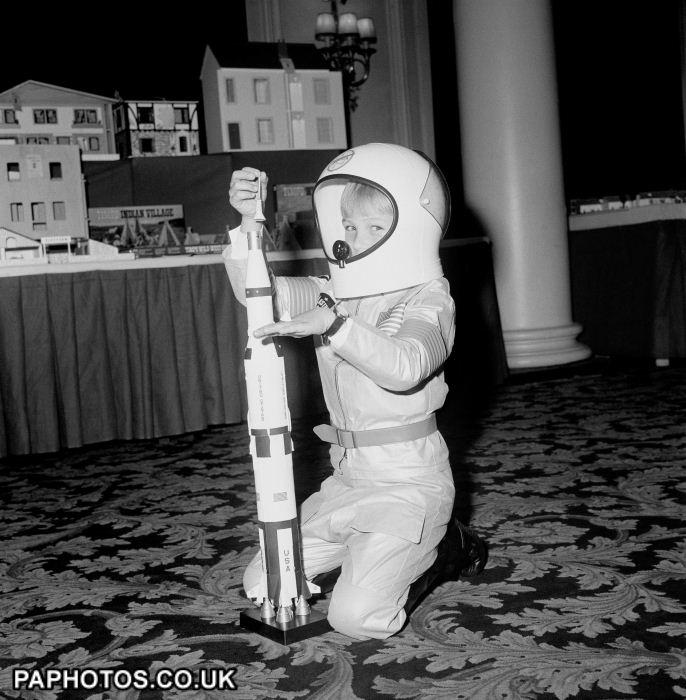
During the 1960s there were lots of little kids jumping into newly fallen snow and shouting “First Man On The Moon!” when their boots left a print. Little boys (and some liberated little girls) dreamed of and played at being astronauts. Even if children weren’t old (or sophisticated) enough to follow NASA’s doings, there was I Dream of Jeannie. Popular culture was drenched in all things space-age and planetary. The space program was in the air if you will. Being an astronaut was to a 1960s kid what being a cowboy was to a 1950s kid. Adventure, exploration, and glamour were all packaged into a very cool outfit. Astronauts, like cowboys, even had special food. They had belts that held their lifesaving apparatus. But they also had science. For a kid who loved rocks, or space, or climate, or chemistry, he/she too could dream of being a superhero.

No one will dispute that the space program has lost some of its glamour and pizzazz over the decades. Space is not new anymore. Technology has progressed and men and women in space suits are no longer required to achieve the mission. NASA has shrunk and no one dreams of being an astronaut any longer. But what has taken its place in the imagination of children? What is there today that encompasses exploration, science and glamour? Surely there are lots of careers that hit on 2 out of 3. But is there anything, not involving sport, celebrity for celebrity sake, or undefined means of accumulating wealth, that is universally compelling to children today?

One could posit that computer programming (in the form of gaming, biomedical, etc.) is our new space program. It is the new frontier. But only for a select few and there’s nothing particularly heroic about it. On a more practical level how in the world do you play “computer programmer” in the backyard? (But then again, does anyone freestyle play in the backyard anymore?) Even if it were fun to do so, only a small percentage of children would ever aspire to sit at a desk and write code. Every kid everywhere played cowboy (1950s) or astronaut (1960s.) Did a kid from the Bronx really stand a chance of homesteading and ranching someday? (Could his mother have survived it?) Did a rural kid with an allergy to moon dust and zero interest in science make it into the space program? Not without a miracle and some sudafed. But they had a shared dream/fantasy.

For all the glamour of being an astronaut (and the sports cars, groupies and ticker-tape parades add up to a whole lot of glamour) it was a serious (and at times deadly) profession. The space program was staffed with; test pilots, scientists and engineers. These were highly educated people with talents and skills of, well of rocket scientists. There was a whole lot of there there. They were glamorized for having the right stuff. Children were right to idealize these grown-ups. Their play, whether building cardboard box rocket ships, or jumping into snowbanks, was rooted in something real and admirable. For too long we have not provided children (and therefore humanity) with a universal dream. We once heeded the call to do something not because it was easy but because it was hard. Perhaps it’s time to suit up and have another go at it.

 
Leave a comment

Posted by on August 26, 2012 in Childhood, Cultural Critique


Tags: , , , , , , ,