RSS

Monthly Archives: May 2013

Mega Pixel Memories Of The Way We Were

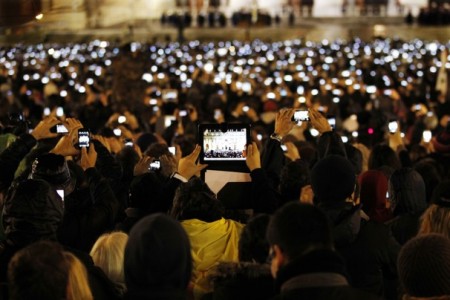
Vatican_Pope_06523

Do you remember home movies? The old silent ones; with the children acting goofy for the camera and the mother shooing away the cameraman/husband. Even if you never saw one of these in real life you’ve seen them in film or television. One of the more lovely and touching is in the film Adam’s Rib; with Katherine Hepburn and Spencer Tracy frolicking around their farm. Knowing just a bit about the actors we feel as if we’re watching an actual home movie. Where have they gone these capsules of family life? One need only attend a child’s recital or traipse through Time Square to know that parents are recording every single moment. But then what? Does the family actually gather around the home screen and watch the footage? The same family who reportedly does not have time for family dinners? Somewhat doubtful, no? Are the moving images sent to family in distant places? Do the videos simply find a resting place on social media? And what of all the moving images taken of stationary objects? What happens to all that statue footage? Has the very act of capturing an event become the end point?

A cluster of people holding up their cellphones is now the universal sign of; “Everybody look what’s going down.” What’s going down could be celebrity in nature and a captured photo or moving image proves you were in proximity. Nowhere is this more evident than in large-scale events. Stadiums are filled with flashing (!) phones. It doesn’t matter that the photo will be so fuzzy as to always need a description attached. It is how we now record (in every way) an experience. It is somewhat reminiscent of tokens once collected; autographs, ticket stubs, crushed cocktail napkins and matchbooks. Scrapbooks, or for the less sentimental or organized, dresser drawers, were once filled with these reminders. One could look at a browned curled remnant of a corsage and conjure a magical evening. The rusty tetanus wielding protest pin reminds us of that chaotic, exhilarating march. A photo or video can evoke those memories as well. But sooner or later what we tend to remember is the photo or the video. Our own mental imagery fades as the recorded image stakes its claim.

And what of the recording? Is it possible to actually have any experience beyond that of cinematographer? Do we actually experience our child’s soccer game, dance performance, birthday party? Or are we simply recording it in the hope of ‘making memories’ for them? What does it mean to ‘make a memory’ and why would we pursue it? Memories are organic. A healthy brain remembers what is meaningful to the individual and (mercifully) often blocks what is too much to bear. The impulse to ‘create memories’ can be a bit creepy. A future memory is not only an oxymoron it’s an abstraction. Being consumed by an abstraction versus being present in the moment is not desirable. How people (including children) are experiencing something in the here and now is far more pressing than anything out in the ether. Being a recorder means disengagement. A court reporter is not participating in the proceedings or even processing any of the analysis. They are recording what others are experiencing (at lightening speed.) A photo or two doesn’t prevent engaging fully in an experience. But chances are a party of eight, photographing each and every course and individual serving doesn’t have the makings of a night to remember.
 
2 Comments

Posted by on May 15, 2013 in Cultural Critique


Tags: , , , , , , , , , , , , ,

The $10 Shirt

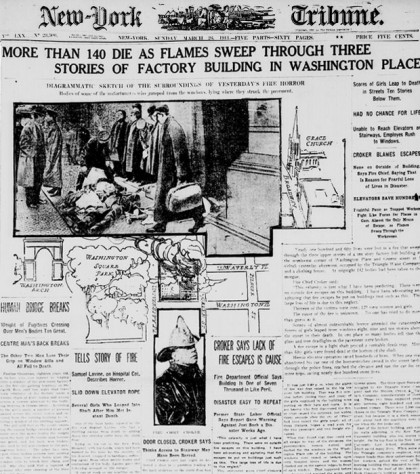
tribune-032611-1

Terrible things have been happening in the garment industry. No, that is not a reference to the return of shoulder pads and high-waist pants. Factories have been collapsing and burning, trapping and killing workers. The most recent of these have been in Bangladesh; a manufacturing hub of preference for many mass-market retailers. The elements which render a locale to be a hub of preference are not surprising; lax regulations, lower wages equaling cheaper costs. Everyone knows this. Everyone has always known this. It’s why garment production moved overseas in recent decades.

Yet each time something dreadful comes to light we (momentarily) consider our $10 shirts. When it’s discovered that our chain store products are sewn/assembled by children, we shake our fists at the celebrity whose name is on the label. When a factory crumbles or erupts in flames, we are as intrigued by the labels left in the ruins as we are the rescue efforts. Perhaps we even sigh in relief upon learning that we don’t wear that particular $10 shirt. But who among us really knows the source of his/her inexpensive goods? Our linen closets, medicine cabinets and pantries are filled with products and packaging from around the globe. One would need to live the most self-sufficient and currency-free existence to never be in contact with something made under inhumane or dangerous circumstances.

There’s a faint buzz beginning about garment labeling. The comparison is being made to the ‘origin of food’ movement. The theory is that people care as deeply about the origin of their food as they do their clothes (and not in a ‘it’s from Paris’ kind of way.) Perhaps there is a similarity between concerns over food as there is clothing. There’s no doubt that there will always be people who care about the origin of their food and the friends the chicken had (before they stick their hand up its rear and remove its giblets.) But we’re talking about a rather privileged segment of the population. They either have the money or psychic bandwidth to perseverate over the ancestry of their produce. They may or may not also be people who purchase a $10 shirt.

Considering that every single garment sold in this country already has a label identifying its country of origin, it’s more likely that manufacturers/chain stores/brands will use a “cruelty free” label as a marketing device. Unless the brand shifts the cost of production (and the manufacturing of these new labels) the price of the goods will rise. It’s not guaranteed. A brand could lower, say employee benefits and maintain the $10 retail price. No matter how you slice it a $10 shirt in 2013 is a mirage. There is no way to manufacture, ship, and sell a shirt for $10, while paying a decent wage. Do any of us need a $10 shirt? Well, the truth of the matter is that yes, many people in this country need a $10 shirt. Could we buy fewer goods at a higher price? Probably, but the more we buy and the frequency of which we buy translates into jobs.

If (insert brand/shop/designer) wants to roll out a splashy marketing campaign about their cruelty-free manufacturing, that’s just fine. But in the end it’s a rather small segment of the population who has the luxury of money or shopping consciousness to respond. We’ve already seen this with designers who eschew fur or other animal products. Their line didn’t really transcend the niche market until they partnered with rock bottom priced chain stores. The animal-free garments might be manufactured with as much respect to human workers as the spared animals, but chances are that most of everything else in the mega-store might not be.

Cheap goods, food, and cars cost. They cost someone somewhere, sometimes with loss of jobs and towns and sometimes with loss of lives. This has been the case since the advent of the industrial age. A $1.00 hamburger and a $10.00 shirt have enormous job, health and economic consequences. They always have and they always will.

 
Leave a comment

Posted by on May 9, 2013 in Cultural Critique


Tags: , , , , , , , , ,

Integrating Sports

stickball

Organized sports have been in the news an awful lot lately, and not in a bowl/pennant/series kind of way. It’s been all about sex. Sexual orientation, sexual (mis)behavior, and gender orientation in team sports has been popping up like kernels in a Jiffy Pop. The accumulated effect of these pops is to force us to look at sports with fresh eyes. Why are teams gender-specific? Well, because (we sputter), because…men are biologically larger. Sometimes they are, and that is an ancient argument that we used to keep women out of the police force, the firehouse and the military.

If a standard of physical skill and strength is set for a team, why does it matter the gender of the player? Organized sports have never been so popular amongst children. Free-range play for every age of child has been replaced by team sports. During the K-12 years, boys and girls are often the same size, and in some cases the girls are bigger. There are unisex teams for children, but usually they only lasts until middle school. Most sports do not legally allow full body tackles. So if a girl/woman has an equal skill to that of a boy/man what is the issue exactly? Why are we hanging onto this gender specific paradigm? We let go of most gender specific curriculum years ago (show of hands for those who remember being tracked into sewing/cooking or mechanical drawing/shop.) The “Boys” and “Girls” engravings on old school doors while quaint are ignored. Title IX opened up an entire world of athletics to girls. And that was good. But it has been almost two generations since the initiation of that progress. Team sports have become as routine an endeavor for girls as ballet once was. So why aren’t boys and girls playing on the same team? Well, (ahem) what of the locker rooms, you ask?

Why in the world do we design locker rooms in which there is no privacy, particularly in schools? Is there ever a life stage more rife with body image issues?! Why do we subject any person to such a thing? Heterosexual, homosexual, pansexual, transgender; everyone deserves a little privacy. That aside, the short answer to the locker room question is; build locker rooms with private showers equipped with a small vestibules (with hooks and shelves.) Lockers can be in a communal setting and dressing/undressing can be done privately.

Any organization, which by definition is for only one segment of the population, cultivates a potentially unhealthy camaraderie. The less diverse a group the more myopic their orientation. A group can easily influence even the most open-minded individual, particularly when they’re coached that there is no “I” in team. It is in closed societies that we often find misdeeds towards others. Opening up the teams to any person with the skills/talents to play the sport will create a better environment for all.

As more young people openly identify as transgender and/or L(esbian),G(ay),B(isexual) we will be faced with privacy and equity issues. And this is good. When we change the way school athletics is handled we will (eventually) see the effect on professional sports. It took years of Title IX to get us to the WNBA, and we certainly have a ways to go in other sports. But it is progress, and that is good.

 
Leave a comment

Posted by on May 7, 2013 in Cultural Critique, Education


Tags: , , , , , , , , , , , , , ,

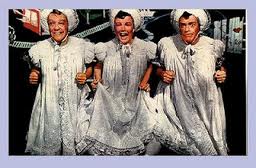
We Dress Alike*

triplets

There’s a stark yet strangely beautiful photo essay by Nolan Conway. Identically styled people sit in various MacDonald’s restaurants. At first (second and third) glance it would appear that this is a collection of twin portraits. But the captions prove otherwise. Capturing clusters of indistinguishable people is no doubt the point of a MacDonald’s story. It makes that obvious and the also not so obvious point of; when did everyone start looking alike?

Recently a story about the ‘edgy’ art scene in the newest hippest neighborhood was accompanied by a photo. A cluster of identically clad and groomed under 40s was captioned. But you’d have to be the profiled artist’s mother to pick his knit capped head out of the half-dozen style clones. The men had moppish 80’s hair, the women had asymmetrical 80’s hair. The men were wearing what they considered ironic T-shirts (when did ubiquitous and mundane become synonymous with irony?) The women are in clothes made to appear as if they were accidentally washed on the incorrect cycle. They are faded just so and just a bit worn. And they all are wearing vaguely ethnic scarves and polyester knit hats perched on the top of their heads. Even the manner in which they wear these unattractive utilitarian hats (indoors!) is identical.

The Bobbsey Twin-ness is not reserved for the under 40 crowd of course. If you’ve attended a high school graduation in recent years, and perhaps sat in a back row, you would see a sea of identical heads. Over 40 female hair is almost always long, straight and highlighted (it’s the equivalent of our foremother’s blue rinse.) The clothing style depends on the B.M.I. but almost always includes denim w/ a minimum of 3% lycra. This Doubleminting has always been pervasive among teens of course. It is the holy grail of adolescence to look exactly like everyone else. But what about college? Have you been to college lately? Move-in day is a riot. All the dads are in cargo shorts, untucked shirts & baseball caps; and all the mothers are in capris and generous cleavage (you think it’s easy to see your daughter turn into a grown woman?!) and the freshman are in uniform. The young women are dressed in body-con pieces from head to shin. From shin to toe they are most likely either in an Ugg or wellie (making them look as if they’re standing in a bucket, which is flattering on exactly no one) or if the weather allows, a rubber ‘shoe’ suitable for the beach, pool or hospital. The young men are either in baggy cargo shorts (like father like…) or slim fitting madras shorts. T-shirt (with message/image suited to the corresponding college/university) and unlaced sneakers or shower shoes complete the look. Since when did college students want to look alike? When did they want to follow the lead of their parents in any pursuit, least of all an approach to style? Wait but what of the art students you ask? Well if completing the checklist of body modifying (piercing, tattoos, earlobe stretchers) is a sign of creativity, then we’re good. (Note to medical students on the fence about their specialty; restorative cosmetic surgery – ka-ching!)

So how did it happen? Is it all the result of very cheap clothing in chain stores? Is it that the same ‘look’ is available across the country in a mall or big-box store near you? Is it our celebrity culture that drives style? Could it be that people (consumers, media, merchandisers) turn to celebrities (who turn to a handful of stylists) to create their look? Or is the styling of one’s person just the tip of the iceberg? Is it more that a culture that celebrates sameness is ultimately going to look the same. A culture that applauds and supports genre over niche does not cultivate creativity. Television talent contests award very specific sounds and looks (there is no Gong Show diversity on display anywhere.) Since the Rocky and Godfather days, film sequels are king. Broadway’s percentage of revivals grows every year. Where are the new ideas? How much wonderful writing never sees the light of day? What happened to the novel? Memoirs (which is a lovely sounding word for ‘it happened to me so it must be interesting’) is the genre of choice. Sensation and sequels sell, but what about good writing and great stories? Is there an audience (aka money) for talented novelists, poets, screenwriters and playwrights? We could also shine the light on indistinguishable home design and decor, museums exhibits and performance arts centers. You’d have to have a GPS to know where you are sometimes.

There have always been style trends. People don’t much go for operetta the way they once did. Sonnets went the way of hoop skirts, and you don’t see a lot of domes and columns being erected. But not since perhaps the 1950s have people strived to look and sound so much alike. Perhaps it is merely cyclical and not a harbinger of the demise of creativity. My goal is to outlive the cycle, seek creativity and to do so while wearing what flatters/interests me.

*The Triplet Song (The Bandwagon 1953) by Arthur Schwartz & Howard Dietz

 
Leave a comment

Posted by on May 4, 2013 in Cultural Critique, Style


Tags: , , , , , , , , , , , , , , , , , , ,

Sideshow

freaks

It’s now been several generations since we considered a carnival sideshow an acceptable form of entertainment. Today photos or drawings from early 20th century circuses tend to evoke gasps. It’s jarring to consider that people who had an unconventional appearance were put on display and were considered entertainment. What societal limitations caused people to take to the circus tent? What kind of people would take pleasure in viewing a ‘freak show’? We will cover these and other questions in Intro To Reality Television: Evolution and Devolution.

After the Elephant Man heyday of the late 19th century and early 20th century, Americans got hold of themselves and backed away from such voyeurism and exhibitionism. Later, with the advent of political correctness we bowed our heads in shame and taught our children not to point. If we came across a midnight showing of Freaks (1932) we watched it in the dark, with a certain amount of guilt. And then we got our base groove back. Sometime during the Reagan boom years we found comfort in gawking at the rich. It’s okay to gawk and make spectacle of those (economically) better off, right? Robin Leach was the mid-1980s barker of Lifestyles of the Rich and Famous and we gawked. He paved the way for us to release our pent up desires. Soon the business of celebrity boomed, to feed our insatiable appetite for fodder. It was okay to gawk and poke fun at people who had what we did not. But like any indulgence, it lost its ability to satisfy. Soon it wasn’t enough to see a child actress implode in front of our eyes. After a dozen or so of those kids, it ceases to impress.

Media abhors a vacuum, and can spot a hole in the market from space. Cue the new wave of reality television. A modern audience would not be satisfied with viewing a stock still anomaly on a stage, we are happier to see these specimens in their ‘natural’ habitat. We want to see people with their; 6,8,12,18,20 children going about their daily lives. Viewing wealthy people’s staged homes is no longer enough. We need to see them in prompted dramas. We need to see them dressed in award ceremony gowns to attend barbecues. We want to see them squabbling and behaving like junior high school students. We care little that there is no real wealth (and often bankruptcy.) Who cares that a title has been purchased, the hair is synthetic and the faces could be used as flotation devices? What we love is the sideshow behavior. It matters not that the behavior is created for our viewing pleasure. Who really cares that a toddler’s beauty pageant (in a sad little rural motel) is the most boring event one could ever imagine? With enough manufactured histrionics and adept editing, it’s more fun than a cross-dressing General Tom Thumb. Having a messy house, clipping coupons, or choosing a dress, are a snore fest. But throw in a few “No she didn’ts” or a litany of psychobabble and you’ve got yourself a show. The more fragile a participant is, the better the show. Make them cry, make them sound certifiable, and we’ll grab our chips and put down the remote. Emotional instability not your thing? Fear not, we’ve got shows about little people, the conjoined, the fattest man, the fattest woman, and the tattooed. Sound familiar? P.T. Barnum would be so proud.

In preparation of our next session: Professions Made To Look Glamorous; please review Baking, Trucking, Fishing shows and the newest addition to the golden age of television: The Search Is on for the Best Hooker in America.


Tags: , , , , , , , , , , , , , , , , , ,