RSS

Tag Archives: Theatre

Superior Donuts – Review

It is simply delicious to see a new play and fabulous actors.  It is particularly fulfilling if the production in question is an ensemble piece.  That is indeed the case with Superior Donuts at the Music Box Theatre.  This new Tracy Letts (Pulitzer: August Osage County) comes directly from Steppenwolf and feels it.  The tight ensemble has packed up their focused and small production and plopped it onto Broadway.  The stage is even scaled down, with the help of blackout curtains to recreate the smallness.  The set is a donut shop in Chicago, seemingly untouched since Arthur’s (Michael McKean) parents purchased it fifty years ago.  The play opens with a suspicious break-in and the introduction of several of the 9 characters.  Shortly after the police leave (fabulously played by James Vincent Meredith and Kate Buddecke) we are introduced to Franco (Jon Michael Hill) who comes to work and change Arthur’s life.  Arthur is a frozen man, as the sound designer reminds us with accents of howling Chicago winds, and Franco thaws him.  We learn of Arthur’s story through spotlight monologues.  There are no surprises in this play, despite the audible gasps from the audience.  But Letts’ skill may very well be in the predictability of his story telling and how very satisfying it is to see the characters develop exactly as one would expect.  There are some very funny moments in this play that features ethnicity as its focal point.  Mr. Letts has great fun with his Russian stereotypes, his digs at the Polish and Irish, and goes to lengths to highlight the rich history of African American poets.  This conceit feels a little awkward, but perhaps it works well in Chicago.  (Personal aside, I’m never quite sure which ethnic groups are amusing to make fun of and which are not.) There is a wonderful actress, Jane Aldermann who plays the alcoholic as Yoda character, Lady.  While I found this character no more convincing than I ever do, Aldermann did, and it showed.  Much of the set design and direction did much to set the tone and move the story forwarded.  While it is always very difficult to stage a convincing fight scene, I must say that the actors were not helped by the harsh lighting.  I’m not sure that it can be helped in a donut shop with fluorescent lights.  Loving the performances as much as I did, I tried not to look too closely at the fake punches and foot stomping as sound effect.

Mr. Letts sat in front of me, as did several Broadway veterans.  Mr. Letts was no doubt pleased with the abundance of laughter and audible response throughout the two acts.  While the actors received a standing ovation (who doesn’t these days?) the curtain call was extremely brief, leaving the audience at somewhat of a loss.  If you love very fine acting, and do not abhor sentimentality, I recommend this play.  If you enjoyed August, not because of its scale but because of its content, you will enjoy Superior Donuts.

 
Leave a comment

Posted by on August 20, 2011 in Uncategorized


Tags: , , , , , , , , ,

A Boy and His Soul – Review

I have never laughed and cried so hard or so much as I did yesterday during A Boy and His Soul at the Vineyard Theatre. This one-man show, written by and starring Colman Domingo has a limited run (September-October) but if yesterday’s audience was any barometer, it will be extended and/or moved. Directed by Tony Kelly and Choreographed by Ken Roberson, A Boy and His Soul is an exquisite composite of music, dance, memoir and more music. Set in a pitch perfect suburban basement/rec room (Scenic Design by Rachel Hauck) Mr. Domingo tells the tale of his childhood and adolescence through a raucous and moving mosaic of soul music. He sings (not enough for this viewer,) dances and is hysterically funny and heartbreaking through 90 minutes of non-stop fabulousness. Mr. Domingo was most recently seen in The Wiz (at City Center) but might be more known for his roles in Passing Strange. He is an extraordinary bundle of talent and has a face that would make Norma Desmond proud. While I usually tread lightly into the terrain of memoir, or as I like to put it; “If it’s about me, it must be fascinating!” there is nothing here that even hints of a vanity project. The script is so shockingly good, I actually found myself wondering if I could purchase it. There were far too many perfect gems in the dialogue to recall, and I wanted to remember it all. If there is a weakness in the script, it is only the way in which the dramatic arc peaks too close to the end and is not in fact the end. A minor point in such an incredible experience. While Mr. Domingo deserves heaps of praise for his script and his performance, clearly this was an ensemble piece. The direction, sound, lights, set, and choreography were all so perfect. I guarantee that this will please you. When the lights came up, I was jubilant and utterly exhausted after loosing so many tears. I have never been so happy to walk outside looking like Tammy Fay.

 
Leave a comment

Posted by on August 20, 2011 in Uncategorized


Tags: , , , , , , , ,

Our Town – Review

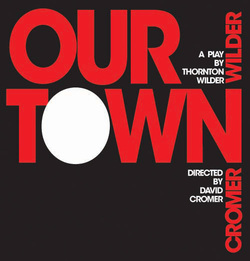
A show of hands of those of us who aren’t really the least bit intrigued by yet another production of Our Town.  Look closely and you will see my hand frantically waving in the back.  This Thorton Wilder gem has been staged by well meaning community theatres, eager High School English teachers, a few edgy prison program directors and even a 1980s sitcom.  We all know it backward and forward, and have ceased to see the delicacy of Wilder’s work.  Have I got the remedy for you.

The Barrow Street Theatre has brought the Hypocrites (Chicago) production, with full cast, to New York.  David Cromer (upcoming Brighton Beach Memoirs and Broadway Bound) directs this fresh and modern interpret ation of the 1938 Our Town.  Cromer, not only brings a clean and engrossing production to the stage, he also manages it.  He is most brilliant in the role of the stage manager.

While the cast is engaging and quite talented, it is the staging that is the star of this production.  Set on a thrust stage (which is actually just the floor of the center of the room) the audience is surrounding (and sometimes IN) the action on three sides.  Cromer keeps the houselights up the entire time, dimming them slightly in the third act.  This device is not nearly as distracting as one would think.  Even with Judd Hirsch sitting directly across from me, my attention was focused on the Our Town actors.  This was partly due to the fabulous use of space.  The choir congregates and sings on a wide fly above the stage.  This gives the audience a new place to focus from time to time.  Actors use the thrust floor space as if it is an actual town square.  Actors weave in and out of the audience in the most naturalistic of manner.  There is nothing self conscious or contrived about the device.

The stage manager’s affect and use of cell phone, combined with the modern day dress of the cast, gives the whole production a sense of the present.  While undoubtedly set in the thirties (evident by milk delivered by horse) there was only a sense of modern day small town throughout the production.
Three acts can seem daunting to the average theatre goer, but the evening simply flew by.  This is a production not to be missed.  It will make you think differently about this American classic and will leave you with a sense of wonder about the experience of true creativity.  Mr. Cromer is someone to watch.

 
Leave a comment

Posted by on August 20, 2011 in Uncategorized


Tags: , , , , , , , ,

Othello: Public Theatre – Review

Watching the Public Theatre’s production of Othello reminded me of seeing a large art installation in a Chelsea gallery.  As I’ve walked round and round various modern configurations that scream an inaudible MESSAGE, I often find myself admiring the artist’s complete and utter self absorption.  “Audience be damned” screams the installation, or in this case Peter Sellars, in his direction of Othello.  This Othello at the uncomfortable and antiseptic NYU Skirball Center is more of a derivative of Shakespeare’s play, than the play itself.  It is recognizable as Othello, but unlike a riveting deconstructionist production, it adds nothing, only takes away from the original.  The enormous auditorium stage is stripped completely, exposing the garage door used for load-in, fuse boxes and flies.  The entire set consists of chairs (sometimes used for “off-stage” actors, and sometimes not,) two standing microphones and 45 video monitors that seem to serve no purpose whatsoever.  Although in case you missed Mr. Sellars’ point, they too are deconstructed.  The conceit of the bare stage can work, but it doesn’t here.  The space is large and the performances are not. Let us start with the very first word uttered on stage.  My spine stiffened and I quickly scanned the audience for signs of communal disbelief.  Shakespeare miked?  Philip Seymour Hoffman miked?  No, no this can’t be.  It must be a device, wait and its intent will unfold.  There was no intent.  It is a large space and for reasons that will remain a puzzlement to us all, Mr. Sellars miked his actors.  There is simply no possible way to enjoy the language and live delivery of Shakespeare via a microphone.   After that first line, I decided that this was not to be seen as theatre, but as an art installation.   As such, this production is not uninteresting, if for no other reason than for seeing the pageantry of unharnessed narcissism. The casting was of particular interest.  I am exaggerating, but it seemed that Othello was the only non-African American actor on that stage.  I’m all for adventures in color blind casting, but this just does not work.  What’s next?  An all white Color Purple?  Surrounding Othello with people of color, and casting him with a Latino actor, is a great conceit for good dinner party conversation, and should not go beyond that.  John Ortiz is Othello, and handles it as well as Mr. Sellars allows.  (Sellars’ heavy hand print is on every performance.)  Philip Seymour Hoffman as Iago is bipolar and has body issues.  Mr. Hoffman spends half of his stage time being placid and the other half; enraged.  He is continuously pulling on his sweater, that does fit rather snuggly over his belly (stress eating during nightmarish rehearsals, no doubt.)  Mr. Hoffman is a phenomenal talent, we all know that, but none of it was evident here.  During his low moments he was clearly recognizable as himself versus Iago. and enraged, he just seemed silly.  Where exactly was the rage coming from?  The only standout, who seemed to transcend Mr. Sellars’ “no do it like this” direction was Desdemona, (Jessica Chastain.)  While she was put through the same absurd paces as her fellow actors, her clear true voice rang out.
The paces that the actors endured included confrontations by cell phone and blackberry, meshing of multiple characters into one, gender switches, a rape scene substituting for a duel, and zero affection between any of the characters.  Othello and Desdemonda spent a great deal of time on the video consoles simulating what can only be called “sleep hugging,” giving no indication of any passion but merely conveying exhaustion (perhaps another remnant of the stressful rehearsal period?)  There was absolutely nothing between Iago and Othello, which left so many actions baffling and void of any drama.  There was no raucous tavern scene, merely a couple of guys drinking beer and no action to speak of, short of the rape (which was horrifying on several levels.)
Adding to the art installation phenomenon was the lighting of this production.  Welcome to Othello: The Light Show.  The lighting  cues were so prominent and misguided that I became convinced they were done by a recent “lighting major” graduate.  “Look what I learned!”  But alas, I was so wrong.  The lighting is by James F Ingalls, a veteran designer.  Bizarre video monitors showing basically nothing aside, the constant; full lights, square spots, full lights, filtered lights, staccato was just unnerving.  What in the world was the point? I suspect that the point was personal.  Audience be damned!  If the audience be damned,.than it really isn’t theatre.  This production at best would make for an interesting lesson for acting students (taught by a self absorbed autocrat) but at its worst it is a personal indulgence and should be treated as such.  As a rule  many private behaviors should be done behind closed doors.

 
Leave a comment

Posted by on August 20, 2011 in Uncategorized


Tags: , , , , , , , ,

Joe Turner’s Come and Gone – Review

On the heels of the 2008 Tony Awards, I bring you a review of a play devoid of pop composers, celebrity casting and green monsters. I saw August Wilson’s Joe Turner’s Come and Gone this weekend (missing the President and Mrs. Obama by a scant week) at the Belasco Theatre. This Lincoln Center Theatre production (no doubt at the Belasco due to Lincoln Center construction) has created much buzz surrounding its direction. Bartlett Sher (South Pacific, Light in the Piazza) was given permission by Mr. Wilson’s widow to direct Joe Turner. Much has been made of Mr. Wilson’s outspokenness and wishes regarding African American directors working on African American plays, and the hiring of the non-African American Mr. Sher. While I cannot speak to the back story of this brouhaha or the motivation of the widow Turner, I can attest to the fact that this was not a gimmick. Mr. Sher does a lush and lovely job with this great American play. There is musical theatre in Mr. Sher’s bones and it shows. The direction is fluid and musical and modulates in tempo, resulting in three hours that actually flies by.

The play is set in 1911 Pittsburgh (the second part of the Wilson Pittsburgh trilogy) in a boarding house. The boarders all present tales of searching and yearning for people and love in various forms. The most permanent boarder is Bynum (Roger Robisnon; TONY,) a mystic of sorts. The (white) traveling salesman Rutherford Selig (Arliss Howard,) creates a rich political and social context. While the individual tales are compelling and dramatically poignant, the real story is post slavery society. Each of the charactersrepresents different stages of acclimation, not unlike non-slaved but subjugated immigrant populations. The owner of the house, Seth Holly (Ernie Husdon,) represents the consummate free man. He has no truck with African customs or mysticism. He owns his own business and has plans to develop a second business that will train and employ other men of color. His wife Bertha (Latanya Richardson Jackson,) except for her salt throwing habit, has embraced the life of the northern experience as well. One boarder, Jeremy, represents the other end of the freedom spectrum. His relationship with his work and his personal life has all the earmarks of a man who does not own his destiny. All of the other characters fall within these opposites.

The cast is flawless, except from an awkward child actor, attesting to the rarity of lack of self-consciousness in pre-pubescent boys. Ernie Hudson (OZ) is mesmerizing. He is a powerful and large actor that does not shy from nuance. Ms. Jackson is a perfect match to Mr. Hudson, and provides a wonderful softness to the tale. It is however, Mr. Robinson that steals this show. His body and cadence curl into a Yoda/Professor Marvel creation. His creation of Bynum is so three dimensional I wanted to have lunch with Bynum.

Like most great American plays, the characters and their stories linger and tell a tale that resonates for all. With absolutely no disrespect intended, Joe Turner’s Come And Gone, is a story that transcends one group of people.

The very end of the play might be considered trite and sentimental by some. Color me a reformed cynic; I loved it. You will be very happy having seen this beautiful production.

 
Leave a comment

Posted by on August 19, 2011 in Uncategorized


Tags: , , , , , , , , ,