
We are who we think we are. Thoughts grow and change over time, but we remain a composite of our memories and our ideals. What happens when those factors don’t grow or change but dissipate? Not in one fell swoop, but slowly and then with ferocious speed that sputters and slows only to resume its pace once more. Who are we when our memories ooze and morph like the innards of a lava lamp? When an illness has no exact start time, how do we differentiate between who we were before and who we are now?
Those questions are just some of the powerful and profound concepts delivered in the mere 80 minutes of The Other Place (Manhattan Theatre Club.) Written by Sharr White with a delicacy and excruciating insight rarely seen in concert with such powerful playwriting. The play is told with many flashbacks and to great psychological thrilling effect. Things are seldom what they seem and that’s what makes Mr. White’s writing so fine. Life is messy, human behavior is diagnosable but not predictable.
Laurie Metcalf is Juliana, a brilliant and accomplished scientist who currently works for a drug company. The drug she’s helped to create is for (yes) dementia. We are introduced to her in her very best condition as she reenacts her first diagnosable episode. She is a somewhat unreliable narrator and it is through her eyes that we view her marriage and her diagnoses. The introduction of her husband Ian (Daniel Stern) and the strength of her doctor (Zoe Perry) helps us to tease apart the narrative. It is an achingly real and raw narrative with a substantial dose of complexity. We learn of the layers of loss and regret and are left wondering how to separate psychic pain from a psychic degenerative wound. Ms. Metcalf is captivating. She is a lithe vibrant powerful woman who must devolve into a heap in a very short period of time. No matter how exacting the writing, in a lesser actor’s hands this feat could go terribly wrong. Ms. Metcalf is on stage the entire time and it is simply not possible to avert one’s eyes. She is wonderfully matched in intensity and artistry by Mr. Stern and by Ms Perry and John Schiappa who play multiple roles. It is a tight and complementary ensemble.
The fluidity of this production is due to the grace of Joe Mantello’s direction. On paper The Other Place might be indecipherable. But with spot on sound (Fitz Patton), lighting (Justin Townsend), precise video (William Cusick) and a pitch perfect set (Eugene Lee & Edward Pierce) the story unfolds gracefully and beautifully.
This is a play whose power and artistry linger. If there was any flaw (and it can be argued there wasn’t) it’s a little tidiness towards the end. It is a rare night at that theatre in which your mind and your soul are put so thoroughly through their paces.
The Other Place opens January 10th.
Tags: Brenda Tobias, Broadway, Daniel Stern, dementia, Edward Pierce, Eugene Lee, Fitz Patton, Joe Mantello, John Schiappa, Justin Townsend, Laurie Metcalf, Manhattan Theatre Club, MTC, Sharr White, The Other Place review, theater, Theatre, William Cusick, Zoe Perry

There are theatrical experiences so real, so raw that it is only when the house lights go up that you remember where you are. Time passes imperceptibly and there is no one to your right or left, just those people up on the stage. Such is the mesmerizing effect of the Roundabout Theatre Company’s Picnic (by William Inge.) Directed by Sam Gold and with an ensemble cast only dreamed of in parlor games, Picnic is a feast.
The set (Andrew Lieberman) is brilliant, designed with the (harmless) voyeur in mind. The Owens house is front and center with many rooms visible. Scenes play in and out of the house and across yards and we watch from across the way. We watch Flo Owens (Mare Winningham) long for what’s best for her daughters Madge (Maggie Grace) and Millie (Madeline Martin.) We watch the Owens boarder Rosemary (Elizabeth Marvel) grasp at a chance for happiness. And Mrs.Potts (Ellen Burstyn) watches them because it makes her feel alive and gives her respite from a demanding invalid mother. There are men who propel the motion of their lives as well. Howard (Reed Birney) has been a steady presence in Rosemary’s life and Alan (Ben Rappaport) may just be Madge’s future. It is Hal (Sebastian Stan) who comes to upend their lives.
Picnic really is the story of women and how they live within the social confines of the 1950s and manage their desires. Flo, a single parent for many years, knows her daughters can have more than she ever did. She sees the artistic and intellectual gifts of her youngest Millie. Her elder Madge is stunning and Flo recognizes her beauty for the commodity it is. She is blunt with Madge about the shelf life of such an asset. Madge doesn’t see the point in being pretty, although she certainly does manage to have a great deal of fun with her looks. She’s savvy enough to realize that her sister has far more than she ever will. Flo sees Al as Madge’s ticket to the good life and encourages her daughter to fake passion to gain his commitment. Rosemary, the ‘spinster school teacher’ of a certain age is coming up right to the edge. She is a ball of fire and energy and is filled with more life than the women half her age. She senses (as Flo does about Madge) that it’s now or never.
It is this urgency of both Flo and Rosemary that provide the most powerful moments of the play. The power and anguish unleashed is unsettling. There is an impulse to turn away. But watching Ms. Winningham and Ms. Burstyn together is not to be missed. And to watch Ms. Marvel in what can only be called a Tony worthy performance is amazing. Ms. Marvel is unrecognizable physically. Normally a lovely and graceful, erect woman, she is curved and springy as Rosemary. In her wig and costume she is reminiscent of an energetic Eileen Heckart. It is her performance and her scenes with Howard that will linger. Their relationship and Rosemary’s longing are played out in a stirring dance sequence (Chase Brock choreographer.)
If there is any weakness in this magnificent production it is that of the ingenue casting. Watching Madge struggle with the superficiality of her ‘gift’ would be more compelling with a more layered actress. Casting Ms. Grace was an interesting stroke of realism, but might have missed to mark just a bit. Mr. Stan conveys a splendid mix of ingratiating grifter and wounded soul, but physically he may not be ideal. There isn’t enough difference in presence between Hal and Al to fully grasp Madge’s attraction. But as this play belongs to the grown women, it’s a minor point.
For all of its very raw and heartbreaking moments, Picnic is an uplifting play. Witnessing people finding their way and grasping joy is always inspiring. And there may never be a stronger ensemble and director than that of this production.
Tags: Andrew Lieberman, Ben Rappaport, Brenda Tobias, Broadway, Chase Brock, Elizabeth Marvel, Ellen Burstyn, Madeline Martin, Maggie Grace, Mare Winningham, Picnic, Reed Birney, Review, Roundabout Theatre, Sam Gold, Sebastian Stan, theater, Theatre, William Inge

The Anarchist is a brief (in length and run) new play by David Mamet. It features two characters on stage for an uninterrupted 70 minutes. Cathy (played by Patti LuPone) is a convict serving her 35th year and Ann (played by Debra Winger) is a wardenesque woman serving her last day at the penitentiary. They are together performing the dance of “I’d like to be released now please.” And the dance is not well choreographed.
Cathy proclaims her interest in Christianity as an indication of her worthiness of release. This device is a bit blurry. She was born and raised by Jews (who it would appear gave her the name Catherine) and has discovered the New Testament in prison. Does she speak with the fervor of a tent preacher to impress the cross wearing Ann? If not, why work so much of the theology into the dialogue? A sense of urgency is implied with the device of Ann’s last day, but why? Ann is not particularly lenient or empathetic. Maybe Cathy’s chances for being sprung will improve with a new administrator. If there is dramatic tension it’s buried too deeply to detect.
Mamet’s dialogue seems to have undergone a conversion as well. A Sunday school teacher would be pleased. However the rhythm is still quintessential Mamet. Ms. Lupone is comfortably at home in this musicality. She is at complete ease and utterly graceful with the dialogue. Ms. Winger is much less so and is not served well by Mr. Mamet’s direction. He has created a wooden and opaque portrayal in her Ann.
There are certainly interesting ideas conveyed throughout the play. Cathy’s (Weather Underground) crimes promise to evoke mixed feelings in audiences of a certain age. The psycho/social scholar will be intrigued with the debate over rehabilitation. There is also much to gain from watching Ms. LuPone stripped of song and embracing her dramatic roots. But watching The Anarchist is more akin to watching a (good) poetry reading than a play. Inserting dramatic tension into the script, recasting the role of Ann, and not having the playwright as director might result in a nice little play.
Tags: Brenda Tobias, Broadway, Christianity, David Mamet, Debra Winger, Patti LuPone, Prison, Review, The Anarchist, theater, Theatre, Weather Underground

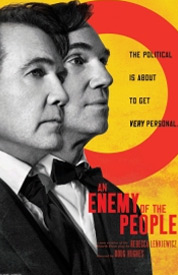
Boyd Gaines and Richard Thomas sparring with seething and faltering restraint may be the finest five minutes on Broadway this year. There is a moment so powerful that the full house holds its collective breath. What good fortune that there is more than five glorious minutes to An Enemy Of The People.
Rebecca Lenkiewicz has adapted this Henrik Ibsen play, which was previously adapted by Arthur Miller. While there are many sparks of modernity in the dialogue it is still clearly Ibsen’s treatises. Mr. Gaines’ Dr. Thomas Stockmann is the voice of the playwright, driven by his pursuit of truth in black and white. Mr. Thomas plays his brother and town mayor Peter Stockmann. The mayor has an enormous investment in the small town’s baths business. He is also the benevolent benefactor arranging for his brother’s employment with the baths’ administration. The bohemian medical brother with his boisterous family is in stark contrast to the restrained top hat and walking stick mayoral brother. Their differences grow starker as the good doctor receives confirmation of his suspicions of water contamination in the baths. It is then that all hell breaks loose.
Many will experience the positions and platforms of journalism, politics and economics to be achingly timely, but in fact they are timeless. The shifting positions and arguments sound excruciatingly familiar but that is because they never change. The masses are not necessarily equipped to lead. Truth may feel more important than commerce, but eating is important. Loudly chanting rhetoric doesn’t make the rhetoric true. People tend to worship the one wearing the fanciest hat. Where these powerful themes fall short is in their obvious biographical nature. It becomes challenging during some of the more heated tirades to see past an angry playwright. The ending moment of the production reinforces this response.
It is through the powerful and nuanced performances which include; Gerry Bamman(Alaksen,) Michael Siberry (Morton,) John Procaccino (Hovstad) that the whole becomes flawless. Directed elegantly by Doug Hughes, the characters and action seem to float. The staging and sound (David Van Tieghem) of the town meeting scene is simply fantastic. The audience, with very little fanfare, seamlessly morphs into the townspeople. We are not just being told how mob mentality develops we experience it firsthand. John Lee Beatty’s set is starkly apt and very cleverly designed. It’s less of a set and more of a world.
This Manhattan Theatre Club production should be seen for the very fine performances, intriguing themes, splendid production, and believe it or not; the laughs.
Tags: An Enemy of the People 2012, Arthur Miller, Boyd Gaines, Brenda Tobias, Broadway, David Van Tieghem, Doug Hughes, Gerry Balmman, Henrik Ibsen, John Lee Beatty, John Proccaccino, Manhattan Theatre Club, Michael Siberry, Rebecca Lenkiewicsz, Review, Richard Thomas, theater, Theatre

When they offered tickets to Hugh Jackman’s staged concert at $250, I was concerned. When they raised the price to $350 I felt a spell coming on. I cast no dispersions on Mr. Jackman. I have seen him perform live (at the Tony awards) and he is a gem. I am also a believer in a free economy and can often be spotted muttering; “people will buy whatever you sell them.” Yet, there is something about the pricing of these tickets that is disturbing me beyond all reason.
I am not an economist (to such an extent, I hear only white noise when people discuss long-term investments,) but I feel in my bones, that there is something “off” about a $350 ticket to a performance of anything. I will defend Mr. Jackman’s producers’ right to charge whatever people will pay, but I have trepidation. I’m worried about what this will (continue to) lead to.
For decades, people have paid extraordinary sums to attend concerts. Even un-scalped tickets have been in the triple digits for quite some time. I’ve long suspected it is due to the rarity of seeing what you’ve been hearing. In that vein, Mr. Jackman’s ticket pricing is almost normative, however I’m willing to wager that his audience is thinking; “Broadway show” not “Concert.” Therein lies the concern. If in fact we are creating/supporting a theatre audience who will pay $350 for a concert, is this helping or hurting Broadway?
How do we support a rich creative process for producing new theatrical works of art in a world in which a producer can charge $350 for a concert on Broadway? In 1961 a ticket to see Judy Garland concert (a comparison, no doubt The Boy From Oz would appreciate) was $7.00. In 1961 the average Broadway theatre ticket was between $5.00 and $9.00. I don’t pretend that this 1:1 ratio does or should still exist. I would however, urge us to detect a trend in the amount of offerings (and pricing) of 1961 Broadway and that of 2011.
When jukebox, comic book and made-from-t.v.-or-film musicals, are bringing in millions, is there still room for new book musicals? Do they even belong on the main-stage any longer? Every couple of years we are graced with an inspiring wonderful new musical. The Light In The Piazza (2005,) Spring Awakening (2006) and Passing Strange (2008) come to mind as shocking in their originality and magic. These shows bubbled up like a tree growing in Brooklyn; defying all odds. If you are a producer how much are you willing to risk? A million dollars invested in a Hugh Jackman show or a jukebox musical cast with contest winners will guarantee a healthy return and perhaps a step onto the stage at the Tony awards. Isn’t that prospect a little more enticing than ponying up a million dollars for something which artistically makes one’s heart sing, but comes with no prospect of a $350 ticket? Where does this leave/lead us?
Tags: 1960 Broadway, 1961 Broadway, Brenda Tobias, Broadway, concerts, Hugh Jackman, Judy Garland, jukebox musical, Max Bialystock, musicals, Passing Strange, plays, producers, Spring Awakening, The Boy From Oz, The Light In The Piazza, The Producers, theater, Theatre


 Here She Is Boys