RSS

Tag Archives: Review

Talley’s Folly – Review

talley's folly

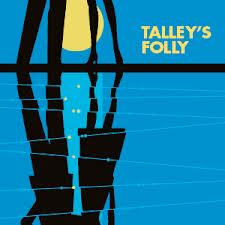
The curtain-less stage, set for Talley’s Folly (by Jeff Cowie) is impossible to ignore. The southern weathered boathouse littered with rusted and discarded objects begs for the arrival of Miss Havisham. The small apron of the Laura Pel’s stage is festooned in large cartoon-like flowers, setting the stage if you will for this realistic play that knows it’s a play.

Lanford Wilson’s 1979 Pulitzer Prize play begins with eliminating the fourth wall. Matt Friedman (Danny Burstein) walks through the house and onto the stage and announces how long the play will be and why he’s there. He repeats his opening speech (at a higher speed) for latecomers. For audience members who cling affectionately to the fourth wall, this is somewhat terrifying. But before we have time to rethink our choices, a halting and delicate story unfolds and we are immersed, enthralled and utterly smitten. We meet Sally Talley (Sarah Paulson) whom Matt has traveled to woo. Theirs is not an easy courtship. In fact at times it would seem that whatever courtship there is only exists in Matt’s mind. Sally is a lovely blonde woman from a wealthy family that is less than thrilled with the existence of the obviously Jewish and vaguely European Matt. That the play takes place during World War II is interesting but not all that relevant. The family’s attitude is timeless as is the story of Matt and Sally. To outline what occurs between them in the course of 90 minutes would deny potential audiences the real pleasure of this play.

Mr. Burstein who if truth be told, owns any role he plays, is Matt Friedman. True the role will always conjure its creation by Judd Hirsch’s (in 1979), but Mr. Burstein is not in anyone’s shadow. He is larger than his physical self yet not in anyway overblown. He plumbs the humor while swallowing the pain. Matt Friedman could easily become pitiable, but Burstein never allows that to occur. Ms. Paulson could easily become set dressing in his presence but under Michael Wilson’s direction they shine equally upon the stage. While we at times we become frustrated by Sally, we never once doubt her. The actors capture the realism and the poetry of Matt and Sally; we ache for them and we cheer for them.

The Roundabout Theatre’s Talley’s Folly opens on March 5th

 
Leave a comment

Posted by on February 28, 2013 in Uncategorized


Tags: , , , , , , , , , , , , , ,

Picnic – Review

picnic

There are theatrical experiences so real, so raw that it is only when the house lights go up that you remember where you are. Time passes imperceptibly and there is no one to your right or left, just those people up on the stage. Such is the mesmerizing effect of the Roundabout Theatre Company’s Picnic (by William Inge.) Directed by Sam Gold and with an ensemble cast only dreamed of in parlor games, Picnic is a feast.

The set (Andrew Lieberman) is brilliant, designed with the (harmless) voyeur in mind. The Owens house is front and center with many rooms visible. Scenes play in and out of the house and across yards and we watch from across the way. We watch Flo Owens (Mare Winningham) long for what’s best for her daughters Madge (Maggie Grace) and Millie (Madeline Martin.) We watch the Owens boarder Rosemary (Elizabeth Marvel) grasp at a chance for happiness. And Mrs.Potts (Ellen Burstyn) watches them because it makes her feel alive and gives her respite from a demanding invalid mother. There are men who propel the motion of their lives as well. Howard (Reed Birney) has been a steady presence in Rosemary’s life and Alan (Ben Rappaport) may just be Madge’s future. It is Hal (Sebastian Stan) who comes to upend their lives.

Picnic really is the story of women and how they live within the social confines of the 1950s and manage their desires. Flo, a single parent for many years, knows her daughters can have more than she ever did. She sees the artistic and intellectual gifts of her youngest Millie. Her elder Madge is stunning and Flo recognizes her beauty for the commodity it is. She is blunt with Madge about the shelf life of such an asset. Madge doesn’t see the point in being pretty, although she certainly does manage to have a great deal of fun with her looks. She’s savvy enough to realize that her sister has far more than she ever will. Flo sees Al as Madge’s ticket to the good life and encourages her daughter to fake passion to gain his commitment. Rosemary, the ‘spinster school teacher’ of a certain age is coming up right to the edge. She is a ball of fire and energy and is filled with more life than the women half her age. She senses (as Flo does about Madge) that it’s now or never.

It is this urgency of both Flo and Rosemary that provide the most powerful moments of the play. The power and anguish unleashed is unsettling. There is an impulse to turn away. But watching Ms. Winningham and Ms. Burstyn together is not to be missed. And to watch Ms. Marvel in what can only be called a Tony worthy performance is amazing. Ms. Marvel is unrecognizable physically. Normally a lovely and graceful, erect woman, she is curved and springy as Rosemary. In her wig and costume she is reminiscent of an energetic Eileen Heckart. It is her performance and her scenes with Howard that will linger. Their relationship and Rosemary’s longing are played out in a stirring dance sequence (Chase Brock choreographer.)

If there is any weakness in this magnificent production it is that of the ingenue casting. Watching Madge struggle with the superficiality of her ‘gift’ would be more compelling with a more layered actress. Casting Ms. Grace was an interesting stroke of realism, but might have missed to mark just a bit. Mr. Stan conveys a splendid mix of ingratiating grifter and wounded soul, but physically he may not be ideal. There isn’t enough difference in presence between Hal and Al to fully grasp Madge’s attraction. But as this play belongs to the grown women, it’s a minor point.

For all of its very raw and heartbreaking moments, Picnic is an uplifting play. Witnessing people finding their way and grasping joy is always inspiring. And there may never be a stronger ensemble and director than that of this production.

 
3 Comments

Posted by on December 27, 2012 in Uncategorized


Tags: , , , , , , , , , , , , , , , , , ,

The Anarchist – Review

Unknown

The Anarchist is a brief (in length and run) new play by David Mamet. It features two characters on stage for an uninterrupted 70 minutes. Cathy (played by Patti LuPone) is a convict serving her 35th year and Ann (played by Debra Winger) is a wardenesque woman serving her last day at the penitentiary. They are together performing the dance of “I’d like to be released now please.” And the dance is not well choreographed.

Cathy proclaims her interest in Christianity as an indication of her worthiness of release. This device is a bit blurry. She was born and raised by Jews (who it would appear gave her the name Catherine) and has discovered the New Testament in prison. Does she speak with the fervor of a tent preacher to impress the cross wearing Ann? If not, why work so much of the theology into the dialogue?  A sense of urgency is implied with the device of Ann’s last day, but why? Ann is not particularly lenient or empathetic. Maybe Cathy’s chances for being sprung will improve with a new administrator. If there is dramatic tension it’s buried too deeply to detect.

Mamet’s dialogue seems to have undergone a conversion as well. A Sunday school teacher would be pleased. However the rhythm is still quintessential Mamet. Ms. Lupone is comfortably at home in this musicality. She is at complete ease and utterly graceful with the dialogue. Ms. Winger is much less so and is not served well by Mr. Mamet’s direction. He has created a wooden and opaque portrayal in her Ann.

There are certainly interesting ideas conveyed throughout the play. Cathy’s (Weather Underground) crimes promise to evoke mixed feelings in audiences of a certain age. The psycho/social scholar will be intrigued with the debate over rehabilitation. There is also much to gain from watching Ms. LuPone stripped of song and embracing her dramatic roots. But watching The Anarchist is more akin to watching a (good) poetry reading than a play. Inserting dramatic tension into the script, recasting the role of Ann, and not having the playwright as director might result in a nice little play.

 
Leave a comment

Posted by on December 6, 2012 in Uncategorized


Tags: , , , , , , , , , , ,

A Really Big Show

Even if you’d never watched the Ed Sullivan show, you probably know what it was. The variety show brought the Beatles to television. Ed and his show played a central part in the Broadway musical (and film) Bye Bye Birdie. Any1950s-1960s period film or television series will make mention of or reference to Ed Sullivan. Ed and his really big show, liked to discover talent. He was an American popular culture tastemaker for decades. He wasn’t a performer in any traditional sense; he was a host.

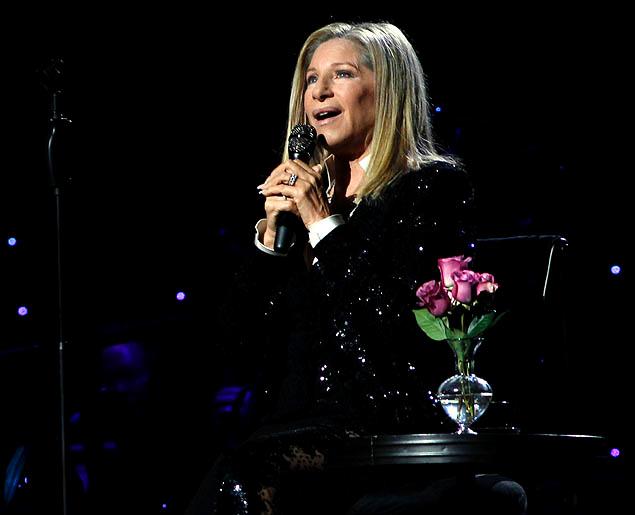
That would be where Barbra Streisand’s new show and Mr. Sullivan’s old show part company. Barbra is a performer and (just in case you missed it) is performing in Brooklyn for the first time. Her show, at the spanking new Barclays Center, entitled Back To Brooklyn, opened last night. It was a long show featuring several performers and videos. She sang some too.

The concert (with a start time of 8:00 PM) started some time after 8:30 PM. It was fun to picture the ghost of Judy Garland whispering in Barbra’s ear; “not yet, you can’t go out yet.” A slideshow of Barbra’s childhood to Funny Girl played on the scrim while the ravishing orchestra treated the audience to beautiful arrangements of bits of her best. The scrim dropped (in a rather quaint old-fashioned stage-handy manner) and the stage was revealed. The stage was designed in and around the orchestra, allowing the audience full view of the wonderful musicians. Barbra appeared and bantered her way into “As If We Never Said Good-bye” from Sunset Boulevard. Whether the song benefited from altering the lyrics to include words such as “lox, knish, and Flatbush” is a matter of personal taste. Shortly after the song, and after many unsuccessful attempts, the audience was able to communicate that the spotlights aimed at the audience’s eyes (for the past hour) must be turned off. Blessedly she got it and took care of her audience. We were then able to see her ravishing self. In the first of three outfits (not including a sequined James Brown cape) she was spectacular.

After a few songs the first of her guests were presented. A young Italian singing trio; Il Volo took the stage; engaged in some rehearsed banter, and sang one song with Barbra. Barbra then left the stage for Il Volo to perform on their own. They have strong, if not particularly interesting voices, but it felt odd to sit through an opening act during a concert already in progress. Barbra returned and sang a bit more and answered (prescreened) question, at times quite humorously. More acts were introduced throughout the night; a trumpeter, a violinist, a drummer, and a children’s choir. If your musical taste is the same as Ms. Streisand this may have been a welcome treat. There was one guest who added tremendously to the evening. The audience was introduced to the guest via a film (one of three shown about Barbra.) This was a film Barbra’s son Jason had made for her birthday. It was a lovely montage of mother and son photos throughout the years (with ages 8-24 somewhat missing in action.) The audio was a stirring rendition of Nature Boy (Nat King Cole) sung by none other than Jason. He joined his mother on stage for what was without question the best 15 minutes of the concert. Jason appeared slightly nervous, and extremely handsome. Barbra simply melted in his pressence. She was a maternal puddle and a swooning fan. Mr. Gould does have a beautiful, pure and strong voice. He seems to have found a sound that is all his own, yet not surprisingly he blended perfectly with his mother in duet.

Barbra’s solo numbers included a brief tribute to her recently departed friend and colleague Marvin Hamlisch and a nice shout-out to the late Donna Summer. The bells and whistles number was most certainly the show-tune medley (2 parts Gypsy and 1 part Funny Girl.) Other audience favorites included; Evergreen, People, and Happy Days. All songs had been newly arranged to accommodate her range. It created an interesting effect, similar to seeing a new interpretation of a classic play. Her voice has changed rather noticeably. It was a bit stressful for the audience to worry about notes being hit. She is a seasoned (to put it mildly) performer and knew just how to recover each and every time.

Audiences will not be disappointed if they are prepared for a variety show. No doubt when the show hits the road it will no longer be called; “Back To Brooklyn.” A more apt title might be; “Barbra and Friends.”

 
Leave a comment

Posted by on October 12, 2012 in Uncategorized


Tags: , , , , , , , , , , , ,

Who’s Afraid Of Virginia Woolf? – Review

Why in the world would a person willingly see a (three hour) play for the fourth time? How strong a suspicion would that viewer have of seeing something completely new? Very strong, 100 proof strong. From the very first sound (Martha’s gentle laughing off-stage) it was clear that this was a new George and Martha. Amy Morton and Tracy Letts, by way of Steppenwolf (and August Osage Country fame) are so very human that watching this production, directed by Pam MacKinnon is more akin to peeking in a window than looking at a stage.

Martha is often portrayed as a braying overtly sexual ball of venom. George is frequently placid and defeated. Ms. Morton & Mr. Letts have no interest in going down that road. When George refers to Martha’s party behavior as braying, her retort is barely in an outdoor voice. It’s then that we know this George and Martha are equally matched in their ferocity. Their words and manners, so natural and true, add a dimension to the rawness of their story, their marriage. Mr. Letts’ George is strong and knowing and funny. The treatment of Martha’s sensuality is an interesting interpretation. Many a Martha has climbed Nick as a boozy floozy in a too tight top. Ms. Morton seduces Nick in the least sexy of ways. She stumbles and clinically performs the seduction in a desperate attempt to have her husband respond. Nick’s interest is seen more clearly for what it is; ambition.

Nick and Honey, perfectly cast with Madison Dirks and Carrie Coon are far less naive and childlike than we’re accustomed. Nick holds his own amidst the incoming shells. Honey is young and quite tipsy, but very real and recognizable. The play motors along via free-range party games (Hump the Hostess, Bringing Up Baby, Get the Guests) as we discover what lies beneath. With the lower volume of this production we can really hear what is and what isn’t being said.

Ms. MacKinnon’s pacing and staging is fast and fluid. A magic trick of sorts results in the three acts rushing by as we simultaneously feel the characters’ building exhaustion. (This play should always been seen at night, preferably late at night.) Who’s Afraid of Virginia Woolf opens at the Booth Theatre on the 50th anniversary of its premiere (October 13th.) This production is a poignant and powerful tribute to Edward Albee’s most popular play.

 
Leave a comment

Posted by on September 29, 2012 in Uncategorized


Tags: , , , , , , , , , , , ,