RSS

Tag Archives: Brenda Tobias

The Lady Business Monologue

old_tampon_ad

There is nothing quite like old movies, advertising or television shows when it comes to social anthropology. Nobody would confuse plot points, costuming or set design with real life. But dialogue is very representative of the way in which people spoke at the time of filming. We can look at films from the 1940s and 1950s and sense racial views of the times. We can watch television of the 1960s and 1970s and see the overt anti-gay sensibilities. Today most film and television depicts bigotry only to make a point. There is one area of bigotry that never seems to have really changed however, and that’s misogyny.

Whether it’s in the casting or the storytelling, women are still objectified and marginalized. Male actors of every age, size, attractiveness and skin condition are regularly cast in prominent roles. Women of one size, one look, one age group and one hairstyle populate film & television roles. If you are an actress who is not a willowy, bouncy haired, 20-35 year old with a symmetrical face you’re lucky to get character roles. Yes, there are exceptions. But for the most part paunchy women over 70 are not getting the guy. The roles themselves often marginalize women. Accomplished doctors, detectives or spies still need to be fashionable and coiffed. When women are depicted as more than a collection of strategically placed highlights they are made to be a masculine cartoon. Even in the most “realistic” television dramas we never see women discussing or experiencing anything about being a woman. Has there ever been a cop show that explains how a female cop on a stakeout deals with her period? Sex, or servicing men is discussed and depicted continuously. Characters are always getting pregnant (and of course having the baby or losing the pregnancy naturally) so someone must be menstruating!

It’s not all that surprising that in the 21st century we still don’t discuss menstruation except as an insult. That’s right, in 2013 it is still perfectly acceptable to refer to someone as “having their period” when the accuser dislikes the behavior of the accused. It is still acceptable to refer to men as “ladies” or “girls” as an insult. In all manner of workplace you can hear these accusations. Imagine just for a moment that instead of hurling a female term as an insult, it was an ethnic or racial term. We wouldn’t and shouldn’t tolerate it. But insulting someone by calling them a woman; that’s cool. And why not; women tolerate it and even perpetuate it. Women will use the word “girl” to deride (ex., you are such a girl.) Women screenwriters, directors and casting agents perpetuate the one-dimensionality of female characters in film and television. And almost all women everywhere persist in using the incorrect terminology for their own genitalia.

Even those now famous monologues about that part of the body, use the wrong terminology. The vagina is one very specific part of the genitalia. The vagina is the internal, or birth canal, part of the female genitalia. Vulva is everything else (and from a sexual response perspective; what matters most.) Using inaccurate terminology is always troubling. Often, if not always, there is an underlying message in such choices. It is quite possible that the term “vagina” first became popular in the medical field (that same medical field that labeled women as hysterics and viewed sexually responsive women as flawed and/or dangerous.) The (male) medical field singled out the part of the female genitalia that most affected them. The vulva has no role in male satisfaction or in birthing. This is a reasonable explanation/theory. But why have women perpetuated this inaccuracy? We teach our children the word vagina, while we teach them all of the proper terms for male genitalia. We don’t refer to testicles as penises. We don’t refer to foreskin as penises. We use the correct terminology for all parts of male genitalia.

Does all this sound cranky, distasteful and maybe even a bit irrational? Are you thinking; “well someone’s got her period!” As a matter of fact, I don’t. But if I did, I wouldn’t whisper it or discreetly palm a tampon on my way to the bathroom. I don’t routinely discuss anyone’s genitalia in public, and wish I didn’t feel compelled to now. But it is one (important) piece of a troubling puzzle. We should teach our children body pride not body shame. We should correct them when they accuse someone of “throwing like a girl” or “crying like a girl.” We should stop ourselves and correct others when insulting someone with female allusions. It’s not a matter of political correctness; it is a matter of correctness. There is something wrong with considering “acting like a man” to be a compliment and “acting like a woman” to be an insult.

 
2 Comments

Posted by on September 7, 2013 in Cultural Critique, Media/Marketing


Tags: , , , , , , , , , , , , ,

Flowerless STEM

stem

STEM is such an oft-used acronym that people outside of the education industry no longer think of flowers and plants when hearing it. The origin of Science, Technology, Engineering and Math emphasis is a response to the United States’ position in the international market. In 2006 President G.W. Bush initiated policies to increase federal funding to support STEM education and output as a response to concerns that the U.S. was falling behind. That same year the Unites Sates National Academies (comprised of; National Academy of Sciences, National Academy of Engineering, Institute of Medicine, National Research Council) issued a plan to federal policy makers to address their concerns regarding the declining state of U.S. STEM education. When the President and national academies directly involved with very lucrative industry call for action, attention is usually paid.

Not many people would argue with improved education and higher standards in any subject. But when an initiative seems reactionary and the response narrow in focus, there is concern. Determining that there is an industry, in which the U.S. is not leading the way let alone keeping up, is relatively unprecedented. It is no wonder that we’ve reacted so strongly and rapidly. It’s a little disconcerting to start to lose one’s superpowers. But to focus on one area of study is tantamount to remodeling K-12 public education into vocational training. To do this while ignoring what other factors make many other nations superior in their industry and education is shortsighted. There are so many cultural, political and traditional differences in the ways countries conduct their business and education.

There are places in which children attend school six days a week and are in lengthy after school classes well into the evening. (There are countries in which one’s work life is as intense and prescribed as well.) There are countries in which K-12 educators are highly trained and paid and are given professional latitude and respect. But we don’t seem to be selecting much from the international buffet table beyond STEM emphasis; and that is what leads to thoughts of shortsightedness. When the money and policies are focused on one area it is inevitable that other areas will suffer. It is often those areas that are less quantifiable but no less necessary in the modern world. Most often and most likely it is Language Arts, History and the Fine Arts that are left behind. Science, math, engineering and technology are fabulous tools to help to understand how our world works and how to work within it. But being well educated is more than being well trained in one area. Understanding the world around us and knowing how to communicate to that world in which we live, knowing how to write, speak, and process the written word are crucial skills; without them there is no sharing of STEM or any other discoveries.

Without a sense of national and international history we are destined to stumble through the world half-seeing. Without exposure and access to the performing and fine arts what (to paraphrase President Franklin D. Roosevelt) are we even fighting for? The arts reflect the times in which they were created and are vibrant and pulsing history lessons. They also stretch the intellect and help us to see the entire world in more vibrant hues. Education (unlike job training) is meant to open and fill our minds. We need to be taught subjects but also how to critically think for ourselves. Education should be broad, deep and challenging. We should bolster STEM studies, and we should also ramp up all liberal arts studies. There will never be a national consortium of arts organizations with serious economic juice. But it is certainly well within the power of federal policy makers to invest in well-rounded education for all.

We have never been a country striving to make everything the same. We celebrate our diversities. We get a kick out of our different dialects, names for foods, and local customs. We are a 31 flavors kinda people. Do we really want the primary focus of our K-12 system to be in one subject area? Where will the political scientists, playwrights and lawyers come from? How will we get well-rounded novelists, historians and Supreme Court justices? There’s no doubt that our education system is not what it once was. Schools are asked to do way too many things besides educate, teachers are not treated well, and funding is elusive. The answer is not to be found by sticking our fingers in our ears and muttering “la la la STEM.’ We’re better than that, we’re bigger than that and we’re certainly more interesting than that.

 
Leave a comment

Posted by on September 3, 2013 in Education


Tags: , , , , , , , , , , , , , , , , , , , ,

Keep Your Eyes On The Prize

CRM

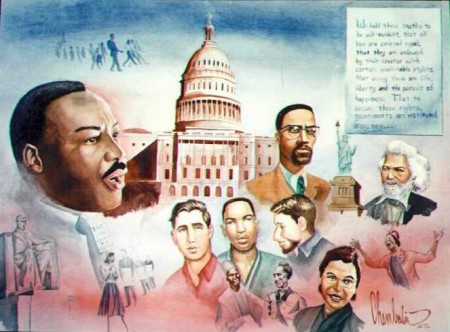
Your age has a direct effect on what you are taught in history class. If you were in school during the Vietnam War, chances are you weren’t being taught anything about it (save for a current event discussion or two.) If you attended school immediately following World War II, curriculum didn’t include a section on internment camps. But these gaps, in theory, should be closed by life experience. Home life, including television, and adult learning (in any form) should eventually create a seamless sense of American history.

Whether unique or not (my personal) recent experience would dispute this scenario. Conversations prompted by the 50th anniversary of The March on Washington have revealed startling ignorance of (relatively) recent American history. My (utterly unscientific) sample included people in every decade from 20s – 70s. It would be a safe assumption that those people in their late 40s to early 50s might not have a full understanding of the history of the civil rights movement. The March, which many would identify as the fulcrum of the movement, happened before their arrival or shortly thereafter. But that particular (non-random, self-selecting) sample was not lacking in information. It was the younger people who seemed to have no knowledge beyond there having been a speech. What led to the March, the climate at the time, the danger, the heroism, and the cast of characters were all news to them. Even those at the anniversary celebration on the National Mall (presumably having an interest in the subject) did not appreciate the significance of the ringing of the bell salvaged from the Birmingham 16th Street Baptist Church.

Going beyond the 1963 March and the people who brought it to life, are the politics that preceded and proceeded. The significance of speakers; Lynda Bird Johnson Robb and Caroline Kennedy was lost on those in their 20s and 30s. More than once I dutifully explained the civil rights legislation that was crafted and signed by their respective fathers. It is hard to fathom how the details of the civil rights movement and all that happened in the 1960s could not be a major part of K-12 American history. History, like most subjects, builds on prior knowledge. Without covering the civil rights movement how does one teach women’s rights, union/migrant workers’ rights and the LGBT movement? How does one cover international civil rights and racial/ethnic issues without discussing our own domestic fight?

I’ve actually no doubt that the civil rights movement is comprehensively covered in many (if not most) schools across the nation. I suspect that the reason for those blank stares and awkward silences I received was due to the time period in which the students were taught. Learning about the 1960s in the 1980s or 1990s must have seemed abstract. Growing up in a Reagan, “greed is good”, post-affirmative action, post-Title IX world, would make the black and white imagery seem archaic and less relatable. But the thing is, it’s not an abstraction. A lack of understanding about the fight (that has not yet been won) is dangerous. If we aren’t conscious we can let too many things slide. When we see things out of context we are more willing to wave our hand and dismiss bigotry or racism. When we don’t know about the Voting Rights Act we might not notice it slipping away.

What we learned in school (whether in the classroom or out) will always shape us to some degree. But that learning and understanding should just be the start of understanding our world. We need to know what came before to appreciate how best to go forward. It is worth mention that my random unscientific sample included people of varying ethnicity and race. The lack of knowledge/understanding was equally distributed. A woman standing behind me (at the 50th anniversary) referred to Dr. Martin Luther King Jr.’s infamous speech as ending the KKK and white supremacy. Part of me wanted to live in her world, but the other part of me wanted to forcibly open her eyes.

 
Leave a comment

Posted by on September 1, 2013 in Cultural Critique, Education


Tags: , , , , , , , , , , , , , , , , , , , , , , ,

Still Dreaming After All These Years

Getty Images

Fifty years is a long time; a very long time. A 50th anniversary is always worthy of commemoration, and naturally occurs within the framework of modernity. Fifty years ago, on an oppressively hot humid day on August 28th, 1963, hundreds of thousands of people marched for freedom and jobs in an event twenty years in the making. They came on buses, trains and on foot; slept wherever they could or perhaps not at all. They marched through the nation’s capital, towards the mall, not knowing what to expect or how things might end. It was a dangerous time for protestors and in Washington D.C.; imprisonment, beatings and even killings were (and continued) to occur. But they came in their finest, marching and standing in that unrelenting heat all day long.

Fifty years later, in 2013, it took days of events to commemorate all that occurred on that one day. A week’s worth of marches, demonstrations, speeches, and festivities culminated in an all-day rally on August 28th, 2013. Over five hours a schedule of military minute precision brought performers and speakers to the steps of the Lincoln Memorial. Early on the crowd (which stretched from monument to monument) was led by Andrew Young in; Woke Up This Morning With My Mind Stayed On Freedom. This set a communal tone for a crowd diverse in age, background and agenda. Another sing-along that either conjured strong memories or made one think of one’s parents, was Peter and Paul singing Blowin’ In The Wind. Anyone familiar with Peter (in particular, but also,) Paul and the late Mary won’t be surprised to learn that Trayvon Martin’s parents stood with the performers. Many who took the stage were living remembrances of the 1963 March. Representative John Lewis (the youngest speaker in 1963) invoked sentiments repeatedly echoed on the steps; “The scars and stains of racism still remain deeply embedded in American society, whether it is stop and frisk in New York or injustice in Trayvon Martin case in Florida, the mass incarceration of millions of Americans, immigrants hiding in fear in the shadow of our society, unemployment, homelessness, poverty, hunger or the renewed struggle for voting rights. So I say to each of us today, we must never, ever give up. We must, ever give in. We must keep the faith and keep our eyes on the prize.”

Two of Dr. King’s children spoke, but it was Christine King Farris, King’s older sister who surprised and moved the crowd. She referred to herself as perhaps not the oldest person present but certainly the only one who had known Dr. King since he was in diapers. She hadn’t been able to attend 50 years prior, due to a bad flu, but had watched her brother on television and knew something magical had happened. She spoke eloquently, powerfully and personally and the crowd felt they had been invited into the circle. Reverend Bernice King, clearly inheriting her father’s gift for oration, was inspiring; “We are still chained by economic disparities, class inequalities and conditions of poverty for many of God’s children in this nation and around the world. If we are going to continue the struggle for freedom and create true community, then we will have to be relentless in exposing, confronting and ridding ourselves of the mindset of pride, and greed, and selfishness, and hate, and lust, and fear, and idleness, and lack of purpose and lack of love as my brother said for our neighbor.” She ended her remarks at precisely 3:00 PM for the ringing of the bell. The bell, the crowd learned, was salvaged from the Birmingham Baptist Church, a reminder of the extraordinary sacrifices that led us to this day.

The most remarkable aspect of the day’s programming was that of having three United States Presidents on the agenda. Presidents Carter, Clinton and Obama were greeted like rock stars and did not disappoint. They paid homage to the work of Dr. King and the strides of the movement, but as one would expect from world leaders, they also carefully criticized complacency, or worse; backsliding. It is a difficult conundrum, complacency. While it is natural to be reactionary to policies and actions that are blatantly racist, it is challenging to keep the fire burning day to day. When we are no longer daily confronted with signs of “Whites Only” or bus and school segregation, our shoulders lower and we breathe easier. But, as the speakers reminded us throughout the day, there is so much left to do. Poverty, incarceration, immigration, voting rights and equality are very current issues. Progress has been made, but we are nowhere near the finish line.

It is so tempting to lose our focus, to give into distraction. In fifty years we’ve evolved into a nation of perpetual distraction and extroversion. Where the 1963 March was an open and accessible event, the 2013 event was constrained and produced for the media. Enormous television camera towers blocked the view for all but the “ticketed” attendees (an oddity juxtaposed to a day celebrating equality.) Celebrities with no obvious connection to the movement spoke and sang (or lip synched) for the cameras. Two dance groups (in very photogenic costume) performed, an odd artistic choice for any rally with limited views. The singers (except for Peter and Paul) sang gospel music, even though international (and even national) folk singers still abound today. But the 2013 event was packaged for viewers back home. That isn’t necessarily bad, it’s just different. As were the 20-somethings playing candy crush during the speakers, and the thousands of selfie pics being taken throughout the day. But amongst all that noise were young, middle-aged and 1963 alumni, riveted and moved. Heads bowed and bobbed, hands waved in solidarity and to this attendee it looked like hope.

 
Leave a comment

Posted by on August 29, 2013 in Cultural Critique


Tags: , , , , , , , , , , , , , , , , , , , , ,

Stick ‘Em Up!

davy

Every so often a new study posits the link between media violence and real violence. The theory most often is that children exposed to violent themes and games become inured to real violence and thus more likely to commit violent acts. There is a certain logic to the premise but is it really that straightforward? Hasn’t violent play always existed?

People raised during the earlier days of television were exposed to far more violent images than their moving picture going or radio listening ancestors. A child growing up in the 1950s was immersed in cowboy-shoot-em-up imagery and play. Cowboy and cowgirl costumes (replete with guns and holsters) were not just Halloween costumes; they were toys. Television, movies, books, comic books and creative play was rife with shooting. Even Superman (the television show) had people shooting (and killing) people. Toy soldiers, G.I. Joe and war games have been a part of child’s play since the advent of war. But all of this happened in a distinct child’s world, in which an adult (related or not) was always at the ready to impose adult order. The world belonged to adults and children knew that. They were ever conscious of their place in the adult world and the distinct delineation between being a child and being an adult. Children engaged in unsupervised play and then returned to the structured adult world.

The adult world demanded marked different behavior than that of a child’s world. The language (e.g., slang, profanity,) manners, appearance and attire requirements in the adult world were different from that in the child’s world. Adults maintained the boundaries in various ways. There were many subjects that were not discussed in front of children (little pitchers have big ears; what in the world does that mean!?) Adults socialized without their children and enjoyed other privileges of adulthood (e.g., choosing which television shows were watched, what foods were eaten, which clothes were purchased, etc.) The rigidity of home life was countered with the wildly independent social life of a kid. Play was unsupervised and free-range. Children engaged in activities without parents. They played sports, danced and sang without their parents witnessing every single moment. They were in their world and they were just playing.

Children flourish when they can explore the world safely. Knowing that adults are in charge and are sure as shootin’ gonna tell them what to and not to do, is very comforting. However, if a child is left with a feeling that the adults are not in charge, or worse yet, the child is in control, that child can grown very frightened and insecure. The same child who senses that “no one is the boss of me” not only has a fuzzy sense of fiction and reality (which is an inherent part of childhood development and why children need parents) but also could possibly be left to immerse themselves far too often in violent games and play. There is nothing about holding a plastic gun and aiming it at a screen that is more violent than holding a Davy Crockett pistol against a friend’s head. However there is something numbing about playing alone and obsessively. An interesting treatment in these “violence studies” would to be to have one group of children “Go Outside And Play!”

This dance of control in which parents involve themselves in a child’s world and children are given equal footing in the family may not be the most effective formula for growing strong children. Children flourish when they are given limits. They want to grow up when being a grown-up looks better than being a kid. While there is nothing positive one could say about violent video games, it is short sighted to think any imagery in any form has the power to change collective behavior. Blurring the lines between reality and fantasy, and childhood and adulthood is much more likely to affect change. If in fact the exposure to violent imagery (in games, film, video, etc.) has risen and violence in children and young adults has risen, that is indeed correlation. But to suggest (yet again!) causation and wag our finger at the media makes us look silly and a bit irresponsible.

 
Leave a comment

Posted by on August 25, 2013 in Childhood, Media/Marketing


Tags: , , , , , , , ,