RSS

Tag Archives: Brenda Tobias

Why This Season Is Different From All Others

The tulips are up and open in our fair metropolis.  Their brief explosion of color the final reminder that the seasons they are changin’.  Spring, by far the most hopeful time of year, brings new beginnings and religious traditions.  Unlike the winter holidays; Easter and Passover are of equal importance to their respective observers.  Like their winter sister holidays; Easter is the more public holiday and Passover the more private.

Homes are not decorated (visible) for Passover, they are cleaned (invisible.)  While Easter’s children scurry about (in exquisitely gorgeous outfits) to seek hidden gifts and prizes, Passover’s children search inside their relative’s home for the matzo which will be traded for fabulous gifts and prizes.  Outside the White House, the lawn will be festooned with egg gathering children, and probably one of those frightening six-foot bunnies, while inside (this) president will be observing a Passover seder.

Passover, like Hanukkah is celebrated for eight days (in this country) but unlike Hanukkah it has stayed rather true to its roots and intentions.  Shopping malls are dotted with gargantuan bunnies (see above) and plastic eggs hang from limbs across America.  For years the winter version of these kinds of displays “egged” people to erect menorahs in town squares.  Why are there no giant seder plates or dangling matzo balls?  Could it be that preparing for Passover is just too exhausting to be bothered?  Or could it be that Passover is so steeped with significance and beautiful ritual that it needn’t try to compete with anything?

Whatever the reason, how wonderful that once a year so many in this country celebrate such meaningful holidays without competition or euphemisms.  There has yet (to my knowledge) to be a card created, covered in tulips which gently implores; “Happy Holiday.”  So before you bite off the ears of the chocolate bunny, or scrape the bottom of the coconut macaroon can, let me be the first to wish you a Happy Easter or a Good Passover.

 
Leave a comment

Posted by on April 4, 2012 in Holiday


Tags: , , , , , ,

I Can Read The Writing On The Wall*

Universities, public and private, are wrestling with affirmative action. Not just ‘still’ but seemingly more so than ever.  For most colleges, having a well-rounded student body is a priority.  Efforts are made to seek out and (sometimes) care for students that might not find their way to the institution on their own.  There are development programs, public and private, that partner with higher education to help nurture underrepresented students and increase their chances of academic success.  Universities should always look to create a student body that is representative of the world at large.  But the fact that they must go to the efforts they do (to seek them out) suggests that there are qualified students who are not bubbling up to the top.  Once out of K-12 and nurtured in the university, these recruited students do quite well (why wouldn’t they?)  Interestingly, college and university classes and life are far more challenging than anything in K-12.  Ability is not the issue here, preparation is.

What does it say that in 2012 the K-12 playing field is so clearly inequitable that higher education affirmative action efforts not only need to exist, but need to increase?  Yes, there will always be parents who have the means to throw every enrichment opportunity upon their child.  And yes, there will always be children who simply do not have a stellar academic acumen.  But then there’s everyone else, which really amounts to an awful lot of children.  At a time when as a group we believe that higher education is the path to work-life success, can we allow for such disparities in preparation?  Variety and rigor in science and mathematics courses vary widely across school systems.  There are schools at which writing (not penmanship, but writing) is not taught beyond the rudimentary.  High school students are not always assigned a smattering of classics to read.  Now before the eyes start rolling; the reason an educated child needs to be exposed to the classics is not so they have something to discuss with grandma at Thanksgiving, but because it fosters their understanding of the world and culture and is a building block for higher level studies.

There are school systems that have all the technological bells and whistles that property taxes will allow.  That’s fine, and maybe even results in higher comprehension, but it’s the sizzle of the issue not the steak.  Curriculum and teacher talent is at the heart of the issue.  Are there enough excellent teachers at each and every school in this country?  Are there tutoring opportunities, effective guidance counselors, and an atmosphere of optimism?  If we are sincere about wanting all children to succeed and want our nation to have a robust economy, it might be time to stop ignoring the inequities in public education and leaving it to colleges to amend.

*Kodachrome – Paul Simon (1973)

 
3 Comments

Posted by on April 2, 2012 in Education


Tags: , ,

The Lady From Dubuque – Review

Edward Albee is not for the faint of heart.  You would not take in a matinee of his, expecting a light and frothy afternoon.  What you will get is a beautifully crafted peek into the human spirit. Those spirits are fighting for their lives in The Lady From Dubuque (Signature Theatre.)

Set in a suburban home, the play takes place over the course of one night and the following day.  The play (directed by David Esbjornson) opens on three couples playing a party game that involves the (oft repeated) phrase; “Who am I?”  The hosts Sam (Michael Hayden) and Jo (Laila Robins) bear a passing resemblance to another Albee couple; George and Martha.  In this case however, Sam is weakened by the kryptonite of his wife’s terminal disease.  Jo is biting, but not nearly to the degree to which she is entitled.  Their friends are mostly silly.  Edgar (Thomas Jay Ryan) and Lucinda (Catherine Curtin) are that special blend of vapid and shrill that makes some people phobic of the suburbs.  Fred (C.J. Wilson) and his girlfriend (Tricia Paoloccio) are at least interesting by virtue of his vulgarity and her preening.  There’s a reason these people all drink.

A bit past the midway of the first act, Jo rapidly deteriorates in (literal) gut wrenching pain.  It is difficult to watch the exquisite portrayal.  When Edgar demands that Jo, writhing in agony on the floor, get up and go apologize to his wife, Lucinda for an insult, it is almost too much to witness.  But then he points out what is so true it can not be discounted; his wife did not cause Jo’s pain, but Jo had caused Lucinda’s.  As Jo struggles to her feet, she is living rather than dying.  It is her last act of physicality.  The first act ends with a cresendo of agonizing wails and the appearance of an otherworldly figure; Elizabeth (Jane Alexander) and a dashing escort; Oscar (Peter Francis James.)

The tone of the second act is decidedly more physical, combative and high stakes.  Sam is frightened by the arrival of Elizabeth, who claims to be Jo’s mother.  His hysteria heightens and results in him being restrained (and ‘put to sleep’ with a strategic touch by Oscar.)  While he cannot articulate it, Sam knows who these people really are and why they are there.  The reality of death is simply far too painful for him to realize.

The rhythm and banter of Albee’s dialogue is a perfect conduit for this allegory.  His characters are so raw and real they create a platform for the surrealism that could feel forced or twee.  This play was not well received in 1980.  Death rarely is.  The only sticking point, for this audience member, was the treatment of race.  Much is made of Oscar’s “blackness” and the transition from superfluous racial humor to minstrel is rapid and unpleasant.  No doubt there is a dramatic intent, it just alluded me.

This is a flawless and beautiful production and should be seen by many.

 
Leave a comment

Posted by on April 1, 2012 in Uncategorized


Tags: , , , , , , , , , , , , , ,

Not Alone In The Universe

Everyone likes to feel a little special sometimes.  When the man arriving at the available cab (at the exact same moment,) gestures to you and backs away; that’s nice.  Not just because you’ve had a long day and those shopping bags are not going to carry themselves, but because another person is acknowledging your existence.  We go through our days almost unnoticed, unless we are part of that small cluster of very recognizable people, who in fact go through their day trying not to be noticed.  We are regularly reminded of our Whoville-like stature when navigating customer service automated phone trees, chain pharmacies, education and health-care bureaucracies and banks.  We walk down the street having people barrel into us while they intently type. We are pummeled by double-wide strollers, rolling briefcases and backpacks.  We sit in restaurants shielding our food from the (repetitive) hairstyling of the woman seated at the next table.  We sit through symphonies, theatre, and religious ceremonies with the blue light of mini-screens shining intermittently.

This phenomenon; of craving to be acknowledged in a self-absorbed world, can turn into quite the carousel of fright.  The more we desire to be seen as something more than cellophane, the more we risk turning into them.  By them, of course, I mean the gentleman who sits on a jury after lying about his relationships with law enforcement (“hey, that rule doesn’t apply to me!”)  I certainly mean the schemers of Ponzi and traders of the inside.  Most of us aren’t exactly as bad as all that.  But at the root of that behavior is arrogance and entitlement, no?  Is that particular brand of motivation all that different from the “letting the dog off the leash” “bullying and tantrums on airplanes” “parking in handicapped spots” behavior?  These more minor infractions are probably even worse as they are the most contagious.  At some point taking one’s place in line, while others ignore the queue can make one feel a bit of a schmendrick.  Slowly, even the most civilized will start to experience “what about me?” syndrome.  Before you know it, the victim becomes the perpetrator.

Perhaps we could take a baby step in breaking the cycle, and start with simple semantics.  Let us take back the word “special”  We use it euphemistically and we use it to the point of meaninglessness.  We all want to feel special but none of us is special.  (Unique and special are not the same.) We are all entitled to the same respect and civility, and yes, the rules apply to all of us.  A person is a person no matter how small.  I propose a teeny tiny movement: Instead of talking about someone’s “special day” call it what it really is; It’s Your Birthday!  It’s Your Wedding Day! It’s Your Sentence Commutation Day!  It is not “their day” anymore than it is anyone else’s day.  It’s a bad mindset to indulge, even if it’s only annual.  Let today be the day we don’t confuse how someone should be treated with how someone should behave.  Let us shower the celebrant with good wishes and love because they are who they are, which is the best thing by far, because you-ness is better than being a star.

 
Leave a comment

Posted by on March 31, 2012 in Cultural Critique


Tags: , , , , ,

New To The Neighborhood

Why is it that time and time again we are ill prepared for entirely predictable events?  We know that giving birth and having an infant in the house will be all consuming and exhausting, but still feel surprised to find it to actually be so.  Freelancers, consultants, contract workers and artists, are serial professional monogamists, yet still experience disorientation at the end of each gig.  It stands to reason that (if we’re lucky) our parents will age.  Yet, with each incremental stage of their decline we feel ourselves breathless and floundering.  It’s in our best interest to be able to feel frightened or sad (lack of affect is a sign of serious trouble!) but why do we also feel “caught off guard?”

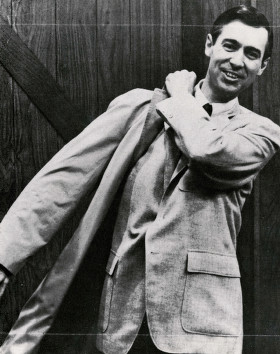
Nobody likes surprises (which is why surprise parties are only fun for the people planning them.)  One of Mr. Rogers‘ most insightful and comforting songs was I Like To Be Told.  He understood that children, with no frame of reference, find most of life surprising and unsettling.  But we grown-ups are supposed to be pretty well versed in the vagaries of life.  Of course events which could never be foreseen (both good and bad) occur, but it’s not those that leave us feeling as if we “really should have a better handle on this.”

Could it be that being truly conscious and cognizant of future hurdles and hardships is just not a pleasant way to live?  Would being at full boyscout readiness at all times rob us of the joys of spontaneity and hopefulness in life?  That could be the answer, if in fact cynics and pessimists find themselves in ship shape when things go a bit awry.  Does a gloomy Gus face a parent’s accident, illness or decline with an attitude of “finally! something I’m good at!”  Maybe.

What is really at the heart of the issue is that of mastery.  We feel caught off guard because of the novelty of the event in our own life.  Yes, we know the event is inevitable, but until we’ve tackled it head on and survived, we feel uncertain.  Life tilting events, by their very nature are not extremely repetitive (if you’re lucky) so there is little chance for mastery. With each of these events (illness, job loss, death, etc.) we feel as insecure as we did as children, yet the situation calls for us being our most adult.  The solution to our feelings of helplessness and insecurity is not to wish for more opportunities to develop mastery.  What we can do is remember that we know enough to do the very best we can do.  We’ve experienced bumps in the road before; this is not our first time at the rodeo if you will.  Hurdles are just that; hurdles.  There is quite a distance between each one (otherwise hurdles would be called bridges.)  When the floundering sensation becomes too much, never underestimate the restorative powers of a cup of tea, and a little Mr. Rogers.

It’s such a good feeling to know you’re alive.
It’s such a happy feeling: You’re growing inside.
And when you wake up ready to say,
‘I think I’ll make a snappy new day.’
It’s such a good feeling, a very good feeling,
The feeling you know that we’re friends. (Fred Rogers,1967)

 
2 Comments

Posted by on March 29, 2012 in Cultural Critique, Well-Being


Tags: , , , , ,