RSS

Tag Archives: Brenda Tobias

The People On The Bus

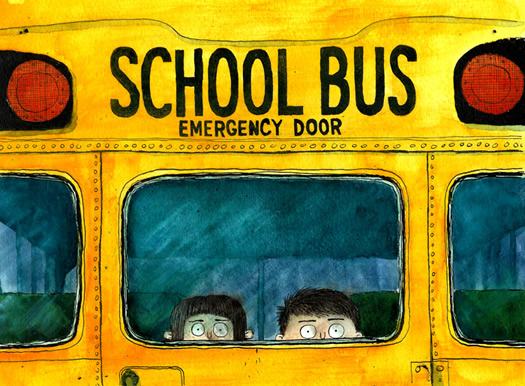
I never had to ride a bus to school, and that was a blessing.  To this day I’m still a little wary of them.  Rare class trips confirmed that they were the ideal breeding ground for my anxiety; an enclosed space with mysterious and opaque social rules and customs.  Where you sat and with whom was evidently meaningful to other riders.  On those rare trips I knew enough to stay clear of the back of the bus.  Even as a very small person I sensed that no good could come from being so far away from an adult.  As a younger child those seats seemed very high and quite conducive to hiding bad behavior.  Bad behavior has always frightened me.

A story of a bus matron (which we did not have on our class trips) being verbally abused by children does not surprise me.  Children are people.  Some people are lovely some are disgusting and some fall somewhere in-between.  What does seem inconceivable to me however is that this behavior would have continued for any amount of time.  It stands to reason that at least a handful of children on that bus are little versions of me.  They were frightened by the behavior.  The thought of getting on that bus every morning made their stomachs hurt.  They told their parents.  They asked to be driven to school.  They explained that they’re bad kids on the bus.  There is no vow of secrecy or non-disclosure agreement on the bus.  These are not members of organized crime.  They’re just kids that happen to live along the same bus route.  Someone (if not many) told.  Kids tell.

Following that theory (and it is just a theory, devoid of any factual support whatsoever) could it be that the parents did nothing to stop it?  Once we get past our shock, it does sound plausible, no?  Don’t we tend to assume that things are not our business?  Don’t we usually duck and dive under a bush to avoid any form of confrontation (unless it’s from the confines of our car and involves obscene gestures, or through anonymous comments on the web?)  Despite all government pleading, how many times do we really see something and say something?  Do we “suffer” through a broken streetlight, or wonky elevator?  Or do we fill out a maintenance report?  Do we gape, horrified at teenage girls pulling their tops up on the side of the highway?  Or do we explain how those photos they’re taking might someday limit their options in life?

Hopefully we speak up.  Hopefully we’ve been on the planet long enough to understand the dangers of silence.  Hopefully every day we choose to tip the balance away from disgusting and towards lovely.

 
Leave a comment

Posted by on June 23, 2012 in Childhood, Cultural Critique


Tags: , , , , , ,

Nobody’s Watching You

A therapist friend recently asked me for advice.  (No this isn’t the opening remark at the American Psychiatric Association convention.)  She was feeling remiss about starting, and not keeping up with, a blog.  What with her practice and her actual life, her energies didn’t seem to be directed into blogging.  I actively listened (until she took a long breath, I’m only human after all) and asked her “why do you want a blog?”  “I guess I don’t, I just thought I should” she replied.  I assured her that no one is watching.

Doing things that have no (positive or negative) impact on anyone else because you feel you should is exhausting.  Time and energy is in fact finite, and to habitually spend any of it on activities that simply don’t resonate for us seems rather self-sabotaging.

Of course I don’t mean to suggest the key to a self-actualized life is to only do what one wants.  Not at all.  There will always be things we must do (i.e., teeth cleanings, insurance wranglings, tax filings, etc.)  There will always be things we do because doing so means something to someone we love.  We will attend partner’s high school reunions (and duck out frequently to text friends back home) we will be by the bedside of a sick and frightened loved one, we will babysit a “I have a permanent marker and I’m not afraid to use it” toddler so his mother can get her hair cut.  Relationships by definition are two-way streets, and no doubt people similarly treat us with generosity.

There is a difference between engaging in the world and with our loved ones and reacting to trends or external pressure.  The tricky part is that the only way to detect what actions resonate for us personally is to listen very closely.  There are some people who love nothing more than staying up until midnight making 60 homemade cupcakes frosted with each classmates’ initials.  These people no doubt love the sense of creativity and accomplishment that comes from such an activity.  But the person next door might be doing the same thing because he/she thinks it is expected.

By whom this activity is expected is an interesting question of course.  No one is watching.  Do we project an exacting parent’s expectations onto strangers?  Maybe.  Do we really think that the world cares that much about what we do or don’t do?  Maybe.  Do we look at the world in a very critical manner ourselves and therefore assume everyone else does as well.  Perhaps.

Not much good can come from living one’s life as if on stage.  Humanity is far too wrapped up in their own lives than to sit and watch ours.  If you find yourself dragging your feet or having a gastrointestinal disturbance when faced with an activity; take a moment.  Are you going to book club or yoga because you love the experience, or because you feel ‘this is what I should do?”  There are enough built-in “should do”s in grown-up life.  Read whatever book you want.  Find a physical activity that makes your heart soar (literally) and blog only if all the words in your head desperately need to get out.

 
Leave a comment

Posted by on June 19, 2012 in Well-Being


Tags: , , , , ,

We Got Trouble*

A study has been conducted which examines depression and computer usage.  The researchers evaluated participant’s indications of depressive characteristics and correlated those to computer usage.  People who viewed email compulsively, or viewed a lot of videos on-line also showed signs of depression.  The report concludes with recommendations for a software to alert users of depressive behaviors.  Any intervention or awareness regarding mental illness is a good thing.  But before we start organizing a keyboard awareness day or choosing a color for our ribbons and rubber bracelets, let’s consider this study.

Isn’t the very crux of depression that of an inward orientation?  Are we at all surprised that people who are depressed are not out in the world socializing?  Isn’t the desire to turn on the computer actually a positive sign?  (Versus drawing the curtains and taking to one’s bed?)  Virtual connections are virtual, but sure beat cutting off all contact with the world.  Why would the researches make such a concerted effort to ignore the possibility that increased screen time leads to depression?  I’m not trying to start a rumor or anything, but could it be that they were funded by a mental health software company.

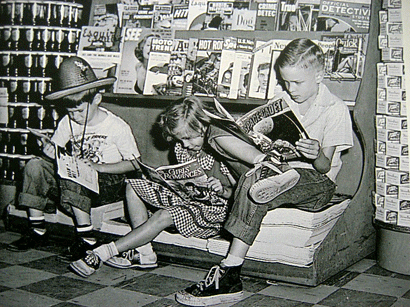
In the end, all this internet sound and fury is reminiscent of the Great Television Scare or Video Game Scourge of years past.  Comic books, dime store novels and packs of sen-sen conjured these same fears once. None of these trends/novelites have the power to ruin.

Depression is an illness it is not an allergic reaction to circumstances.  Do people enter a depressive state due to cataclysmic life events?  Certainly.  But that is a depressive state not depression.  Potato Potahto?  Not exactly.  There are many serious differences between a normative response to sad and/or traumatic events and that of a state of being.  For one thing a depressive state has a beginning, middle and end and a cause.  Knowing there is a cause to feeling so bad is the difference between night and day.  Having your world close in and become gray and fuzzy for no discernible reason is both frightening and self-perpetuating.  Our natural inclination is to move towards pleasure and away from pain.  If you can not see pleasure, if everything you see and feel is dark and thick and unrelenting, you’ve no reason to believe that there is a different world.  The darkness is the reality and it can be difficult to claw your way towards something you can’t detect.

Social isolation can certainly exacerbate depression.  Humans (even the most anti-social of us) are meant to interact.  (As a species we would perish without the desire to mingle.)  However people with depressive tendencies are a diverse group.  Their depression can be triggered or worsened by physical changes (hormonal transitions, illness, sleep deprivation, etc.) by life changes (moving, job changes, marriage, divorce, etc.) by nature (cycles of the moon, seasons, etc.) or by a myriad of other triggers/events.  That said, as an illness whose hallmark is inward focus, forced external interaction can be very effective.  Volunteer work can alleviate symptoms of depression.   It would seem that the very act of doing something for someone else, gives the brain a break from its persevering.

Living in a culture which extols the virtue of self above all else is powerful nourishment for the growth of depression.  If we were to pay attention to all the messaging, we should be painstakingly obsessing over every body part/function and moment in our lives.  We are to chronicle every; party, meal, trip, pee stick, grade promotion, softball game, and sonogram to the world and thereby give us the patina of great significance (Because It Happened To Us.)  We are encouraged not to experience life and its many moments, but to “create memories.”  So much self-consciousness is not good for the self.  Isn’t it a culture of; “your special day” “best snack provider-friendliest-rookie-player trophy” and general sense of entitlement that is far more socially isolating than technology?

When the first books were mass printed, the townspeople were up in arms.  What would happen to communal oral storytelling traditions.  There goes the neighborhood!  The first home radios caused some anxiety no doubt.  Families were now holed up in their living rooms staring at a box.  Little did they know, that box-staring was just beginning.  Television took people out of communal movie theaters (which were/are communal only in the sense of shared germs, smells and noise, not in any actual ‘communing’)  Personal music devices were said to be bad, yet I have never seen a campaign to bring back the boom-box, and I’ve never quite understood how the iPod affects behavior any differently than transistor radios did.

Invention and innovation do not come from the sky to do evil to our land.  They are not the flying monkeys.  Products/progress succeeds because there is a hunger that it satiates.  The fact that consumers represent the population and are thus diverse and include those with mental illness, is expected.  How one behaves, with or without technology will always be a lens into an individual’s inner workings.  Unfortunately it will always be far more tempting to design research or blame which looks to demonize the new and inanimate.  Mental illness, criminal behavior, gambling and pornography obsession are real issues.  Spending our valuable resources to shout; “No, no, look over here, the internet is to blame” does not seem wise.

*The Music Man – Meredith Wilson (1957)
 
3 Comments

Posted by on June 17, 2012 in Cultural Critique, Media/Marketing


Tags: , , , , , , , , , ,

Dear Ms. Magazine

Happy Birthday Ms. Magazine!  It seems like only yesterday when you were born.  It must be annoying to hear that over and over again.  40, wow!  You look great!  Really you do.  Don’t give me that look, it’s okay to care about your looks if you’re a feminist, don’t try that on me.  You look great, really.  You know a lot of other magazines have very bloated advertising, and a rather eerie glossy finish.  But not you.  Yes you’ve freshened yourself up over the years, but that’s what keeps you modern and relevant.

Do you remember the first time you came to my house?  Me neither.  But I remember you being there in those early years.  My housewife mother must have heard about you at her consciousness-raising group and invited you home.  I’m guessing you got passed around a bit.  Household expenditures were tightly monitored (it was the 70s after all, things were tough all over.)  Come to think of it, it took some chutzpah to start a magazine outside of the standard advertising model on the cusp of the recession, didn’t it?  But you never did shy from a challenge.  They laughed at you.  I know you remember that.  Who did you think you were?  A serious magazine for women?  A business run by women?  They said a lot worse too.

It must have been hard at times, all that bullying.  They even made fun of your name.  You know, that name that is now a standard fixture in the English language; appearing on all official documents and forms?  You were the first to talk about abortion openly, instigating untold honest conversations and sharing in homes across the country.  You shone the spotlight on domestic violence, helping to place the shame where it belongs; on the perpetrators.  You gave voice to issues that often had no visible champion.  You helped us to understand our bodies and minds and how they can work.

You never have been popular.  I don’t mean that to be hurtful, it’s actually praise.  Who wants to be adored by the masses?  It’s far more satisfying to be loved by those who ‘get us.’  You did come along at the right time, that’s for sure.  No one was rolling out a red carpet or anything.  No, no.  But the swelling of bias and bigotry awareness of the early 1970s was a boon to Ms. and feminism.  Even the most misogynistic would begrudgingly admit that 51% of the population should be treated equally.  Not so far as enacting the ERA or anything, but wait, no sad stories, this is your birthday!

Milestone birthdays can be affirming but they can also be a bit jarring.  It’s a gift to age, to survive!  While no one wants to live in the past, it is the shared memories that give us a feeling of being a collective.  How many remember when grown women were routinely called ‘girls?’  Remember when we didn’t even have names?!  We were Mrs. Robert Smith or Mrs. Nathan Green.  We not only keep our first and last names now, but sometimes a man actually takes a woman’s name (gasp!)

I remember that you were the only magazine in our house, quite possibly ever.  I’ve no doubt you played some part in my mother returning to school and becoming the writer she always longed to be.  You probably had a hand in the household responsibilities being distributed to all family members (yeah that was just great, thanks!)  I can see your handiwork now, in my own outlook on life.  I struggle, like I know you do, with the backlash of some of our progress.  There are times I thought we’d be further ahead by now.  I know you know.  We still have work to do don’t we Ms.?  Maybe 40 really is the new 30!  Happy Birthday Ms. and thank you.  Now get back to work.

 
1 Comment

Posted by on June 14, 2012 in Cultural Critique, Media/Marketing


Tags: , , , , , , , ,

Skout: It’s Not For Boys & Girls

There is no ignoring a headline of 3 child rapes being linked to social apps.  Child rapists have successfully posed as teenagers on Skout and attacked children.  It’s awful, it’s disgusting, it’s devastating, but demonizing social media is shortsighted.

Perhaps I am too literal, but I’m not entirely comfortable categorizing software application whose sole purpose is to bring strangers together as “social” media.  It’s not just the semantics that trouble me, it’s that the category of social media or networking is far too large and vague now.  (As technology grows, our language needs to keep up.  It’s too tempting to make sweeping generalizations otherwise.)  Skout, to my understanding, is an app that children over the age of 13 can legally use to find strangers.  Why?  What could possibly be the reason for such a thing?  What corporate brain trust decided that the teen market was a must-have for this app?  Were the decision makers reassigned from the Joe Camel ad campaign?  Has the dream machine behind flavored vodkas and wine coolers moved on to software marketing?  Have we really in fact allowed corporations to now actively lure children into talking to strangers?

What kind of teenager do we think would be interested in meeting strangers on-line?  Would it be strong, stable children with solid social networks and adult relationships?  I’m guessing not.  Teenagers are nothing if not acutely socially aware.  They know who’s in and who’s out at any given moment.  The adolescent social world shuns strangers.  It is likely that a teen would only seek out strangers if he/she felt alienated by the real social world or had a propensity towards risky behavior.  So let’s make an app available for that!

I worry that this story will cause the villagers to take up arms.  Not against Skout, which seriously needs a trip to the woodshed, but against the bogeyman of social networking.  Should children have access to social networking sites (whose intention are to connect people to those they actually know?)  I’m not sure it’s necessary, but then again I don’t think children need to sport fake sleeve tattoos, so I might not be the best judge. What would be wonderful is if the news of these attacks on children prompts family conversations.  Strangers are people you do not know.  The fact that a friend knows them doesn’t make them less strange.  Someone you’ve heard of is not a friend (that’s why Beyonce isn’t returning your calls.)  I would go so far as to suggest that an adult is not a friend either.  An adult might be a teacher, coach, therapist, tutor or friend of a child’s parent, but not a friend of the child.  But then again, I think putting a toddler in high heels, a sequin dress and fake fur jacket is a slippery slope.

It’s always tempting to blame an outside force, particularly a consumer product.  In this case it actually is appropriate to enforce changes to the product.  But let’s resist the urge to demonize everything we find unfamiliar.  Let’s not run to blanket our airwaves with every child “expert” or media “expert” exposing catchy, yet utterly vague sound bites about children and social networking.  Let’s do our best to remember that technology isn’t the issue, human beings are the problem.  Child rapists by definition will seek out children.  Our job is not to hide our children; our job is to pay attention to who they are and what they need.  We need to know about their world and how they are living in it.  Unless they actually paid for their phone and monthly bills (insert; ‘ha ha ha’) parents have every right/obligation to access the phone on a regular basis.  A child who knows he/she is not living in a secret alternate world from their parents is more likely to make good decisions.  Part of what we teach our children is how to live in the world not how to hide from it.  There will always be dark and dangerous forces in the world.  Strong children with well honed coping tools grow into resilient and successful adults.

 
1 Comment

Posted by on June 13, 2012 in Childhood, Media/Marketing


Tags: , , , , , , ,