RSS

Tag Archives: Brenda Tobias

Putting One Foot In Front Of The Other

Life is not a spectator sport. Life is to be embraced, battled, survived and celebrated. Yet there are times (perhaps long stretches of them) that life is barely tolerable. The world, if it must exist, is best viewed from under a blankie from the vantage point of the couch. There are variations on this lookout. Perhaps a box of Cap’n Crunch (crunch berries optional) is involved. There may be an 18-hour background chatter of Law & Order employed. The constant of course is the elastic waist pant. No respectable day of sloth can be had in real pants.

Self-imposed solitary confinement is nothing to aspire to, but it’s not shameful either. One need only be concerned if frequency or duration increases (like an erectile dysfunction drug side effect; after four days one should seek medial attention.) If we are relatively healthy people, our forays into fleece and foods of childhood are sporadic and strangely motivating. But what of the everyday less-than-fleece malaise?

If life is lived with any participation: sh*t happens. Things come up that are not of our own making and that make us miserable. Even good things (new; jobs, projects, relationships, etc.) can make us feel overwhelmingly uneasy. Dread, misery and anxiety are often lumped into the category of “stress.” Since “stress” can also result from happy things, we sill stick with specifics; dread, misery and anxiety.

  • Dread – Channel your Scarlett O’Hara
    • Don’t think about it until tomorrow. Dread is one of the all time biggest thieves of happiness there is. Weeks will be wasted dreading an event that at most will encompass 24 hours. Each time a lump in the pit of your stomach starts to form, grab your phone, notebook, slab of stone and write down your specific concern (i.e., my cousin-in-law will use the funeral as a platform for subtle anti-Semitic rhetoric) and go back to the business at hand. Trust that the specific concern has been properly mulled.
    • Focus on getting back to Tara. Yes that root canal or colonoscopy is going to be wretched. Nothing will change that. Focus on what you will do after the event (and after the narcotics wear off.) Plan something enjoyable.
  • Misery
    • Awful things happen, that is the burden of survival. Disease, death, desertion are often unavoidable. Sadness and often mourning is wildly appropriate, but should not become a lifestyle. There’s really only one way out; take a shower. Get up, put one foot in front of the other and fake it ‘til you make it. Pretend you are functioning and before you know it, you will be.
  • Anxiety
    • High anxiety (as it relates to a state of being not a Mel Brooks’ film) is a very uncomfortable state. Sustained non-specific anxiety (not related to an event) warrants medical attention.
    • The remedy for event specific anxiety is often directly related to the event:
      • Public speaking? Rehearse, rehearse & remember that most people aren’t really listening
      • Job interview? Research and keep in mind that you are interviewing them as well
      • Blind date? Have an exit plan
      • Socializing with people you do not know? Think of yourself as Jane Goodall and discover everything you can about these people and their ways

Often the best way out or through is to consider what we’d advise a friend. Most likely we would not encourage a friend to perseverate, we’d encourage them to get up and get out. We would lift the afghan from their shoulders, brush the crumbs from their chest, wipe the melted ice cream from their chin and whisper; step into the sun, step into the light.

 
1 Comment

Posted by on September 30, 2012 in Well-Being


Tags: , , , , , , , ,

Who’s Afraid Of Virginia Woolf? – Review

Why in the world would a person willingly see a (three hour) play for the fourth time? How strong a suspicion would that viewer have of seeing something completely new? Very strong, 100 proof strong. From the very first sound (Martha’s gentle laughing off-stage) it was clear that this was a new George and Martha. Amy Morton and Tracy Letts, by way of Steppenwolf (and August Osage Country fame) are so very human that watching this production, directed by Pam MacKinnon is more akin to peeking in a window than looking at a stage.

Martha is often portrayed as a braying overtly sexual ball of venom. George is frequently placid and defeated. Ms. Morton & Mr. Letts have no interest in going down that road. When George refers to Martha’s party behavior as braying, her retort is barely in an outdoor voice. It’s then that we know this George and Martha are equally matched in their ferocity. Their words and manners, so natural and true, add a dimension to the rawness of their story, their marriage. Mr. Letts’ George is strong and knowing and funny. The treatment of Martha’s sensuality is an interesting interpretation. Many a Martha has climbed Nick as a boozy floozy in a too tight top. Ms. Morton seduces Nick in the least sexy of ways. She stumbles and clinically performs the seduction in a desperate attempt to have her husband respond. Nick’s interest is seen more clearly for what it is; ambition.

Nick and Honey, perfectly cast with Madison Dirks and Carrie Coon are far less naive and childlike than we’re accustomed. Nick holds his own amidst the incoming shells. Honey is young and quite tipsy, but very real and recognizable. The play motors along via free-range party games (Hump the Hostess, Bringing Up Baby, Get the Guests) as we discover what lies beneath. With the lower volume of this production we can really hear what is and what isn’t being said.

Ms. MacKinnon’s pacing and staging is fast and fluid. A magic trick of sorts results in the three acts rushing by as we simultaneously feel the characters’ building exhaustion. (This play should always been seen at night, preferably late at night.) Who’s Afraid of Virginia Woolf opens at the Booth Theatre on the 50th anniversary of its premiere (October 13th.) This production is a poignant and powerful tribute to Edward Albee’s most popular play.

 
Leave a comment

Posted by on September 29, 2012 in Uncategorized


Tags: , , , , , , , , , , , ,

Where There’s A Will

When is the last time you took a look at you will? Your will. You have one don’t you? What’s that you say; you’re not Thurston Howell III? Well, it’s not about money (entirely.) Nor is about great “I gotchyas” from beyond the grave. (The image of Christina and Christopher Crawford being inexplicably iced out comes to mind.) Wills can of course be used to have one’s last say but that’s not the true intent. We have wills so as not to leave a mess behind. It is our final act of cleaning up after ourselves.

Of course wills are crucial in dispersing of scads of real estate, stocks and bonds. But they are also key in identifying who will clean up financial and legal logistics. Without a will anyone even slightly related to you, could be left with quite a mess. Wills are not for the wealthy; they are for the conscientious (and can be purchased on line for quite a reasonable sum.)

Wills when written usually are done when expecting the arrival of a child or upon remarriage. But it’s not an archive; it’s a document that needs regular tending. Consider it less of a social security card and more of a driver’s license or passport. Your last will and testament needs to be renewed. If more than five years passes before reviewing the document you might be in for some surprises. Imagine discovering that you had bequeathed your jewelry to someone with whom you’ve lost all contact? What if the executor you named has in fact pre-deceased you? What if the cat to whom you’ve left your millions now has a brother? Things change, life happens, and a will should as well.

Now that you’re convinced to a) write a will b) review a will on a regular basis; there’s one more step. Inform those mentioned in the document that they are in fact mentioned in the document. They needn’t know details (and in fact in some cases they shouldn’t. You wouldn’t want junior to necessarily live his life as if he is receiving an inheritance, would you?) they need only to know that they are mentioned. An executor who has not consented is not going to be much of an executor. This person(s) needs to know where the document is and what, if any (funeral) arrangements have been made.

Writing a will, making funeral arrangements, and discussing it, will not hasten your demise. If you believe (and I’ve known those who don’t) that our time on the planet does have an expiration date; planning for that time is just part of life. Nobody wants to believe that his or her stay on the planet was meaningless. We try, as we stumble along to make some sort of positive impact. Leaving behind bereaved people who must divine or recall your wishes and intentions is simply not a great legacy.

 
2 Comments

Posted by on September 27, 2012 in Cultural Critique


Tags: , , , , , , , , , ,

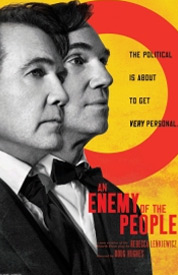
An Enemy Of The People – Review

Boyd Gaines and Richard Thomas sparring with seething and faltering restraint may be the finest five minutes on Broadway this year. There is a moment so powerful that the full house holds its collective breath. What good fortune that there is more than five glorious minutes to An Enemy Of The People.

Rebecca Lenkiewicz has adapted this Henrik Ibsen play, which was previously adapted by Arthur Miller. While there are many sparks of modernity in the dialogue it is still clearly Ibsen’s treatises. Mr. Gaines’ Dr. Thomas Stockmann is the voice of the playwright, driven by his pursuit of truth in black and white. Mr. Thomas plays his brother and town mayor Peter Stockmann. The mayor has an enormous investment in the small town’s baths business. He is also the benevolent benefactor arranging for his brother’s employment with the baths’ administration. The bohemian medical brother with his boisterous family is in stark contrast to the restrained top hat and walking stick mayoral brother. Their differences grow starker as the good doctor receives confirmation of his suspicions of water contamination in the baths. It is then that all hell breaks loose.

Many will experience the positions and platforms of journalism, politics and economics to be achingly timely, but in fact they are timeless. The shifting positions and arguments sound excruciatingly familiar but that is because they never change. The masses are not necessarily equipped to lead. Truth may feel more important than commerce, but eating is important. Loudly chanting rhetoric doesn’t make the rhetoric true. People tend to worship the one wearing the fanciest hat. Where these powerful themes fall short is in their obvious biographical nature. It becomes challenging during some of the more heated tirades to see past an angry playwright. The ending moment of the production reinforces this response.

It is through the powerful and nuanced performances which include; Gerry Bamman(Alaksen,) Michael Siberry (Morton,) John Procaccino (Hovstad) that the whole becomes flawless. Directed elegantly by Doug Hughes, the characters and action seem to float. The staging and sound (David Van Tieghem) of the town meeting scene is simply fantastic. The audience, with very little fanfare, seamlessly morphs into the townspeople. We are not just being told how mob mentality develops we experience it firsthand. John Lee Beatty’s set is starkly apt and very cleverly designed. It’s less of a set and more of a world.

This Manhattan Theatre Club production should be seen for the very fine performances, intriguing themes, splendid production, and believe it or not; the laughs.

 
Leave a comment

Posted by on September 23, 2012 in Uncategorized


Tags: , , , , , , , , , , , , , , , , ,

Inheritance Allowances

According to reports, retirees are distributing (what would have been) inheritance to their children while they are still very much alive. This is not a new phenomenon; it is just going by an awkward and clumsy new name. “Early distribution of inheritance” is also known as supporting your adult children. The reasons for the life support are somewhat varied. There are adult children who come upon unavoidable and devastating life experiences, and need a hand. Thank goodness for family. But the stories that seem to bubble up, and are told rather defensively, seem to be of a different ilk.

Married retirees speak of their adult children “needing” health insurance and suggesting that it would be tantamount to eating one’s young to have these grown-ups go uninsured. Spend your money on whatever you’d like Mr. & Mrs. Retiree, but no one ‘needs’ health insurance (yet.) What your elderly children need is healthcare. Purchase hospitalization or cataclysmic insurance if you must. But they can go to doctors and pharmacists on their own. If they can’t afford those bills, chances are that they (or at least their children) qualify for assistance. Don’t confuse what your children “need” with what you or they may “want”. If you do that you might end up paying off your elderly child’s six-figure student loan debt.

Yes much of higher education is ridiculously expensive. But so are sports cars, and sable coats. Before buying sable most people would have to do a little R.O.I. exercise. “Will I miss the money that I would spend on this coat?” “Do I have a life which will enable me to get use out of this coat?” It’s pretty much a given that this exercise does not include “How high is the credit limit on all my cards?” If you can’t afford it, you don’t buy it. If you live in a warm climate, or have a casual way of life, you don’t buy it. For many people, attending any kind of institution of higher education will demand incurring debt. But it never should be more than the projected career can support. The high school teacher with $100,000 in debt either had very poor advice or experienced some sort of catastrophic event. Four years of a private liberal arts education is a luxury few can afford. Two years at a community college followed by two years in an accredited college/university can be made affordable by most. Savings, grants, awards, and work-study (students do better academically when they have a job) can make a serious dent in what needs to be borrowed. For the graduate who wants to teach; you might want to look into public school systems that pay for your master’s degree.

Of course not all baby boomers are supporting their adult children with large chunks of change. Some choose a more homey approach, and modify their existing dwelling, or move to a larger abode to accommodate elderly children and their families. Many extol the old-fashioned virtues of multi-generational living. But often there is something a little less sweet simmering beneath the Norman Rockwell imagery. The retiree might not have pictured a lifetime of parenting of a seemingly developmentally typical son/daughter. The retiree might have niggling thoughts of how they might have contributed to this situation. One thing is pretty certain; these ‘kids’ are not worried about an inheritance. For an adult living with his parents, time has pretty much grinded to a halt. The relationship dynamic has not shifted yet. The two-way street of adult child/parent relations has not been paved. No one is getting older and no one is ever going to die. Chances are they’ve never even heard of Sugar Mountain.

 
Leave a comment

Posted by on September 22, 2012 in Cultural Critique, Education


Tags: , , , , , , , , , ,