RSS

We Gather Together

It’s almost time.  The turkey is defrosting, the wine has been purchased and we’ve unearthed the tablecloth.  We are poised for that magical holiday: when our family gathers around the groaning table for the annual telling of the “Time We Left Brenda At The Parade (and blithely journeyed on to Thanksgiving dinner without her)” story.  As the first words are uttered, eager faces turn upwards and the chattering ceases.  We settle into a quaint familial posture, reveling in this heartwarming tradition.  The story never alters.  The ending always the same.  The mother invokes her; “I knew she didn’t do it on purpose” line.  (Dear reader, I implore you not to spend too much time wondering how a child leaves herself at the parade on purpose.)  The father shamefaced, swears he has reformed his communicating ways.  And then we eat.

The variety of food is more or less the same regardless of who hosts.  The turkey has the most variation from year to year.  Butterball, free range, organic, kosher, we’ve had them all.  Under-cooked and over-cooked, we’ve lived to celebrate another year.  Sweet potatoes have been canned, candied, mashed and stewed.  I’m here to tell you, it makes no difference whatsoever.  Change recipes if you’re bored, knock yourself out if you love to cook.  But whatever you do, don’t worry about it.  No one cares.  This is not the time to channel Billie Burke in Dinner At Eight.  No one gives a hoot about the aspic.  You are not preparing for a gourmet magazine photo shoot (which is a good thing considering what they do to the food to have it photograph well!)  People are coming to your home because they want to be with you.  They are delighted to not be cooking AND to be fed.  They don’t care what state your home is in (as long as you have the necessities in the loo.)  They are not measuring the viscosity of your gravy or the moisture level of your bird.  There’s no such thing as a flaky crust in a pumpkin pie, and no one cares if you made all or none of it yourself.  Being knackered is no way to enjoy a holiday.  Buy what you can, prepare ahead of time and above all else, delegate.  People like to feel needed.

Thanksgiving is one of the few holidays we have that’s sole intent is gratitude.  There are no cards, gifts, tips or parties.  The only societal expectation is that we gather with family and/or friends, eat and drink in excess and give thanks for the opportunity to do so.  This year, just like every year, after the last bit of pie has been scraped out of the dish, and the top buttons have been opened, one of us will chime; “remember that year we all had the flu and the ones who could keep food down had turkey t.v. dinners?”  That, dear reader is what great Thanksgiving memories are made of.

 
Leave a comment

Posted by on November 22, 2011 in Cultural Critique, Holiday


Tags: , , , , , ,

On A Clear Day You Can See Forever – Review

A new Broadway Baby has been born, and delivered to an unstable home.  Jessie Mueller is making a show-stopping debut in On A Clear Day You Can See Forever in what used to be the starring role of Daisy/Melinda.  This revival, starring Harry Connick Jr. (Dr. Mark Bruckner) has been “re-conceived” within an inch of its life.  (On the heels of the “new” Porgy and Bess, this phenomenon really begs the question; “If you don’t care for the original show, why are you reviving it?”)

The basic premise of all former productions including the film is; a wonderfully talented woman (Daisy/Melinda) with low self-esteem seeks out a psychiatrist to assist her in quitting smoking.  Through clinical hypnosis sessions, her past life (in the 19th century) is revealed.  After a few sessions, the psychiatrist falls in love with the recovered memory.  With music by Burton Lane, and book and lyrics by Alan Jay Lerner, it was a kicky addition to the 1960s musical genre.  The songs aren’t terribly memorable (save for the title song) but there is a certain charm about the show.

Today, with approximately 20 producers (including Mr. Lerner’s daughter) and a new book by Peter Parnell, the show is almost unrecognizable.  The character of Daisy, is now a gay man (David Turner) when awake in present day.  The time period (of present day) is now 1974 and the flashbacks are 1943.  Mr. Turner’s character, David, has none of the charm and talents of the original character Daisy.  He is a milquetoast slight child/man who is hesitant to move in with his boyfriend on their one-year anniversary.  The boyfriend, Warren (Drew Gehling) makes many musical and non-musical references to their one day getting married.  Because that is what homosexual men in 1974 evidently talked about.  Changing the gender and sexual orientation of the lead serves no purpose except self-indulgent ones (whatever they may be.)  It adds nothing to the story, if anything it takes away any believability and creates awkward moments.  Is my world view to be challenged by accepting it is not offensive to suggest a homosexual man is no more than a repressed woman inside?  And while we’re at it, am I not to be offended by a (presumably) all white cast?  The biggest of all the crimes of this “re-conception” is that it diminishes Jessie Mueller’s role to that of a walk-on.  Her voice and demeanor are reminiscent of a young Liza Minnelli.  She is funny and poignant, has incredible stage presence and possesses a voice that is not to be believed.  She stopped the show with her number Ev’ry Night At Seven.  That second act number and a ballroom dance number (in Act I with David, Melinda and Dr.Bruckner) are the true gems of the show.

Directed and “re-conceived” by Michael Mayer, the show has very little dancing, which really is just as well, as the ensemble includes not one dancer.  The two requisite chorus song and dance numbers are dull and give the impression of fulfilling a requisite.  But the ballroom dance number (Joann M. Hunter, choreographer) is wonderfully conceived and executed.

The set (Christine Jones) is simple and streamlined and a bit noisy.  The costumes (Catherine Zuber) are somewhat schizophrenic.  The 1943 costumes are simply lovely, they are appropriately costume-y, to portray a waitress, band singer, etc.  The 1974 ensemble of the show is dressed as H.R. Puffentstuff extras.  They are color coordinated cartoon-y interpretations of how students (in their 30s) dressed.  Mr. Connick is dressed in a 2011 suit and tie.  His long suffering colleague Sharone (the lovely Kerry O’Malley) is dressed for a Cosmopolitan photo layout.  She has more costume changes than anyone else, and each wrap dress is stunning.  There is nothing about her character to suggest she is a fashionista, but I enjoyed the clothes.

Clumsy, self-serving revisions aside, it can not go without mention, that a director needs to work very very hard to strip Harry Connick Jr. of all charm and humor.  Granted, Dr. Bruckner is not the most scintillating character ever conceived, but in this production he is on thorazine.  Luckily, Dr. Bruckner has many songs, and oh to listen to Harry Connick Jr. sing from just a few feet away!  But if you have ever seen Mr. Connick Jr. live, even having just a casual conversation, you will not recognize him in this fugue state.  Meanwhile, much exuberance and stage time is given to the character of Muriel (Sarah Stiles,) David’s roommate.  She is a non- traditionally attractive quasi ethnic looking friend to all gay men (get it?)  I’m sure she’s a talented woman, but this role is a caricature and employs one of those novelty voices that I don’t enjoy (think Kristin Chenoweth as a muppet.)  Giving this character more stage time than Jessie Mueller, is a poor but fixable choice.

And some fixing they will do.  I saw this production one week into previews and on the night the second act was entirely re-worked (and ran 20 minutes over.)  Removing the misguided attempts at laugh lines (Cher and Barbra Streisand cringe inducing “jokes”) is an easy cut.  There is time to fix the sound and give Harry Connick Jr. more to work with, but the re-conceived conceit is not going anywhere.  I am not a stolid traditionalist, I like new things.  I loved Mr. Mayer’s Spring Awakening.  But I am not a fan of changing something just to say it’s new.  I am not buying that something is improved just because it’s changed either.  And I will never ever support squandering talent.  Ms. Mueller deserves a better debut and Mr. Connick Jr. deserves a better role.

 
1 Comment

Posted by on November 22, 2011 in Uncategorized


Tags: , , , , , , , , , , , , , , , , , ,

@ Work :( TTYL

Have we all heard just about enough about the dangers, both physical and evolutionary, of texting?  Do we need another article haranguing against smart-phones on dinner tables?  Isn’t it crystal clear to us all that “living in the moment” is now only a behavior for which we pay thousands of dollars to experience in a spa? Technology has changed our orientation to the world around us.  But I don’t particularly care about all that right now.

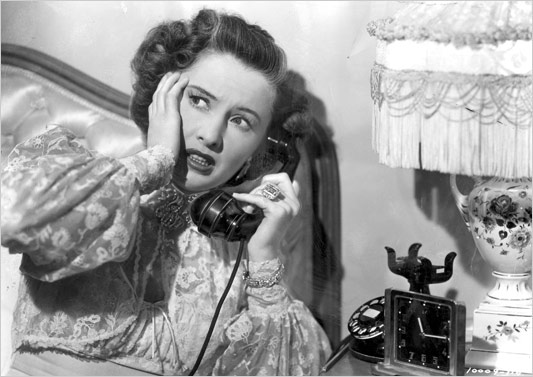
What I do care about is personal phone calls at work.  (Quaint, isn’t it?  That sentence conjures up visions of Judy Holliday at the switchboard.)  For reasons which allude me, the technology of a “phone call” has obscured the intent of the call.  The fact that people needn’t speak to communicate, or use a telephone belonging to an employer, seems to have blurred the lines for many.  Show of hands, how many times has the clerk at your checkout register been tapping his/her acrylics onto a phone?  Have you ever entered a boutique and not heard the shopkeeper on a personal call?  The last time you frequented a restaurant with a host/hostess, were they looking down and squinting, behind their station in the dark?  There are work situations in which personal communication is not only permissible, it is probably encouraged.  I was recently on a film shoot at which the principals (waiting upwards to 15 minutes between takes) typed away, happily passing the time.  But those particular employees were not actually working while making their personal calls.  Their attention was not expected to be anywhere but on themselves.

Now here’s where the rant builds up steam.  I have lost count of how many of New York’s finest I have seen texting or making personal phone calls while working.  I suppose the traffic officer would argue; “Hey, I can give tickets and text at the same time.”  Perhaps, but you’re in uniform and; a) it is unseemly to be engaged in personal activity, and b) you are an officer, and if you’re not seeing something and saying something, why should I?  I have also seen “beat” officers, standing and texting on a corner, officers in squad cars (thankfully, the passengers not the drivers) texting as well.  Now unless that is how the police department now communicates with its officers (and for all I know, it is) I find this truly distressing.

I am not suggesting that we all don’t have personal emergencies that need attention.  But what I’ve witnessed is far more lackadaisical than an emergency would ever suggest.  Somehow, because we have the technology, we’ve decided that rules of the workplace and common decorum need no longer apply.  I’m no techie wonk, but I’m willing to posit, that we’re only going to get more little sexy toys with which to play.  Perhaps we should engage, now, in the real face to face conversations about what is appropriate and what is not.  Maybe I’m just an old fashioned gal, but I enjoy being looked in the eye, be it by a police officer or dinner companion (or one and the same, if it’s Tom Selleck in Blue Blood.)


Leave a comment

Posted by on November 21, 2011 in Cultural Critique


Tags: , , , , , , , , , , , , , , ,

Private Lives – Review

I’ve never been a fan of Noel Coward’s Private Lives.  I suppose I have found the play to simply belabor the issue.  A little voice in my head starts declaring; “very well then, get on with it will you.”  Don’t get me wrong, I am not immune to the charms of a well delivered; “Don’t quibble Sybil,” I just find the premise does not warrant a full length play.  However, nothing was going to stand in the way of seeing Paul Gross on stage.  Mr. Gross (Slings and Arrows) is a delicate actor who is a master of comedy and quite simply is dreamy.  There, I’ve said it.

So it was Mr Paul Gross who got me to the Music Box to see the newest (via London’s West End and Toronto) production of Private Lives.  Directed by Richard Eyre, and originating in London, the cast speaks in British accent.  I found this far less distracting than did others in the audience.  Mr. Gross (Elyot) and Kim Cattrall (Amanda) are clearly not British but the supporting cast; Simon Paisley Day (Victor) and Anna Madeley (Sybil) are.  There is a lightness, or perhaps a gaiety to this production which I have never before seen.  Ms. Cattrall plays Amanda as a lovely ephemeral good time gal.  While Mr. Gross relishes his role as Elyot, giving the character subtle and overt humor.  It is very easy to see why they would be besotted with each other.  Yet, the actors seem to be anything but.  Independently, they are quite wonderful.  However, there really is no chemistry between them.  Their kisses are awkward and somewhat embarrassing.  Yet, even seen as interlacing monologues, their scenes are enjoyable.  The production is at its best when all four actors are on stage together.

There are some technical issues with this production that left me scratching my head.  This Private Lives has joined the ranks of age-blind casting.  Always such a baffling endeavor in a play which announces everyone’s age.  I suppose it should not be surprising today when people dress and inject themselves to remain forever young.  But people in their fifties playing people who are 30 will always seem strange to me.  I am not a fan of changing a playwright’s words to suit a director’s agenda.  So I will have to declare this play simply miscast.  There were some technical issues with the set as well.  This is at least the third staging of this production, yet some of the set (Rob Howell) struck me as a bit community theatre.  During intermission, two stage hands came out to the apron with a hand-held drill to dismantle the balcony.  In Act II, several props pooped out and the fish tank terrified the actors (I’m guessing something very very bad had happened recently.) The canned music coming out of the piano being “played” by Mr. Gross was just bizarre.  Adding to that the curtain delays and missed light cues, I was left wondering what the story was.

Ms. Cattrall does a lovely job with Amanda’s dialogue, delivering her lines on the top of her voice and also looking divine.  However she is terribly uncomfortable with the physicality of the role.  There is a mental metronome in her head that is very distracting to the audience: “Step two three four. Light cigarette two three four. Place glass on ledge two three four.”  The “fight” scene in Act II was painful to witness.

Yet for all of these bumps in the road, of a play I don’t really care for, I am terribly pleased I had the opportunity to see Mr. Gross stake his claim to the Broadway stage.

 
Leave a comment

Posted by on November 20, 2011 in Uncategorized


Tags: , , , , , , , , , , , , ,

Cotton Club Parade – Review

Last night I stepped into a magical way-back machine and found myself at The Cotton Club in the 1930s.  The Duke Ellington’s Cotton Club Parade is a phenomenal collaboration of Jazz at Lincoln Center (JALC) and City Center Encores.  These two organizations, on their own, produce some of the finest arts experiences in New York City.  Together, they have created an astounding evening.

The newly renovated N.Y. City Center was a packed house dotted with celebrities and what appeared to be audience members from the actual Cotton Club’s opening night.  The crowd’s reaction was equal parts stunned silence and pounding ovation.  Warren Carlyle directed the evening, with an old fashioned show biz sensibility.  Two dozen numbers were performed by the Wynton Marsalis Orchestra and a powerhouse cast of singers and dancers.  Lighting and one portable set of five steps were the only devices in play.  The voices were pure and perfect and the dancing was simply not to be believed.  I relished my fourth row view of tap dancing feet, which reinforced that yes, these men really were defying the laws of physics.

All the numbers had Mr. Ellington’s fingerprints on them (either through composition or arrangement) and some were recognizable classics.  Even more enjoyable however, were the new (to my ears) numbers that rarely receive play anymore.  The interplay between orchestra, singers and dancers was lovely and organic.  I was at times reminded of the show Black and Blue (1989) a revue of the music of Paris in the 1930s.  From the very first note, I longed to be seated at a cabaret table sipping champagne.  My feet tapped the rhythm uncontrollably and my fingers drummed the melody as I itched to bound onto a dance floor.

Like all Encores productions, Cotton Club Parade has a very limited run.  There is a bitter-sweetness about seeing this production.  It is a jarring reminder that excellent theatrical experiences can be created, if people so chose.  Shows with nary a gimmick, a video projection, an engineered voice or a television personality can sell out and be enthusiastically received.  I do hope that this JALC and Encores collaboration is the beginning of a beautiful friendship.


Leave a comment

Posted by on November 19, 2011 in Uncategorized


Tags: , , , , , , , , , , , , , ,