RSS

The Columnist – Review

The Columnist, by David Auburn, is based upon the true story of Joseph Aslop.  The play, directed with breathtaking precision by Daniel Sullivan, spans approximately fifteen years (1954 – late 1960s.)  The storyline is tightly woven into the time periods.  We experience the cold war, the Kennedy administration and; (the elephant in the room) the Vietnam War.

There is a reason this period of time is often used as a backdrop; it is simply riveting.  Movies and television have played with the cultural and political extremes of the period.  There’s no “playing” in The Columnist.  This is a true story.  There seems to be many plays about real people that are little more than monologues impassionedly delivered to the balcony.  This is not one of those.  This is a well-crafted story with three-dimensional characters.  The play works so solidly that you needn’t know the people were real.  (Clearly many in the audience had no framework for “real” as the murmuring explanations of the Kennedy assassination would indicate.  Really?  How many times did the actors declare it was November 1963?!  What are they teaching in high school?)

John Lithgow is Joseph, perhaps it’s more accurate to write that “he plays Joseph” but to this viewer he was Joseph.  Mr. Lithgow is entirely comfortable in the skin of a man not entirely comfortable in his own skin.  Joseph is a popular columnist (syndicated in 190 newspapers – are there still 190 newspapers in this country?)  He is well-educated and talented conservative columnist with the ears of the nation’s leaders.  He also prefers the company of men, leading to a blackmailing incident that is a bit of a thread throughout the play.  Joseph does marry; a lovely widow and perfect hostess for his many parties; Susan (the dreamy Margaret Colin.)  Ms. Colin is almost unrecognizable as Susan, not physically; she’s as beautiful as ever.  She is every inch the Susan as Mr. Lithgow is Joseph.  Their family unit is rounded off by Joseph’s brother Stewart (Boyd Gaines) and Susan’s daughter Abigail (Grace Gummer.)

Mr. Gaines has a wonderful role in Stewart.  His interactions with David Halberstam (Stephen Kunken) allow us to see the wheels turning and the guards shifting.  Stewart, unlike his brother, relishes intimate connections.  (We suspect Joseph hosts Robert McNamara and Westmoreland partly to avoid personal dinner table chitchat.)  It is on Mr. Gaines’ face and in his posture that we see the weight of life’s events.  Ms. Gummer on the other hand becomes lighter and freer as she grows into a turbulent time.  She (brilliantly) evolves from a child to a woman.  Her relationship with Joseph creates some of the more joyous moments of the play.

There is a school of thought that cautions that it’s never good news for a play when it’s the set that is mentioned.  Rubbish.  The dramatic seamless transitions of time and space are intricately linked to the magic of John Lee Beatty.  “Seamless” is the operative term as so many shows introduce their lumbering sets with the sound of pulleys, wheels or grunting stagehands.  The Columnist set is brilliantly used to support the play and the actors.  The same is true for Rocco Disanti’s projection design.  A favorite moment is when the overhead typed words melted into falling snowflakes.

The Columnist is perfectly performed and produced (by Manhattan Theatre Club) and is a breath of fresh air in the “true politics and figures as characters” category of theatre.  The story is compelling and the tempo never falters.  The play does not however pack much of an emotional wallop.  There is a moment, delivered without any sentimentality by Ms. Gummer that creates a bit of a lump in the throat, reminding us of this absence.

The Columnist is at the Samuel J. Friedman Theatre until June 24th.

 
2 Comments

Posted by on May 9, 2012 in Uncategorized


Tags: , , , , , , , , , , , , , , , , , ,

One For My Baby

Parents have been arrested for throwing their children a booze infused party.  Perhaps I’m being a bit incendiary with the phrase; “throwing their children a (party)”  However, I suspect that teenagers and their tons of friends did not buy the alcohol themselves, and certainly not with their own money.  The justification that these gated community Queens parents make is the standard: “I’d rather they did it at home.”

Can we just tease that apart a bit?  It’s sounds so wholesome on the surface, doesn’t it?  “Baking: I’d rather they did it at home.”  It suggests supervision and perhaps even an informal tutorial.  Nobody is hosting wine tasting parties for their teens (to my knowledge.)  These kids are drinking to get drunk.  That is the goal.  Drinking as a social behavior takes a level of sophistication and social ease that teenagers rarely possess.  They drink to get drunk, they use prescription drugs to get high or stoned, they use street drugs (and freaking aerosol cans!) for the same reason.  Would these same parents host a few dozen teenagers and pass out methamphetamine?  It happens (usually not in gated communities) and (with any luck) those children go into protective care.

I’m all for parents teaching children how to be fully functioning adults.  If they feel that teaching their child to drink responsibly is part of that, so be it.  But hosting your kid’s friend’s booze bash is not about that.  It’s about wanting to feel cool.  Children from this gated community are going to the hospital for alcohol poisoning (delivered by parents to avoid detection.)  Do you know how much alcohol needs to be ingested to result in poisoning?!  Banish all thoughts of Liesl having her first sip of champagne at the ball.  You’ve got to power drink serious alcohol (or be a toddler) to be poisoned.

They’d rather they did it at home.  What does that mean?  One parent suggested that he’d rather his kid was drinking at home than at the beach.  Why’s that?  Is drowning a concern?  What about the dozens of teenagers getting drunk in your house?  Are they all sleeping it off in your bonus room?  How do you feel about your cherub getting drunk at their friend’s house?  Is that okay?  I’m guessing not.  I’m guessing you want the party at your house.  You know what would make you even cooler in a 16 year old’s eyes?  Invite tattoo artists to the next bash.

Let’s put aside class discrepancies (people of means don’t usually lose custody of their children for indiscretions) and even issues of physical danger for a moment.  Instead let’s focus on what this behavior actually teaches children.  1) The rules don’t apply to you 2) It’s not breaking the law if you don’t get caught 3) Behaving irresponsibly is not only a natural part of adolescence it’s a healthy part of middle-age.

Kids do stupid things.  It’s their job.  It’s only by going too far that they find their own limits and comfort levels.  The best protection you can offer a child is a strong sense of self.  A teenager who feels he/she has worth is less prone to trying to prove it in questionable ways.  The same could be said for parents.

 
9 Comments

Posted by on May 8, 2012 in Childhood, Well-Being


Tags: , , , , , ,

Shattered Illusions*

About a year ago, a health care professional offered to glue artificial lashes to my lids.  Glue. Something. To. My. Eyelids.  This offer(?) wasn’t prompted by any medical need.  There’s been no adverse reaction to any treatment or genetic syndrome.  All of my eye hair is present and accounted for.  The woman in scrubs explained that ‘eyelash extension’ was the new big thing.  I replied that false eyelashes were in fact one of the oldest big things.  Ah, but false eyelashes are removed!  The glue she was offering was permanent or until the false hairs drop off (preferably not into something one is cooking.)

When the (head) hair extension phenomenon picked up steam, I found it amusing.  I’ve yet to spot an extension that looks even remotely organic.  I can still picture that mother and daughter having lunch.  They had identical yellow extensions all over their heads.  The shared the same length and shade and visible knots all over the back of their heads.  What kind of psychodrama was playing out that afternoon in which they wouldn’t tell each other that their slips were showing?

The zeal for spray tanning has not faded either.  If you’ve ever been overcome by a sudden mob of midwestern high school seniors on their school trip to Times Square, you might feel a bit like Willy Wonka.  These orange little people are everywhere.  Acrylic nails don’t seem to be going anywhere too soon either.  But if you’ve ever seen them on toes, you’d agree it’s time to ratchet it back a bit.  If people have the time, money and inclination to cover themselves in synthetics, so be it.  There are worse hobbies/vices.  But I would draw the line at gluing things to one’s eye!  What is so striking about all this artifice is how terribly retro it is.  It’s reminiscent of the 1950s; a time that was not all that great for a lot women.

Cone bras and girdles are now push-up bras (and surgery) and girdles with the naughty name; Spanx.  (It’s so much more empowering to have your innards squished when you can wink at the product.)  Hair was set in rollers every night and “done” at the beauty parlor once a week.  Today, hair may or may not be coming from your scalp.  Scalp hair is chemically straightened (because straight hair is fashionable right now) or professionally blown out several times a week (today’s women apparently lack the upper body strength of their ancestors.)  Fashion has a very retro feel as well, with strapless dresses being de rigueur for a decade or so now.  The 1950’s pointy toed pointy heeled shoe has eaten its Wheaties and grown big and tall.  (There’s nothing quite as sad as a woman who can not walk in her own shoes.)

I’m not ready to scream “conspiracy,” but there is something about keeping women in a 1950s mindset that is discomforting.  Do I think eyelash extensions are part of the war on women’s health care?  Not exactly.  Do I think selling young women on the idea of physicality above intellectuality is the backlash of the second wave of feminism?  Probably.  Let me be clear; fashion is fun.  But sometimes it can slide into raison d’etre.  It takes an enormous amount of time (and resources) to emulate Barbie.  When you’re not gluing on hair, you’re lasering it off.  There’s the plumping and the smoothing, the changing of eye-color according to the season.  All this while, finding the “It” bag of the millisecond.  There’s also the unrelenting pursuit of whatever brand is being sold by the celebrity of the moment.

Maybe there wouldn’t be even a whiff of political overtone if men were engaged in the same pursuits.  The majority of the (heterosexual) pairings I’ve witnessed indicate that men are caring less about their appearance as women are caring more.  Perhaps there is only a finite amount of superficiality which can exist on the planet?  Women seem to go to great lengths (no hair extension pun intended) to dress as men seem to look like a 12 year old who just got their wish from Zoltar to “be Big.”  There is certainly a budding relationship between these polarities.  Hopefully it won’t result in more distance between people.

*He thinks I’m lovely but entre nous,
My lashes and nails are stuck on with glue.
Oh, his shattered illusions

Fascinating Aida – Dillie Keane (1983)

 
Leave a comment

Posted by on May 6, 2012 in Style


Tags: , , , , , , , , ,

The Race To The Cure

“28 days” has become shorthand for a detoxification program.  Perhaps you doubt me.  Perhaps you grew up only hearing “28 days” intoned by a distracted health & hygiene teacher while she directed her pointer towards an image evoking more cartoon bull’s head than uterus.  Trust me, four weeks (categorized in as days) means something else now.  Feel free to give it a test run and announce to your co-workers that you’re taking some time off; 28 days to be precise.  Then sit back and watch as one by one your office mates slide up to you and give you an awkward pat on the back, or shyly tell you about their own/their spouse/their parent/their child’s struggle.  Be prepared for the happy hour invitations to taper off as well.

28 Days” has become the normative addiction treatment time to such an extent that a movie was given only that title.  No subtitle was necessary; the masses knew exactly what was in store for Sandra Bullock.  But how in the world did we get to a point of this time period being synonymous with becoming sober?

Have you ever tried to cultivate a new behavior?  Perhaps you’ve quit smoking (if not, you really should consider it) or adopted an exercise program.  Maybe you’ve tried to modify someone else’s behavior, say, trying to get an infant to sleep through the majority of the night.  The first two weeks are hell.  Pure unadulterated hell.  Every morning brings the realization that; yes, you have to do that THING again.  At two weeks a change in diet is still feeling punitive and perhaps constipating.  By three or four weeks, the sulking starts to ebb and a begrudging buy-in takes its place.  By six weeks most new behaviors have found their firm footing.  Yes, you might still find yourself with a cigarette in your hand (perhaps at your high school reunion where you become a 17 year old trapped in a 42 year old’s body.)  But, by week six, your body and mind now have a sense memory and you have gotten past some unconscious triggers.  You can have a drink without smoking, finish a meal without smoking, etc.  It may always take effort to keep from lighting up, but it doesn’t take every cell in your body to resist.

Keeping that analogy in mind; how in the world is four weeks sufficient time to a) rid the body of substance b) discover why you use the substance c) develop coping mechanisms beyond using d) learn to be in the world without substances?  I don’t think there is anyone in the medical profession who would recommend such a brief treatment stint.  Six weeks might be sufficient time for some people who do not have multiple diagnoses (ex.; addiction + bipolar) or have not been addicted for too long a period.

Abbreviated treatment, whether 28 days inpatient or 6-10 therapy visits, is the brainchild of insurance companies.  There is no doubt that there are many many people who can greatly benefit from short-term problem solving based therapy.  But viewing all psychological conditions as the same is as nutty as considering every physical condition as equal.  A hospital stay for a tonsillectomy is not the same as that for brain surgery.

Addiction treatment is tricky.  Addicts are crafty folk.  Their relationship to their substance is the most important thing in the world to them.  The substance one is addicted to is not the issue.  Removing access to alcohol, drugs, starvation, for 28 days is meaningless.  Addicts don’t use because of how it makes them feel, they use to stop feeling like they do without it.  Helping someone to find comfort in their body, soul and the world without their substance of choice is hard work.  There are no shortcuts.  Four weeks is a significant time, it is.  It’s a long time to miss a traveling spouse.  It’s a long time to wait for test results.  It’s a long time to wait for an electrician.  But I don’t think it’s enough time to change the fundamental wiring of a human being.

 
2 Comments

Posted by on May 3, 2012 in Cultural Critique, Well-Being


Tags: , , , , , , , ,

The Mother’s Day Mystique

Mother’s Day is coming around. Even if you don’t own a calendar app, you would know. You can not open a newspaper, walk through a pharmacy, or click on anything, without a pinkish flower festooned banner reminding you that the day is near. The ‘holiday’ was first conceived as a call to disarmament (a family friendly version of Lysistrata) and later revised as a way to honor mothers. But it did not take hold in the public’s imagination until an enormous department store got behind it (evidently the miracle of motherhood takes place on 34th street too.) So it really should come as no surprise that the day is seen as such a major retail event.

What always does take me somewhat by surprise is how marketers and publicists view mothers and motherhood. If you were to try and understand motherhood by reading greeting cards (presumably created for adults to give to their mothers) you would believe that throughout her entire lifespan a mother gives selflessly of herself, denying herself to the extent of needing a ‘special day’ on which she can put up her feet. You would be hard pressed to find even one card that speaks to how an adult may feel about his/her mother (ex. “Thank you for helping to make me the person I am today.” OR “Isn’t it nice we’re still speaking?”)

The gift suggestions that have been bombarding consumers since midnight on Easter would have us believe that every woman who has ever parented is in fact Donna Reed (who in fact is not even Donna Reed.) Her interests (if I can use that term) include; decorative scarves, perfume, manicure devices, make-up sets or cardigans.This time of year is when any and every version of “chicken soup for the postnatal soul” is strategically placed on a table front and center of the store. (Noticeably absent from the displays are copies of Mommie Dearest or that lovely book by Bette Davis’ daughter.) There are stores that offer specially decorated (cue pink and roses) gift cards for the day. You know, for the person who’s never actually met his/her mother.

Mother’s Day is one of the more profitable days for retail. Some of that cash is coming out of husband’s wallets (which from a psychological perspective seems a bit icky.) I suppose when a macaroni necklace simply won’t do… Grown men purchasing gifts and passing them off as being from their children (which is kind of the inverse of Santa, isn’t it?) might explain the Mother’s Day marketing of some youthful apparel. An adult is not buying his/her mother “whimsical/retro apparel” unless there’s a biologically improbably minute difference in their ages. Nor are most adult children buying mommy a diamond tennis bracelet (I said, most; I can just hear the dissent of professional athletes, captains of industry and show people.)

Many of us have (or are) mothers who have actual interests, and who read books not pitched to them from a mass retailer or talk show hosts. We delight in the many gift options we enjoy giving and receiving, and don’t use promotions or advertising to guide us. But isn’t it just mildly offensive to walk through these few weeks with a vague sense of being caricatured? If we were to jot down each and every message being broadcast (re: Mother’s Day) and try to distill it into a portrait of motherhood, we’d find ourselves with some sort of apron wearing, vapid drag version of motherhood. Isn’t the whole point of this holiday to honor the woman (not the cartoon) who has played an important part in our lives?

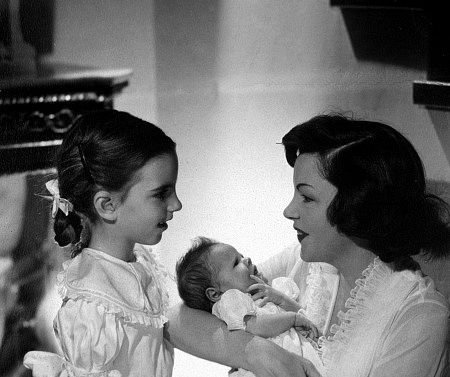
*Photo – Liza Minnelli, Lorna Luft and Judy Garland


Tags: , , , , , ,