RSS

Outing DOMA

constitution
Everything I know about the law I’ve gleaned from a handful of undergraduate classes, To Kill A Mockingbird, In Cold Blood & every version (including the British) of Law & Order. In other words; I know very very little. But why should that get in the way? As the Supreme Court is considering equal marriage it occurs to me to question why? Why are we pinning our hopes on the Supremes?

The Supreme Court is rarely at the forefront (or even midway) in changing our nation’s narrative. There are few decisions (that come to mind) made that the populace had not already thoroughly considered. So why then is it the Supreme Court we look to to settle this matter once and for all? What would happen if the body that decided (in 1996) that marriage was only legal for couples of opposite genders did a do-over? Before the signing (by President Clinton) and the passing of the Defense of Marriage Act (DOMA) there were no gender specifications in regards to legal marriage.

What would prevent President Clinton from launching an enormous mea culpa campaign? He is an incredibly influential man who no doubt has favors to call in. What would prevent him from lobbying congresspeople and senators to overturn what he created? The benefits of clearing his conscience notwithstanding, it would be an efficient method of eradicating the illegality of equal marriage.

Would the Supreme Court (or any court) even need to be examining the legality of any marriage had DOMA not been signed into law? Does anyone want to put their basic civil liberties in the hands of nine appointed people? Wouldn’t it be more appropriate for elected officials to make those decisions for their constituents? If the polls are even remotely accurate it would seem that the majority of Americans support equal marriage. The (seemingly) vocal minority is similar to most vocal minorities who value their personal beliefs/views more than the public good. It is in the best interest of the public to have the people we’ve elected represent us.

“I think there’s just one kind of folks. Folks.”
― Harper Lee, To Kill a Mockingbird

 
2 Comments

Posted by on March 27, 2013 in Cultural Critique


Tags: , , , , , ,

You (version 6.1)

lifeoftheparty
We are our stories. Some of us scour ancestral records looking for the ‘truth’. Some of us pick and choose what elements best tell our story. Some of us (a la Holly Golightly) create our own stories. But in the end we are our stories.
Whether we cling to family names and lore or change our names and run from the past, we are saying the same thing to the world; we are who we say we are. It often helps us to find our footing in the world, these narratives. Perhaps Mr. Romanoff never would have opened a successful restaurant if he didn’t claim a royal title. Perhaps Dale wouldn’t have won friends and influenced people had he not changed the spelling of his last name; giving the impression he came from a more distinguished family. People have been changing their names for as long as they’ve been changing their stories. Often for reason of life and death, but also for the pursuit of happiness.
We could argue the definition of happiness but we agree on what happiness isn’t; misery. There is much research on the resilience of human beings. There are people who have withstood the most horrific and miserable of circumstances and not just survived but thrived. There are other people who shatter like antique glass under much less harrowing ordeals. Why? If we are all made from (very) similar biological stuff, why is there such a discrepancy in our resilience? It would seem there is little correlation between optimism and resilience. Someone in the throes of anguish doesn’t bounce back because they believe the sun will come out tomorrow. It must be more about self-definition. A person having a strong sense of themselves can separate (not disassociate) from their circumstances. They can walk through hell and keep walking. A person who defines themselves by external stimuli (including the manner in which they’re treated) believes that hell is their new mailing address.
If this is true how do we help ourselves (and others) create a strong sense of self. The very first way is the stories we are told or tell to to the small. Children with a sense of ‘where they come from’ have a better sense of where they’re going. If their creation was mainstream/traditional the storytelling is pretty straightforward. If there is anything that veers slightly from “when a mommy and daddy love each other very much they want to be close as possible…” children must be told in an age-appropriate manner. The way we tell these stories is as important as the stories themselves. No parties should ever be demonized as children can do simple math (if my biological father was an evil son of a bitch what does that make me?) Having a sense of one’s ancestry creates solid roots on which to grow.
Beyond our narrative of origin what can help make us strong? External rewards are often kryptonite to a strong sense of self. Awards, honors and trophies are based as much on others’ performance as they are our own. You can’t win any kind of accolade unless others lost. The only way to feel accomplished is to accomplish something; at any age (ex. riding a 2-wheeler, taking the bus unescorted, learning to drive.) Finding things that we’re good at is one of the more rewarding ways of bolstering a sense of self. When we know we’re good at something (ex. raising ferrets, making goulash, painting murals, investing money, etc.) it matters little what others think and thereby diminishes any inclinations we might have towards external definition.
In the end we are exactly who we say we are. We decide how to pitch our own story. If we cull our life stories, most of us could create a compelling Lifetime move script. But to what end? (Have you ever watched one of those films?!) What do we gain from being the lead in a bad made-for-tv-movie? Why not go back and look at what happened in between the hardships and tell that story? Whatever happened, either despite it or because of it made you who you are today. More importantly you are still here. It’s never too late to reframe or update your story. No one is keeping track of how many versions there are.

 
1 Comment

Posted by on March 25, 2013 in Childhood, Well-Being


Tags: , , , , , , , , , , ,

The Math/Science Divide

clothes
Why don’t girls excel in math science? Well, for one thing what does excel mean? I’m a (mature) girl and I’m good at math but don’t find it to be particularly compelling. I much prefer studies involving people and social behavior. I quite took to college Physics (as let’s face it, it explains the whole freaking universe) but never loved it enough to marry it. I do know female mathematicians, programmers and scientist (rocket and otherwise.) They exist in moderately significant numbers. Are there still a lot of lockers available in the lady scientist dressing room? Yes, and it’s a good thing attention is being paid. But what about boys?

If we’re going to engage in conversations that generalize gender why do we focus on girls’ deficits? Why is it we never discuss the gender discrepancies in the social sciences? Where are the boys in studies of philosophy, exposition, psychology, and sociology? Do they measure up? Why is it that the top (public) high schools in New York City are for math/science studies only? Do math and science concentrations lead to better paying jobs? Sometimes, but when did public high schools revert back to their roots of workplace preparation? I suspect that what’s really at the root of the exultation of math & science is the very fact that it has been a male-dominated field.

We have a long rich history of imbuing male centric endeavors or behaviors with positive attributes. It is immaterial for this argument, to dissect what gender behaviors are learned (aka socialized) and which are innate. Any parent of a baby will share with you their surprise when his/her yet to be socialized tyke exhibited gender stereotypes. Is it that the parents are looking for gender specific behavior in their child (and fail to be impressed by gender atypical or gender neutral behavior)? It doesn’t matter. Gender is very very important to people. It’s the first thing one asks when hearing about a new baby. It’s the first question on almost any form. We’ve decided it’s important and part of how you elevate a concept is to attribute it with certain characteristics.

Fine. But why are characteristics long associated with boys some how more desirable than characteristics attributed to girls? When did we decide that expressing emotion is a weakness? Was it at the same time we decided that an affinity with numbers is more admirable than an affinity with language? Why do we think that understanding machines is more valuable than understanding people? While it is true that as a cultural we are becoming slightly less rigid around gender issues. We have quite a ways to go. At the heart of much of our rigidity is our sense that boys are strong (which equals good) and girls are soft (which equals bad.) This core belief colors much of what we do as a society and traditionally has left little wiggle room for boys who enjoy a softer side and girls who enjoy a stronger side.

 
4 Comments

Posted by on March 23, 2013 in Childhood, Cultural Critique, Education


Tags: , , , , , , , ,

Everybody’s Fancy*

YE6MG00Z

Everyone is entitled to be the person they wish to be; adults, teens, children; everyone. As long as you are not hurting anyone, you can live your life exactly as you see fit. Society does expect some level of conformity of course, mostly to avoid utter chaos. We can stomp our feet or roll our eyes at the notion of conformity, but we look rather adolescent doing so. The world is large and diverse; there are a lot of us living on this relatively small planet. We make certain accommodations to ensure a modicum of tranquility. Nobody enjoys waiting on line but as a society we’ve decided it’s efficient. We’d probably prefer if the bus took us directly to our front door, but that’s not how a public bus works.

Public education is just that; public. No one person’s rights are more important than that of anyone else. Yet recently there was a report of a public school being pressured to behave otherwise. A transgendered elementary school student’s parents wanted her to use the girls’ bathroom. This arrangement worked until it didn’t. As the student got older there were parents (and perhaps girl students) who grew uncomfortable. A gender neutral bathroom was provided by the school, but the parents found this option ostracizing. Teachers and administrators had always used the (adopted) female pronouns for the student, which would indicate efforts of inclusion.

On the surface one might think; “They’re kids! Let them use whatever bathroom they choose.” But there’s a reason that bathrooms are divided by gender. Sometime around age 5 (otherwise known as; school-age) children become aware of gender differences. If we asked the parents of the transgender student they would probably recall their child expressing frustration at having boy parts (versus girl parts) at around age 5. Children develop a (healthy) curiosity about gender (both physical and social) at this age. Role playing games start around this age (ex. house, office, etc.) They often explore their own and other’s bodies. There’s nothing perverse about the curiosity. But like all behavior in children, it needs to be monitored. Children have much of the same physical anatomy they will in adulthood, but that doesn’t mean they should be engaged in adult behavior. They also have the physical ability to smoke and tie one on. But even the most precocious child is not equipped for adult situations.

It is easy to think of a child (at any age) feeling coerced and/or frightened by situations. It is also easy to imagine a bathroom frequented by children of all grades and unmonitored by adults. All kinds of things happen unbeknownst to adults in a school bathroom. This in no way is to suggest that a transgendered student is any kind of aggressor. Far from it. But why should a girl child be exposed to a biological boy child in the most private of ways? What if that girl child is significantly younger than the transgendered child? What if the girl child has been victimized at home? In other words; how are the rights of one student more valid than that of another?

The fact is that they are not. No one person is entitled to anymore than anyone else. Equal opportunity means just that; equal. Sticking to the bathroom motif; anyone who has stood on line for a public restroom because the people in the front of the line avoid the handicapped accessible stall, know this to be true. The Americans with Disabilities Act was enacted so that people had equal opportunity, not so that there was a private unoccupied bathroom stall available at all times. Everybody’s fancy, everybody’s fine and everyone is equal. We need to accept (not tolerate) all people. We need to allow for all points of view. But we also all need to live together, and sometimes that means not getting every last thing one wants. Sometimes we need to consider how others are impacted by our behavior. Sometimes we need to use the private bathroom.

*Some are fancy on the outside.
Some are fancy on the inside.
Everybody’s fancy.
Everybody’s fine.
Your body’s fancy and so is mine.

Boys are boys from the beginning.
Girls are girls right from the start.
Everybody’s fancy.
Everybody’s fine.
Your body’s fancy and so is mine.

Girls grow up to be the mommies.
Boys grow up be the daddies.
Everybody’s fancy.
Everybody’s fine.
Your body’s fancy and so is mine.

I think you’re a special person
And I like your ins and outsides.
Everybody’s fancy.
Everybody’s fine.
Your body’s fancy and so is mine.

Fred M. Rogers (1967)

 
2 Comments

Posted by on March 19, 2013 in Childhood, Cultural Critique, Well-Being


Tags: , , , , , , , , , ,

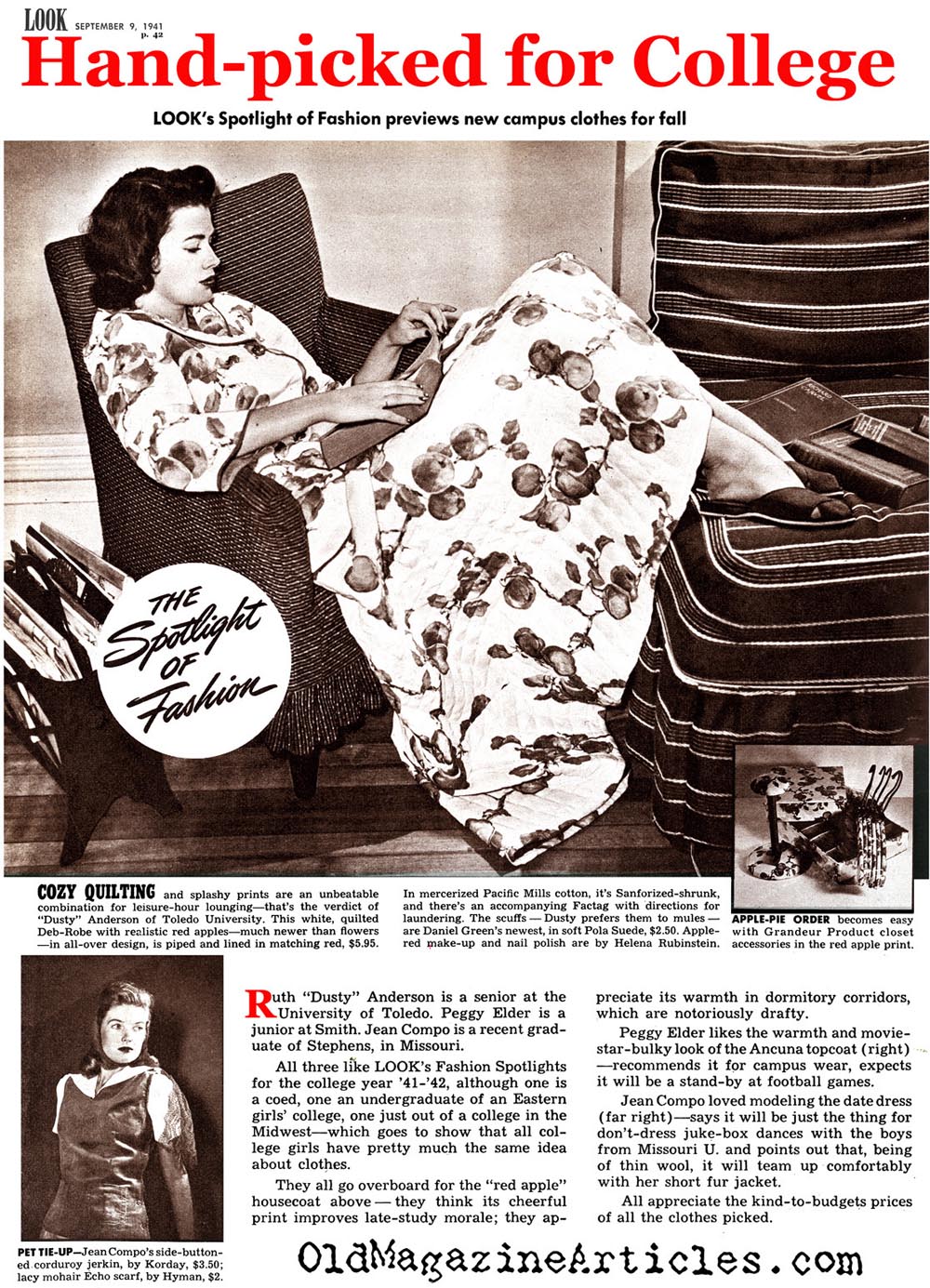
Hand-Picked For College

1941_college_fashion_0001

According to today’s paper better colleges fail to lure talented poor students. If it’s true the reason is simple; it’s complicated. While it is not complicated to identify and recruit academically gifted poor students, it is more involved to ensure that they succeed.

Many if not most financial aid packages do not include monies for housing and/or dining. There are rarely stipends for books, computers or travel. There are several periods during the academic year in which dormitories close and dining plans evaporate. Students who come from great distances and/or do not have the funds to travel are left utterly unmoored, often during a holiday. Colleges and universities now invite not just parents, but entire families to weekend events on campus. Families with limited means could not attend and students might be affected. Student activities occur throughout the years that cost money (not supplied by aid). Joining the Greek system (aka fraternities & sororities) is not free. Attending sporting events, senior class events, or arts events are rarely free. Without a meaningful stipend a university would ensure a second-class status to poorer students.

The more complex issue is that of social and/or emotional support. Attending classes and getting good grades is only one part of the college experience. If the idea of luring talented poor students to ‘better’ colleges is for them to get more out of the college experience (than they would’ve attending their local college) then more has to be done for them. Academic advising would need to be aggressive and include tutorials on research opportunities, graduate schools, and career opportunities. Student services would need to help foster networking opportunities to ensure the students reap the benefit of the stellar student body. Adjusting to college life is never all that easy. The environment always feels just a bit foreign, and the expectations daunting. For poorer students the culture itself could be off-putting and/or foreign. If a student has left an economically struggling family behind, it can feel disorienting to be among people with plenty. There can be issues of guilt if a family could use the student at home.

Finding talented students who are poor is not difficult. Every high school in the nation can identify their top 10% and SATs do a fine job of categorizing people. Many universities already recruit students from big cities (which no doubt offer a pool of talented, poor and ethnically or racially underrepresented students.)  Many schools have institutionalized support programs for students from ethnically/racially-underrepresented groups. If the ‘better’ schools are to recruit poor students from more remote locations they will need to create a similar model of institutional support programs. Recruitment and admission are only the very very beginning of the higher education journey. If colleges and universities take an aggressive role in recruiting students they must take seriously their obligation to ensure success.

 
1 Comment

Posted by on March 17, 2013 in Education


Tags: , , , , , , , , , , , , ,