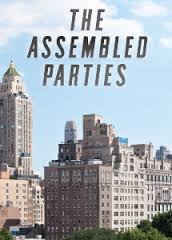
Anyone who has even suffered the slightest twinge of real estate envy should stay away from the Manhattan Theatre Club’s The Assembled Parties. The play, set in a lavish 14-room apartment on Central Park West (designed by Santo Loquasto) would make even the 1% pea green with envy. This imperfect play by Richard Greenberg takes place in two discreet times periods; 1980 and 2000, on the same day. At times the two acts even feel like two discreet plays. This is not a unique theatrical phenomenon and can work, but it’s a terrific hurdle to clear. Recently, the device was used in Clybourne Park and there wouldn’t have been a play without it. The key to its effectiveness is to create two acts, or time periods of equal force.
The first act is a rapid and rotating collage of a family assembled on Christmas. Christmas could easily be replaced by Thanksgiving or Passover for this Jewish family, as it’s just an excuse to gather and overeat. The curtain rises on Julie (Jessica Hecht) in the kitchen (the size of most living rooms) with her eldest son’s friend Jeff (Jeremy Shamos). Jeff is young and socially out of his league in the presence of the glamorous (former movie actress) Julie. She speaks in a cadence not usually found in nature and is dressed in a jumpsuit created by her mother (a renowned designer.) Julie teases Jeff with obvious affection and Jeff seems on the edge of pinching himself throughout. He is a first-semester Harvard Law student, the son of first generation Jews and he’s spending Christmas at the captain’s table. Julie’s husband Ben (Jonathan Walker) appears and we learn of another (much younger) son who is upstairs with a cold. The set then starts its rotation and the apartment and the family dynamics unfold. We meet Julie and Jeff’s two sons; Scott (Jake Silberman) and Timmy (Alex Dreier). Ben’s sister Faye (Judith Light) arrives with her husband Mort (Mark Blum) and her lumpish daughter Shelley (Lauren Blumenfeld). Director Lynne Meadow has the women characters use pronounced accents & Ms. Blumenfeld’s is beyond enjoyable. Shelley grew up (and stayed) in Roslyn, an unambitious and perhaps intellectually challenged 30-year-old single woman. Her blank face and very low center of gravity is a wonderful counter to the rapid fire speech and movement of her extended family. And the first act does move. Just when we’ve learned something new, the set rotates once again and more story unfolds. Faye is not happy, in that; “I miss Miltown” way. Ms. Light (as we saw in Other Desert Cities) is superb at portraying complicated women entirely at ease with their shortcomings. She is splendid and is given an embarrassment of riches of one-liners with which to work. You could create a fabulous twitter feed out of her zingers (both English and Yiddish) and pronouncements. This is not to suggest that her performance relies upon these quips. Not at all. But one does wonder if Mr. Greenberg wrote these gems with Ms. Light in mind.
That niggling little thought got in my way during the sedate second act. The curtain opens to a non-rotating large living room set that bares no resemblance to the fist set. We spend several moments wondering if the family (what little there is left of it) has moved. The husbands have died and Scotty (who looked a bit flush in the first act) died in 1981. Ms. Light delivers the line that informs us that Scotty died from AIDS; from a blood transfusion in a New York City hospital in 1981. Now it’s possible that if we combed medical records from 1981, this might have actually happened; but it probably would never have ever been identified as such. Scotty had just spent time overseas and could have easily been killed off by a myriad of diseases. That this implausible death was created and spoke of by Ms. Light (a longtime AIDS activist with a famed association with Ryan White) was distracting. There are other distracting theatrical devices that unfold in the second act which weaken the impact of what should be a moving play. One definite asset to the second act is Mr. Silberman; ill at ease as Scotty in the first act he flourishes as grown-up Timmy.
It’s clear in the first act that the character of Timmy is a device. His little boy self, ensconced in Star Wars sheets is ignored by his parents (on Christmas) and his existence is never explained (it’s not customary to have two children 20 years apart.) Yet the other characters or so wonderfully and fully formed. Mr. Greenberg captures the subtleties of middle-class New York Jews so perfectly and to utter delight. There are cultural conflicts and tensions beautifully and delicately rendered. None of these illuminations are delivered in a “The More You Know” public service announcement, but as real and integral dialogue.
There is much to love about The Assembled Parties. The performances alone are worth the very fast 2 1/2 hours.
Tags: AIDS, Alex Dreier, Brenda Tobias, Broadway, Clybourne Park, Jake Silberman, Jeremy Shamos, Jessica Hecht, Judith Light, Lauren Blumenfeld, Lynne Meadow, Mark Blum, Other Desert Cities, Richard Greenberg, Ryan White, Santo Loquasto, The Assembled Parties review, The Manhattan Theatre Club, theater, Theatre
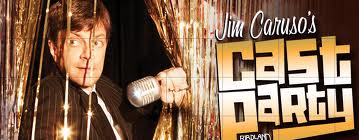
Did you ever pine for Ed Sullivan? Maybe ‘pining’ for the real Ed is a stretch, but what about the beatific Ed of Bye Bye Birdie? Either Ed Sullivan that promised and delivered a really big show of stellar entertainment can create a longing and wishful thinking. His was a show that practically guaranteed that if you could make it there you would make it everywhere. Well if you could do without the spinning plates, dogs prancing on hind legs and monkeys on bicycles; if you don’t mind your Ed now dashing, debonair, brimming with charm and humor, then have I got the Ed Sullivan Redux Show for you!
Jim Caruso has been throwing his Cast Party at Birdland for 10 years. Each Monday night those folks in the business of show flock to West 44th Street to take to the stage and audience. The standards, show tunes, and jazz flow seamlessly in no small part because of Mr. Caruso’s producing, M.C.ing and song. The stellar band (Ted Firth on piano, Steve Doyle on bass and Daniel Glass on drums) provides a wonderful constant and backbone to the evening. They opened last night with a gorgeous jazzy homage that set the mood and the stage for Mr. Caruso’s medley of We’re In The Money/Pennies From Heaven. The audience was then treated to over a dozen performers and songs that included; If I Were A Bell, Everybody Says Don’t, Just In Time, and It’s Alright With Me. Stylings ranged from crooning to belting and all were flawless. However when William Blake took to the stage and delivered At Last the air in the room changed. There is wonderful and even excellent performing, and then there’s magic. There really is no other word for it. Mr. Blake delivered this song, which you’ve heard before but never like this, with the power of a rocker and the soul of a jazz singer. He brought a tender strength to the song I never imagined possible. He admitted to “showing off” for audience members Liza Minnelli and Michael Feinstein, and if that what comes from ‘showing off’ have at it Mr. Blake. (Speaking of wanting or not wanting to show off, The Drowsy Chaperone’s music/lyrist Lisa Lambert was in the house.)
We often grouse over the dearth of great entertainment. We wax poetic about the heyday of the variety show and bemoan the proliferation of game shows and contests passing as entertainment. How wonderful to know that as we once turned to CBS every Sunday night, we now can turn to Birdland every Monday night; where we’ll be treated to an ever-changing roster of phenomenal talent and the constant of the consummate showman Jim Caruso.
Tags: Birdland, Brenda Tobias, Bye Bye Birdie, cabaret, Daniel Glass, Ed Sullivan, jazz, Jim Caruso, Jim Caruso Cast Party, Lisa Lambert, Liza Minnelli, Michael Blake, Michael Feinstein, nightlife, standards, Steve Doyle, Ted Firth, William Blake

The curtain-less stage, set for Talley’s Folly (by Jeff Cowie) is impossible to ignore. The southern weathered boathouse littered with rusted and discarded objects begs for the arrival of Miss Havisham. The small apron of the Laura Pel’s stage is festooned in large cartoon-like flowers, setting the stage if you will for this realistic play that knows it’s a play.
Lanford Wilson’s 1979 Pulitzer Prize play begins with eliminating the fourth wall. Matt Friedman (Danny Burstein) walks through the house and onto the stage and announces how long the play will be and why he’s there. He repeats his opening speech (at a higher speed) for latecomers. For audience members who cling affectionately to the fourth wall, this is somewhat terrifying. But before we have time to rethink our choices, a halting and delicate story unfolds and we are immersed, enthralled and utterly smitten. We meet Sally Talley (Sarah Paulson) whom Matt has traveled to woo. Theirs is not an easy courtship. In fact at times it would seem that whatever courtship there is only exists in Matt’s mind. Sally is a lovely blonde woman from a wealthy family that is less than thrilled with the existence of the obviously Jewish and vaguely European Matt. That the play takes place during World War II is interesting but not all that relevant. The family’s attitude is timeless as is the story of Matt and Sally. To outline what occurs between them in the course of 90 minutes would deny potential audiences the real pleasure of this play.
Mr. Burstein who if truth be told, owns any role he plays, is Matt Friedman. True the role will always conjure its creation by Judd Hirsch’s (in 1979), but Mr. Burstein is not in anyone’s shadow. He is larger than his physical self yet not in anyway overblown. He plumbs the humor while swallowing the pain. Matt Friedman could easily become pitiable, but Burstein never allows that to occur. Ms. Paulson could easily become set dressing in his presence but under Michael Wilson’s direction they shine equally upon the stage. While we at times we become frustrated by Sally, we never once doubt her. The actors capture the realism and the poetry of Matt and Sally; we ache for them and we cheer for them.
The Roundabout Theatre’s Talley’s Folly opens on March 5th
Tags: Brenda Tobias, Broadway, Danny Burstein, Jeff Cowie, Judd Hirsch, Lanford Wilson, Laura Pels, Michael Wilson, Miss Havisham, Pulitzer Prize, Review, Roundabout Theatre, Sarah Paulson, Talley's Folly, Theatre

We are who we think we are. Thoughts grow and change over time, but we remain a composite of our memories and our ideals. What happens when those factors don’t grow or change but dissipate? Not in one fell swoop, but slowly and then with ferocious speed that sputters and slows only to resume its pace once more. Who are we when our memories ooze and morph like the innards of a lava lamp? When an illness has no exact start time, how do we differentiate between who we were before and who we are now?
Those questions are just some of the powerful and profound concepts delivered in the mere 80 minutes of The Other Place (Manhattan Theatre Club.) Written by Sharr White with a delicacy and excruciating insight rarely seen in concert with such powerful playwriting. The play is told with many flashbacks and to great psychological thrilling effect. Things are seldom what they seem and that’s what makes Mr. White’s writing so fine. Life is messy, human behavior is diagnosable but not predictable.
Laurie Metcalf is Juliana, a brilliant and accomplished scientist who currently works for a drug company. The drug she’s helped to create is for (yes) dementia. We are introduced to her in her very best condition as she reenacts her first diagnosable episode. She is a somewhat unreliable narrator and it is through her eyes that we view her marriage and her diagnoses. The introduction of her husband Ian (Daniel Stern) and the strength of her doctor (Zoe Perry) helps us to tease apart the narrative. It is an achingly real and raw narrative with a substantial dose of complexity. We learn of the layers of loss and regret and are left wondering how to separate psychic pain from a psychic degenerative wound. Ms. Metcalf is captivating. She is a lithe vibrant powerful woman who must devolve into a heap in a very short period of time. No matter how exacting the writing, in a lesser actor’s hands this feat could go terribly wrong. Ms. Metcalf is on stage the entire time and it is simply not possible to avert one’s eyes. She is wonderfully matched in intensity and artistry by Mr. Stern and by Ms Perry and John Schiappa who play multiple roles. It is a tight and complementary ensemble.
The fluidity of this production is due to the grace of Joe Mantello’s direction. On paper The Other Place might be indecipherable. But with spot on sound (Fitz Patton), lighting (Justin Townsend), precise video (William Cusick) and a pitch perfect set (Eugene Lee & Edward Pierce) the story unfolds gracefully and beautifully.
This is a play whose power and artistry linger. If there was any flaw (and it can be argued there wasn’t) it’s a little tidiness towards the end. It is a rare night at that theatre in which your mind and your soul are put so thoroughly through their paces.
The Other Place opens January 10th.
Tags: Brenda Tobias, Broadway, Daniel Stern, dementia, Edward Pierce, Eugene Lee, Fitz Patton, Joe Mantello, John Schiappa, Justin Townsend, Laurie Metcalf, Manhattan Theatre Club, MTC, Sharr White, The Other Place review, theater, Theatre, William Cusick, Zoe Perry

There are theatrical experiences so real, so raw that it is only when the house lights go up that you remember where you are. Time passes imperceptibly and there is no one to your right or left, just those people up on the stage. Such is the mesmerizing effect of the Roundabout Theatre Company’s Picnic (by William Inge.) Directed by Sam Gold and with an ensemble cast only dreamed of in parlor games, Picnic is a feast.
The set (Andrew Lieberman) is brilliant, designed with the (harmless) voyeur in mind. The Owens house is front and center with many rooms visible. Scenes play in and out of the house and across yards and we watch from across the way. We watch Flo Owens (Mare Winningham) long for what’s best for her daughters Madge (Maggie Grace) and Millie (Madeline Martin.) We watch the Owens boarder Rosemary (Elizabeth Marvel) grasp at a chance for happiness. And Mrs.Potts (Ellen Burstyn) watches them because it makes her feel alive and gives her respite from a demanding invalid mother. There are men who propel the motion of their lives as well. Howard (Reed Birney) has been a steady presence in Rosemary’s life and Alan (Ben Rappaport) may just be Madge’s future. It is Hal (Sebastian Stan) who comes to upend their lives.
Picnic really is the story of women and how they live within the social confines of the 1950s and manage their desires. Flo, a single parent for many years, knows her daughters can have more than she ever did. She sees the artistic and intellectual gifts of her youngest Millie. Her elder Madge is stunning and Flo recognizes her beauty for the commodity it is. She is blunt with Madge about the shelf life of such an asset. Madge doesn’t see the point in being pretty, although she certainly does manage to have a great deal of fun with her looks. She’s savvy enough to realize that her sister has far more than she ever will. Flo sees Al as Madge’s ticket to the good life and encourages her daughter to fake passion to gain his commitment. Rosemary, the ‘spinster school teacher’ of a certain age is coming up right to the edge. She is a ball of fire and energy and is filled with more life than the women half her age. She senses (as Flo does about Madge) that it’s now or never.
It is this urgency of both Flo and Rosemary that provide the most powerful moments of the play. The power and anguish unleashed is unsettling. There is an impulse to turn away. But watching Ms. Winningham and Ms. Burstyn together is not to be missed. And to watch Ms. Marvel in what can only be called a Tony worthy performance is amazing. Ms. Marvel is unrecognizable physically. Normally a lovely and graceful, erect woman, she is curved and springy as Rosemary. In her wig and costume she is reminiscent of an energetic Eileen Heckart. It is her performance and her scenes with Howard that will linger. Their relationship and Rosemary’s longing are played out in a stirring dance sequence (Chase Brock choreographer.)
If there is any weakness in this magnificent production it is that of the ingenue casting. Watching Madge struggle with the superficiality of her ‘gift’ would be more compelling with a more layered actress. Casting Ms. Grace was an interesting stroke of realism, but might have missed to mark just a bit. Mr. Stan conveys a splendid mix of ingratiating grifter and wounded soul, but physically he may not be ideal. There isn’t enough difference in presence between Hal and Al to fully grasp Madge’s attraction. But as this play belongs to the grown women, it’s a minor point.
For all of its very raw and heartbreaking moments, Picnic is an uplifting play. Witnessing people finding their way and grasping joy is always inspiring. And there may never be a stronger ensemble and director than that of this production.
Tags: Andrew Lieberman, Ben Rappaport, Brenda Tobias, Broadway, Chase Brock, Elizabeth Marvel, Ellen Burstyn, Madeline Martin, Maggie Grace, Mare Winningham, Picnic, Reed Birney, Review, Roundabout Theatre, Sam Gold, Sebastian Stan, theater, Theatre, William Inge


 Here She Is Boys