RSS

Category Archives: Cultural Critique

There’s Gotta Be Something Better To Do*

The world of work has changed dramatically in this country during the past fifty years.  If we conjure “work” from the early 1960s, most of us will flash on some sort of variation on Mad Men.  Homogeneity in the workplace was de rigueur, and many retired from the very same company with which they began their work life.  Unskilled labor opportunities were somewhat divided between manufacturing and the service industry.  Labor was pretty well organized during this period and again it would not be unusual to retire from the same factory/department store where one began their work life.

While we still have a fair share of light manufacturing in this country, most would agree that the service industry makes up the majority of our unskilled labor industry today.  The funny thing about the service industry is that the world sees you working.  Most of us would have little cause to witness an administrative assistant at work, but we’ve all probably seen a home health aide or shop assistant.  And from where I’m standing, it would appear that we are the only people watching.

Recently I have observed a desire by (what we consider) unskilled workers to make their job as small as possible.  Some of this should be attributed to self-check out for customers, automated phone trees and the like.  But some of it is clearly a lack of training and professional development programs.  No doubt most of us had (or have) jobs at which the clock moves very very slowly.  It makes the day all the more endless to do less!  When the check-out woman at the (relatively gourmet) food store tells me to move my reusable shopping bags to exactly where she likes them, I have to wonder.  Her arms are fully engaged in checking her cell phone, so we know it’s not a mobility issue.  Her eyes do not need to scrutinize prices, as she only need sweep them in the general vicinity of the scanner.  She is not distracted by the register as I am checking myself out with a credit card.  There is no heavy lifting to speak of as gourmet tidbits rarely come in bulk.  So why would she want to make her job as robotic as possible?  No doubt she tires of waiting on people who might be paying a bit too much for that pound of coffee.  However, acting sullen and hostile is not always the most direct path to management.  Where exactly is her supervisor in this story?

The service industry can be a very rewarding career option.  Working in retail needn’t be the least bit mind numbing or dead end. The same is true for any number of service sector jobs.  The industry, by its very nature, often attracts those with the least amount of formal education.  All classes and cultures have a slightly different orientation towards work.  The great equalizer should be the workplace.  It is in the best interest of the employer and the economy, to train workers and illuminate their way towards a lifelong career.  It would not be realistic or sustainable to expect independent companies to have training and professional development guidelines in place.  But certainly any company or agency doing business with any branch of government need to demonstrate their commitment to their employees.  High schools could have a huge impact on workplace readiness, either with mandatory internships or classes.

Work has changed, industry has changed, higher education has changed and work readiness has definitely changed in the last fifty years.  When manufacturing was our largest (unskilled) employer, changes were made to the (once heralded) assembly line to address the needs of the worker.  Our economy is now sufficiently shifted to do the same for service workers.

*There’s Gotta Be Something Better Than This – Cy Coleman & Dorothy Fields, Sweet Charity (1966)

 
Leave a comment

Posted by on January 17, 2012 in Cultural Critique


Tags: , , , , , ,

No Shirt, No Shoes, No Service

There was a time when business establishments felt perfectly within their rights to set behavioral standards for their clientele.  These standards ranged from the sublime (jacket required) to the ridiculous (unescorted ladies forbidden.)  The hospitality was not the only public congregating business known to set behavioral standards.  Back in olden times, movie theater ushers policed the audience.  They wielded flashlights and a keen eye for misbehavior.  Paying patrons would be asked to leave if their behavior was deemed unacceptable.

Can you imagine that today?!  Well, why don’t we?

Why are we paying large amounts of money to dine out amidst loud cellphone chatting and wild child patrons?  Restaurant owners and maitre d’hotels are allowing it, because we have done nothing to erode their profits.  There are those of us diners who have asked to remove a screaming infant from a small restaurant (after 9:00 PM) to only then fear for our bodily safety.  We have exaggeratedly stared (a la Harpo Marx) at loud cellphone talkers only to be ignored.  (Of course we should have seen that coming, what with their obvious obliviousness.)  I have seen “no cellphone” signs on the doors of one or two shops.  But the request is made so that the shopkeeper need not be disturbed.  The customer (of any establishment) is left to fend for themselves.  There is absolutely no imperative for business owners to manage the ambiance, if we keep paying for abuse.

Far more grievous is the boorish behavior during performances.  Talking during the overture, rustling plastic bags, slurping from sippy cups, repeating dialogue, playing with cellphones, taking photos, and basically behaving as if one is in his or her living room watching television.  There is no acknowledgment of there being real live people performing, let alone other real live people in the audience.  The fact that theater managers and ushers seem to be hiding in the lobby while this behavior occurs is inexcusable.  Some of us have pointed out (illegal) photo taking to ushers only to be given the “oh you poor crazy woman” look.

I propose the radical step of printing on every ticket, ticket website, and Playbill the following message: “Any cellphones or cameras that are left on while inside the theater will be confiscated.”  Ushers, waiters, managers and the like must form the first line of defense.  Formalizing human behavior standards is sad, but it’s not new.  What do you think would happen if an audience member lit up a cigarette during a classical music concert?  We no longer tolerate this behavior, it is time to enforce what we once called common courtesy.

 
3 Comments

Posted by on January 13, 2012 in Cultural Critique


Tags: , , , ,

Lose Pounds and Inches Fast!

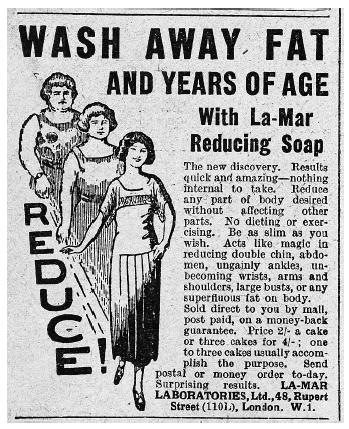
“Eat our processed food and lose weight!”  “Join this gym and lose weight!”  “Take this pill, shake, herb, tea, suppository, and lose weight!”

And they’re off!  New Year’s is the weight loss industry’s black Friday.  Many millions are reaped throughout the year, but it is January that does wonders for the industry’s bottom line.  As our nation has grown in size so has an industry filled with an abundance of promises and zero standards.  How has this happened?

Whether one considers excessive weight to be a health, behavior or public issue is somewhat secondary to the point that the market feels free to exploit the situation.

If you feel that being overweight is a health issue, what do you make of reality television shows featuring obese contestants being humiliated as a means to bolstering their health?  Do we watch smokers and drinkers being humiliated on reality shows?  Do we honestly think that this programming is not solely about the viewer’s entertainment?  How did other people’s heartbreaking struggle with a health issue become fodder for our entertainment?

If you feel that being overweight is the result of an utter lack of self-control, what do you make of products that reinforce that disconnect between outcome and behavior?  The “behavior” camp asserts that maintaining a healthy weight is the result of not consuming more than one is using.  A sensible diet and a moderate amount of exercise is the permanent method with which to control weight.  If the federal government believes this (and they seem to) why then are companies allowed to sell snake oil?  Why doesn’t every advertisement for Nutri-Jenny-Fast have a big black box across it stating “Eating our fake food is not sustainable & your behavior will not be changed by our program.  You may in fact lose weight while you are our customer, but most people gain it back immediately after leaving our program.”   Too big brother?  Remember, we now have warnings on aerosol bottles to dissuade people from huffing.

If you feel that the public health of our nation is at risk, then we really have to talk.  Whether we should start with the corn subsidies or food labeling, or school lunches makes for good dinner party conversation.  But so do dinner parties for that matter.  All of our habits, from the decline of dinner tables to carbo-loaded toddlers while they burn zero calories riding in a stroller, to wheels on sneakers (children don’t even walk anymore, they roll,) it’s all up for scrutiny.  What about processed foods designed specifically for children?  The baby food industry started the trend with “toddler” jarred foods.  Apparently toddlers find real yogurt and bananas to be daunting.  As they get older, the food industry has graciously provided, fake cheese, yogurt with candy, processed breaded chicken nuggets, lunchables and colored flavored drinks.  For those in the public health camp; why is this even tolerated?  We regulate pill bottle caps, cribs, car seats, window blind cords, but not the food sold for our children?  We are cultivating a lifelong appetite for fake food.

It is a terrible burden to feel as if your size is standing in your way.  Feeling as if your own body is the enemy is an exhausting way to go through life.  For anyone pulling on their new sneakers and heading out into the unknown this January, I say Brava!  It is physics; the first steps are the hardest.  Keep at it, and in about six weeks it will be the new normal.  Eat real food, celebrate meals, enjoy life and save your money.  There are no shortcuts and the only magic is discovering your own strength.


Leave a comment

Posted by on January 2, 2012 in Cultural Critique, Media/Marketing


Tags: , , , , , , , , , ,

Do We Have A Witness?

“The Penn State abuse scandal is prompting new legislation that could broaden abuse reporting laws.”  According to an NPR story, Missouri, Pennsylvania and Congress are considering proposals to make every adult a mandated reporter.  Traditionally, mandated reporters are determined by profession (i.e,. social workers, physicians, etc.)  Adults working in these professions are obligated by law to report suspected abuse of children.

Ordinarily, I cringe at legislating decency and/or common sense.  I am troubled that we need laws to enforce adults to differentiate themselves from children, and to exert their inalienable right and responsibility to protect children.  But I am choosing to only see the silver lining in this development.

There are some curious (if not disingenuous) arguments being made against this proposal.  One state commissioner of Children and Family services has suggested legislation is not needed because when; “you walk in and you see somebody sexually molesting a 10-year-old, you don’t need a statute to tell you that that’s a crime.”  Well sir, recent headline stories would dispute that assertion.  Some case managers are concerned about being inundated with unsubstantiated calls.  I would argue a) 18 states currently have mandated reporting laws and calls have increased in some states and decreased in others, and b) so what.  Do we even want to flirt with an argument that might at its core be: we don’t want to increase our ability to protect children because it might result in more work for us?!

The fact that rates of reporting have not increased uniformly in states which have mandatory reporting laws is not necessarily an indication of anything.  We simply don’t know if abusers are less likely to abuse when they know the whole world is watching.

Sometimes reports are unfounded, or simply can not be proved.  That is the nature of society and of law.  Being falsely accused can be devastating to an individual and a family.  However that has always and will always be true.  There is nothing in the world preventing any of us right this second from calling in suspected abuse.  What this new proposal changes is the legal responsibility to do so.  All this really means is that if anyone over the age of 18 should come across a child appearing to be violated in a locker room shower, they will now know exactly what to do.

 
Leave a comment

Posted by on December 21, 2011 in Childhood, Cultural Critique


Tags: , , , , ,

School Scandal’s Sexist Subtext

It is a national pastime to second guess the handling of situations we couldn’t possibly imagine.  In that vain, I find myself asking, if the child (allegedly) being violated (in a university locker room shower) had been a girl, would this story have a different ending?

Would an adult, regardless of professional status or age, hesitate even for a moment before dragging a girl child to safety?  Would anyone, anywhere, doubt for a moment that the child was in serious jeopardy and needed rescue?  But substitute a boy child and our impulses become a bit more restrained.  Our sexist view of sex knows no age limits.  Our reaction to an adult male authority figure having sex with an adolescent girl is that of revulsion.  We wouldn’t dream of nudging and winking as we do when hearing about a teenage boy having sex with his female teacher.  Somewhere down deep we feel that boys, once physically able, are always delighted to have the opportunity to have sex.  Girls, however need to be protected.

I do wonder (indulging hindsight) what would have happened if a young female staffer had come across the boy (allegedly) being violated.  Would a woman had seen two males being sexual, or would she have seen a child being attacked?  Would a woman have gathered up the boy while screaming rabidly at the perpetrator?  This is of course is a gross generalization of gender proclivities, but it does feel accurate.

I’m going out on a limb and suggesting that despite political strides (equal marriage) and representation in popular culture, as a country we are woefully uncomfortable with homosexuality.  (The fact that men incorporate (simulated) lesbian intimacies into their heterosexual fantasies is not proof of enlightenment but of viewing women sexuality existing only to please men.)  Despite the fact that adults having sexual contact with children, has nothing to do with being attracted to members of the same gender and everything to do with a sexual attraction to children, it is conceivable that the shower violation was interpreted as homosexual.  I find it repugnant to consider that anyone would view a child being accosted as a sexual act, period, but I can’t help come to this conclusion after playing the hindsight game.  I fervently hope I am wrong.

Perhaps if any good can come of this scandal, it is a reexamining of childhood and our (adult) role in children’s lives.  All adults have a moral obligation to protect children.  In the extreme, we concur.  Most of us would drag a child out of the path of oncoming traffic.  Danger really is not always that black and white however.  If we are confused about what we are witnessing, ask questions.  Asking a child if they are okay will almost always tell you what you need to know.  Even if you are not certain about anyone’s age of consent, a simple “Whoa, what are you guys doing?” will yield information.  Silence really is complicity.

 
2 Comments

Posted by on December 17, 2011 in Childhood, Cultural Critique


Tags: , , , , ,