RSS

Category Archives: Cultural Critique

Woman v. Woman

Can you hear it?  It’s bubbling up again.  There it is!  The woman wars.  Every so often (usually precisely timed to an election cycle) the media is abuzz with the ‘in the home versus outside the home’ battle.  There are so many flaws in this campaign it’s difficult to know where to start.  But I hardly see why that should slow me down.

  • There is no war – this is completely made up.  Nobody cares what you (or I) are doing with our lives.
  • If I’m wrong (and it’s been known to happen) and there are snips and snarks and snide remarks, they are being made by people who feel insecure about their own choices.  In other words, it is a very biased opining.
  • Semantics matter: “Working inside the home” means a person “works from home” – for money.  It doesn’t make anyone’s efforts less worthy to properly identify them.  Managing a household and perhaps children for no compensation is difficult and unrelenting labor and warrants its own term.  It is confusing to use euphemisms such as “working inside the home” simply because we’ve become allergic to terms such as housewife and haven’t come up with anything better.
  • Where a woman spends the majority of her time has little to do with how she votes.  Women can see the world as a larger place than what is directly in front of them.
  • When is it time for men to be pitted against each other in a fictional sophomoric war?

The whole point of feminism is freedom of choice.  Women should be free to choose the life that works for them at any given point.  Women should also be free from being a subcategory or manipulated to fulfill a stereotype.  Women are not a numerical minority, but historically have had limited access to opportunities.  Our country has a long history of creating fictional fracases within minority groups for the purpose of distraction.  Eventually people do catch on.

 
1 Comment

Posted by on April 12, 2012 in Cultural Critique


Tags: , , , , ,

The Hunger Bane

No doubt you’ve heard of Americans flocking to Canada (virtually or really) for inexpensive pharmaceuticals?  There’s nothing necessarily back-alley about it, it’s just that the name-brand legitimate pharmaceuticals are less expensive in other countries.  But it seems that Canada may also be a destination for surgical procedures that are not exactly F.D.A. approved.  People with life threatening diseases (with resources) have often flocked to other countries in pursuit of treatment not available/legal in this country.  However, the recent surge in maple leaf medical tourism is for weight-loss surgery.

Since 2006 Canadians can have a balloon inserted into their stomachs.  (Think of it as angioplasty for your tummy.)  The balloon makes you feel full.  I’m guessing nobody in the lab screamed “Eureka!” when they developed this device.  To my (very) non-medical self, there is nothing necessarily all that different between this and any other inflatable device one would have inserted somewhere.  Unless there’s some sort of high stakes patent wrangling in play, no doubt this procedure will be available in the lower fifty states soon enough.

But should it?  All weight-loss surgeries involve reducing the amount of food the patient can comfortably ingest.  In essence they are the modern-day equivalent of wiring one’s jaw shut.  The theory behind these “solutions” is that people need to be physically blocked from responding to their desires.  Rarely is putting a lock on the refrigerator door a sustainable weight-loss plan.

What would be most helpful to people, either in concert with surgery or not, is learning to cope with the sensation of hunger.  Hunger is not necessarily a cue to eat.  Needing nutrition is a cue to eat.  Someone who is constantly thirsty shouldn’t just be watered, they should be checked for diabetes.  A person who feels constant hunger needs help determining why and learning to manage the sensation.  Beyond the standard analysis of; are you bored, thirsty, sad, lonely? is addressing the feeling of emptiness that might be present.  The world is not a friendly place for the obese.  Clothes, furniture, seats, etc. are all geared towards average sized people.  Prejudice, mockery and serious health consequences lurk at every turn.  In other words, nobody wakes up and decides that what they really want to be is obese.  It tends to just happen.  Over time.

Since the F.D.A. seems to be dragging its feet in approving the balloon method, I’d like to think it’s because they are giving serious thought to reforming the protocols of weight-loss surgery in general.  While it is a slippery slope to mandate counseling before medical procedures, we do have precedent.  Since its invention, a person can not undergo gender reassignment surgery without structured preoperative psychological counseling and clearance.  (No doubt this protocol was created by male doctors who had their own issues about loss.)

If we agree that obesity is a problem, and that people are entitled to pursue good health, than we need to stop offering quick fixes in a vacuum.  There is no such thing as any surgery without risk.  But by ignoring the psychological side of the patient we are adding the risk of failure to the mix.

 
Leave a comment

Posted by on April 11, 2012 in Cultural Critique, Well-Being


Tags: , , , ,

I’ll Take Manhattan*

Metropolis is brimming over with sights and sounds.  Flashing lights, street musicians and traffic meld together to form something close to a hum.  The density of the island means often there is no rhyme or reason to architectural placement.  Soaring glass office towers loom over the Art Deco Radio City Music Hall.  New condominium buildings cast a shadow over original mercantile buildings in the seaport.

The diversity of talent, interest and priorities in the city lead to incongruous surprises at every turn.  Sitting (or more aptly, “wedged”) on a seat in a subway car, feet often need to be lifted to accommodate rolling bottles or discarded lunches. One is surrounded by people at their very worst (which is to be expected in a can in a tunnel from which one can escape every 2 1/2 minutes.) Amidst all this, there is sometimes a poem (versus an advertisement urging one to sue someone else) on the wall.  Often the stations themselves are festooned with mini-mosaics.  On a bad day these reminders of our artistic potential only makes things more confusing (we are a species that can create, and evidently appreciate, such beauty, but we can’t move out of the doorway or help someone with a stroller?)

But it is actually these very incongruities which make for an interesting environment and lead to lovely surprises.  The most magical places in our fair city are practically silent.  This is the ideal time of year to discover a new spot.  Quiet blocks, uptown and down, are lined with brownstones and trees are heavy with flowering blooms.  If you look closely (or have the right app) you can discover who lived in the spot you are standing.  Being amidst beauty or charm is always a boost, but standing on history is flat out encouraging.

As we strive to keep up in life (whatever that means to you) it is inspiring and a bit soothing, to consider those who came before.  So much of what we find challenging or distracting is simply old news. It can feel overwhelming to trod ground that is only new to you, but it makes it a bit easier when you consider all that came before.  Whether wide open space, or concrete canyons, there are endless spots to lose oneself and find something inspiring if even for just a moment.

*Rogers and Hart (1925)

 
Leave a comment

Posted by on April 10, 2012 in Cultural Critique


Tags: , , , , ,

Not Alone In The Universe

Everyone likes to feel a little special sometimes.  When the man arriving at the available cab (at the exact same moment,) gestures to you and backs away; that’s nice.  Not just because you’ve had a long day and those shopping bags are not going to carry themselves, but because another person is acknowledging your existence.  We go through our days almost unnoticed, unless we are part of that small cluster of very recognizable people, who in fact go through their day trying not to be noticed.  We are regularly reminded of our Whoville-like stature when navigating customer service automated phone trees, chain pharmacies, education and health-care bureaucracies and banks.  We walk down the street having people barrel into us while they intently type. We are pummeled by double-wide strollers, rolling briefcases and backpacks.  We sit in restaurants shielding our food from the (repetitive) hairstyling of the woman seated at the next table.  We sit through symphonies, theatre, and religious ceremonies with the blue light of mini-screens shining intermittently.

This phenomenon; of craving to be acknowledged in a self-absorbed world, can turn into quite the carousel of fright.  The more we desire to be seen as something more than cellophane, the more we risk turning into them.  By them, of course, I mean the gentleman who sits on a jury after lying about his relationships with law enforcement (“hey, that rule doesn’t apply to me!”)  I certainly mean the schemers of Ponzi and traders of the inside.  Most of us aren’t exactly as bad as all that.  But at the root of that behavior is arrogance and entitlement, no?  Is that particular brand of motivation all that different from the “letting the dog off the leash” “bullying and tantrums on airplanes” “parking in handicapped spots” behavior?  These more minor infractions are probably even worse as they are the most contagious.  At some point taking one’s place in line, while others ignore the queue can make one feel a bit of a schmendrick.  Slowly, even the most civilized will start to experience “what about me?” syndrome.  Before you know it, the victim becomes the perpetrator.

Perhaps we could take a baby step in breaking the cycle, and start with simple semantics.  Let us take back the word “special”  We use it euphemistically and we use it to the point of meaninglessness.  We all want to feel special but none of us is special.  (Unique and special are not the same.) We are all entitled to the same respect and civility, and yes, the rules apply to all of us.  A person is a person no matter how small.  I propose a teeny tiny movement: Instead of talking about someone’s “special day” call it what it really is; It’s Your Birthday!  It’s Your Wedding Day! It’s Your Sentence Commutation Day!  It is not “their day” anymore than it is anyone else’s day.  It’s a bad mindset to indulge, even if it’s only annual.  Let today be the day we don’t confuse how someone should be treated with how someone should behave.  Let us shower the celebrant with good wishes and love because they are who they are, which is the best thing by far, because you-ness is better than being a star.

 
Leave a comment

Posted by on March 31, 2012 in Cultural Critique


Tags: , , , , ,

New To The Neighborhood

Why is it that time and time again we are ill prepared for entirely predictable events?  We know that giving birth and having an infant in the house will be all consuming and exhausting, but still feel surprised to find it to actually be so.  Freelancers, consultants, contract workers and artists, are serial professional monogamists, yet still experience disorientation at the end of each gig.  It stands to reason that (if we’re lucky) our parents will age.  Yet, with each incremental stage of their decline we feel ourselves breathless and floundering.  It’s in our best interest to be able to feel frightened or sad (lack of affect is a sign of serious trouble!) but why do we also feel “caught off guard?”

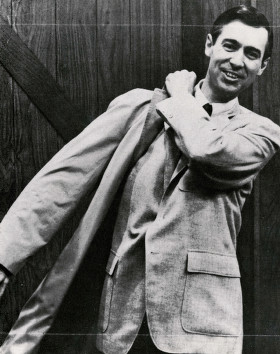
Nobody likes surprises (which is why surprise parties are only fun for the people planning them.)  One of Mr. Rogers‘ most insightful and comforting songs was I Like To Be Told.  He understood that children, with no frame of reference, find most of life surprising and unsettling.  But we grown-ups are supposed to be pretty well versed in the vagaries of life.  Of course events which could never be foreseen (both good and bad) occur, but it’s not those that leave us feeling as if we “really should have a better handle on this.”

Could it be that being truly conscious and cognizant of future hurdles and hardships is just not a pleasant way to live?  Would being at full boyscout readiness at all times rob us of the joys of spontaneity and hopefulness in life?  That could be the answer, if in fact cynics and pessimists find themselves in ship shape when things go a bit awry.  Does a gloomy Gus face a parent’s accident, illness or decline with an attitude of “finally! something I’m good at!”  Maybe.

What is really at the heart of the issue is that of mastery.  We feel caught off guard because of the novelty of the event in our own life.  Yes, we know the event is inevitable, but until we’ve tackled it head on and survived, we feel uncertain.  Life tilting events, by their very nature are not extremely repetitive (if you’re lucky) so there is little chance for mastery. With each of these events (illness, job loss, death, etc.) we feel as insecure as we did as children, yet the situation calls for us being our most adult.  The solution to our feelings of helplessness and insecurity is not to wish for more opportunities to develop mastery.  What we can do is remember that we know enough to do the very best we can do.  We’ve experienced bumps in the road before; this is not our first time at the rodeo if you will.  Hurdles are just that; hurdles.  There is quite a distance between each one (otherwise hurdles would be called bridges.)  When the floundering sensation becomes too much, never underestimate the restorative powers of a cup of tea, and a little Mr. Rogers.

It’s such a good feeling to know you’re alive.
It’s such a happy feeling: You’re growing inside.
And when you wake up ready to say,
‘I think I’ll make a snappy new day.’
It’s such a good feeling, a very good feeling,
The feeling you know that we’re friends. (Fred Rogers,1967)

 
2 Comments

Posted by on March 29, 2012 in Cultural Critique, Well-Being


Tags: , , , , ,