RSS

Monthly Archives: April 2013

Put The Baby Down

roger

Picture if you will a lovely restaurant: equal parts festive and posh, a place where you’re as likely to spot birthday celebrations as celebrities. The lights are dim, the tablecloth routinely brushed to hide your shame and the prices are calibrated to reflect all this. It’s a proper time of night to be dining; somewhere between post early bird special and post theatre. It’s late enough that generous amounts of skin and inebriation are on display. As are the babies. And by ‘babies’ we are not casting dispersions on the nieces/dates of men eligible for monthly federal checks and movie discounts. We instead refer to actual babies too young to sit, let alone eat solids. Why? Why are babies having their night feeding in an upscale restaurant (late in the evening)? The babysitter canceled at the last minute? Perhaps, but that would suggest that a babysitter was procured in order for the adults to have an adult experience. If that were the case, upon cancelation wouldn’t the take-out menus come out? It’s more probable that the baby makes three, in every conceivable way.

The particular baby in question was silent (to the point where someone who maybe had one too many french martinis would’ve thought it was a doll and the whole thing was a prank.) Yet the (assumed) father futzed and fussed over the infant seat throughout the meal. There were bottles, there was bouncing, there was picking up and walking about (for a silent baby.) There’s a pretty good chance that the person being comforted was the father. Not everyone is comfortable in social situations. There is quite a continuum between introversion and extroversion, and most people are a wee bit closer to introversion. Sometimes a little psychic or physical prop is all that’s needed to smooth the way. Smoking once served that purpose. One could take long breaks from patter with a drag a flick or a light. Drinking has always served that purpose (and many more.) Having a glass of champagne while dressing, meeting for a drink before dinner, or ordering a drink before dinner are all ways to smooth out the awkward edges. There are people who use their own appearance to distance themselves and/or gain comfort in social situations. Style can be used as armor or distraction or even take the place of conversation. A grown person who’s dyed their hair bright blue sends a message of “let’s just talk about my hair.” A person who’s dressed in baggy neutrals while toting a small person styled for her/his close-up, is saying “please just focus on my child.”

The child as “detractor” is at its roots more neutral than noxious. If we had to choose only one of two parenting approaches, focusing on the child rather than ignoring the child would win hands down. But somewhere past “focusing” on the child lies “using” the child and that’s just plain icky. Children are not accessories and should not pave the way for adults. Using your child to ease your social phobias is no more kosher than using your child to fulfill your waylaid dreams. Sure there could be other reasons that baby or toddler is at the restaurant, wedding, funeral (!) or dinner party. But it is challenging to imagine any explanation that is actually in the best interest of the child. Children (of any age) actually benefit from other’s care. Creating a fear of non-family members increases the odds that a child will ‘inherit’ social phobias. A babysat child learns that other adults are trustworthy and that the world is not comprised of strangers. The child gains knowledge and perspective from other adults, and the parent creates/maintains/nurtures his/her own identity and relationships, which is an important thing to model for a child.

 
3 Comments

Posted by on April 29, 2013 in Childhood, Cultural Critique, Well-Being


Tags: , , , , , , , , ,

Funny Girl

Fanny Brice

Fanny Brice

‘You’re a funny girl.’ Has that phrase ever been uttered (by a man) without subtext or semi-colon? “And I hate funny girls” or “And you look it too.” Perhaps there are times it is delivered as a compliment, but rarely is it heard as one. It’s probable that Nicky Arnstein (played by Omar Sharif) said it with love and adoration, but it’s an odds on favorite that Fanny (Barbra Streisand) heard it as; “not pretty.” It is not entirely Fanny/Barbra’s insecurities that lead to this interpretation. Women have been derided and ridiculed for being funny since the dawn of time. There’s a chance that Eve ran from the Garden of Eden in shame after Adam ridiculed her for her “one bad apple” joke.

Humor or (gasp) joke telling is masculine. No really, ask any comic trying to get top billing. At the core of being funny is the ability to make people laugh (stay with me on this, it gets less ‘duh’) and ‘making’ people do anything is a measure of powerfulness. Well women aren’t supposed to have power. In fact what women were told for decades (if not centuries) was to look good and listen. If they were to speak at all it was in niceties and affirmations. Early comediennes understood this land mine and went to lengths to mitigate their ‘offensiveness.’ They down played their physicality to create a gender neutral or cartoonish woman. This worked as an immediate physical cue to the audience; “It’s okay, we can pretend I’m not a woman.” Fanny Brice and Phyllis Diller made themselves into physical characters (as did many others.) Ms. Brice had a lovely moving singing voice but is best remembered for playing Baby Snooks. What could be less threatening than a baby? Phyllis Diller was a slim, sleek stylish woman who festooned herself in clown-like garb and used self-deprecating humor.

Things began to change in the late 1960s. Joan Rivers engaged in similar self-deprecating humor, but did so in a little black dress and pearls. There were no fright wigs or juvenile characters, just a fearless gal from Larchmont with a wickedly quick wit. Carol Burnett came along shortly thereafter and blew the roof off. Her show (1967-1978) opened the doors and national minds to the fact that a woman can be outrageously funny, smart and striking. Yes, she played cartoonishly grotesque looking characters, but she also played bombshells. Every show started with Ms. Burnett standing center stage in a striking (Bob Mackie) gown. When she sang (and she did/does so beautifully) it was often in character but not a caricature. Several came after her, these funny women who didn’t apologize for being women. Tracey Ullman embraced a similar format of characters as Ms. Burnett as well as singing and having a striking physical presence.

These examples of progress are not to suggest that we’ve come a long way baby. Comic actresses (versus comediennes) still manipulate her physical image to placate the audience. Think of the ‘funny’ gal on any sitcom and you will find that her look or shtick about her look is at the business of her character. Most often it takes the form of an eating disorder. Binge eating, eating off-brand Mexican snack chips, clearing a buffet; all while staying a size four can be seen on any channel near you. The scripts poke fun at bosom size (’cause that’s funny) or weight struggles or tragic fashion sense. Granted there are male comedians and comic actors whose bread & butter is their sad sack image. But there’s a sense that it’s done with a wink especially when their characters seem to engage with lovely looking women.

There is an ancient and depressing mathematical formula (that surely can be found on a cave wall somewhere): attractive=dumb=desirable and funny=smart=intimidating. Anyone on this earth for any length of time past the parallel-play period can attest to the unmitigated fallacy of this formula. We’ve all met plain dumb women, attractive smart women, we’ve met women who were funny and not so clever (which can be really funny!) and chances are we’ve never been intimidated by humor. But it doesn’t change the fact that rarely does a woman hear “you’re a funny girl” and automatically get a spring in her step. We are simply not conditioned to hear it as a compliment. There are no magazine articles promising us 10 simple ways to crack your guy up. There is no potion, pill or powder being pitched to power our punch lines. It’s okay to be smart (and that’s serious progress) but funny, able to evoke stomach cramps and copious tears, while looking like oneself? We’ve got a ways to go. They are out there, these outrageously funny comediennes embracing their femaleness, don’t get me wrong. But they are in no way celebrated by the masses (and by masses I mean heterosexual men) the way male comedians are. There is still, after all these years, something intimidating about a woman who is not a cartoon, and who can make you wet your pants a little.

I’m so glad we had this time together.

 
Leave a comment

Posted by on April 27, 2013 in Cultural Critique


Tags: , , , , , , , , , , , , , , , , , , ,

The City Of Love

images

The news that France passed ‘marriage for all’ was delivered with jubilant footage. Members of Parliament cheering and tearing; there was hugging. It’s tempting to see France becoming the 14th country to legalize equal marriage as inevitable. Mais bien sûr! This is a country known for being far less rigid and puritanical than America. From a vantage point of 3,000+ miles France appears to be a more vivre et laisser vivre kinda place. This perception is distilled in mental images of Josephine Baker, James Baldwin (and just about every other writer found in any decent home library) finding a more agreeable way of life in France. The French, Parisians in particular, seem impervious to race and fluid when it came to sexuality. Sexual behavior and couplings seemed more akin to the pleasures of fine dining than a naughty or shameful undertaking. But is this live and let live kinda place actually for real? Have we, from 3,000+ miles, taken bits and pieces and formed an attractive if not entirely accurate picture?

Those hugging tearing politicians are just one image among many. Have you seen the violent protests and ugly worded signs? Have you heard the (translated) rhetoric? Much of the ‘anti’ argument (that has made the journey across the Atlantic) has centered on ‘the children.’ Almost without exception anytime ‘the children’ are invoked in an argument it is code for ‘no, look over here at this bright shiny thing.’ The children. That’s right, gay and lesbian French are fighting for their equality because of ‘the children.’ Opponents of equal marriage have declared that children need a mother and a father. That certainly makes for a nice sentimental placard but what does it mean? Are there no single parents in France (she says while spitting out her latte?) That’s pretty hard to fathom in a country known for being more lax about relationships outside of marriage. Are there currently no gay and lesbian households that include children? Doubtful, as some people come to relationships having already lived a bit. Without a law protecting equal marriage and the ability for both spouses to adopt a child, gays and lesbians will still parent. The children however will have less protection. It is remarkable in this day and age, when people are regularly parenting without benefit of marriage, that anyone would even attempt to wave the ‘one mother one father’ flag. No one, not any child expert, psychologist, sociologist or anyone would ever posit that a child is better served by fewer caring adults or instability. What children need most is a secure, stable environment in which the adults are focused on the care of the child. Denying their parents the right to marry or preventing the children from being adopted is simply not in the best interest of ‘the children’. That this or any argument is being made by a country known (to us) as being far more lax seems uncharacteristic.

It’s tempting to view an entire people as being cooler, thinner and far more adept at walking in heels on cobblestones than us. We’d like to imagine an entire country that sits down when drinking coffee, and not dressing their children in cartoon festooned garb. Knowing that there’s a place in which one greets the shopkeeper and ends every request with ‘if you please’ gives us hope. But there are manners (real or perceived) and then there’s real life. In real life the French aren’t that much different than us. Yes, they can do that scarf thing, and yes there’s the accent that can turn even a craggy old fisherman into Yves Montand, but when it comes to social issues, are they really that different? It is true that people of color, particularly artists, found an accepting home in France. But was that so much about French color-blindness as it was an appreciation for the arts or dare we say, Americans? When people of color moved into France in significant numbers troubles began to simmer. The 2005 riots were the result of a people of color feeling marginalized for quite some time.

Discovering that the land in which so much seems better, where the wine and bonhomie flow all day and into the night, is really not that much different than us is jarring but incredibly inspiring. It is a sign that Americans, with our baseball cap, sippy cup toting selves, with our puritanical views of sex and our discomfort with race, we too can pass a law that states that all people are created equal.

 
Leave a comment

Posted by on April 24, 2013 in Cultural Critique


Tags: , , , , , , , , , , , , ,

Sports Talk

8609912747_ccec01f4c2_z

Team sports and bad behavior have been linked more than a few times recently. The theme of the stories isn’t necessarily new nor are their clusterings. It’s common that news producers bring similar stories (of any vein) to the forefront resulting in the illusion of clustering. The fact remains that bad behavior in team sports probably happens all the time to varying degree. What makes the recent spate of stories worth examining is that they’ve prompted conversations regarding homosexuals in sports. Several sport professionals and commentators have made grim pronouncements and analysis about the state of ‘tolerance’ in team sports. More than a handful of serious men are giving serious thought to what homosexuality means to and how it affects team sports. Armchair commentators are baffled by the efforts to correct what they experience as innocuous behavior. Some harken back to their own survival of a coach’s wrath and wonder what the hell has happened to sports.

What seems to be missing from all of these conversations is women. Where is the serious analysis of women’s sports teams? Why are we not discussing what a locker room might look like with openly gay women in it? Where are the exposes of women coaches yelling gay slurs at her athletes? Putting aside the fact that women sports teams are not nearly as financially lucrative as their male counterparts, why the discrepancy? Why do we not seem to care all that much about the sexual orientation of women athletes? Why is it hard to even imagine a woman using a lesbian slur? Can we even picture a locker room in which any female athlete would care a whit about the orientation of a teammate? Could it be that the recent ‘homosexuals in sports’ conversation is much more about ‘machismo in sports’?

Men dominate sports, and sports are often about domination. For men (regardless of orientation) homosexuality can be seen as a threat to machismo/dominance. Much of the anti-homosexual slurs don’t refer to men loving men, but of a state of being effeminate. Of course on a purely rational level it’s hard to imagine anything more masculine than men partnered with other men. It is the very celebration of manhood that is what defines homosexuality, but we digress.

Even if we ignore women being ignored in this conversation, we are still left questioning whether we’re being ingenuous in this conversation. Is it really about how athletes and coaches view and treat homosexuals? Or is it that male sports teams are defined by homogeneity and there is little room for divergence? Could it be that male team sports is an ancient phenomenon and like a good chorus line, is dependent upon a neutrality of identity? Is the version of machismo fostered by team sports am ancient defense to the intense touching and often underdressed state of teammates? Could it be that self-concsciousness that sometimes leads to bad behavior with women? Could it be that all traditionally all-male groups suffer from the same self-consciousness? Could that be behind “don’t ask, don’t tell” and the Boy Scout ban? Could all the bigotry really just be an attempt to affirm; “No, I’m not, they are!”

 
3 Comments

Posted by on April 22, 2013 in Cultural Critique


Tags: , , , , , , , ,

At Last

35015_10200856162875372_145497542_n

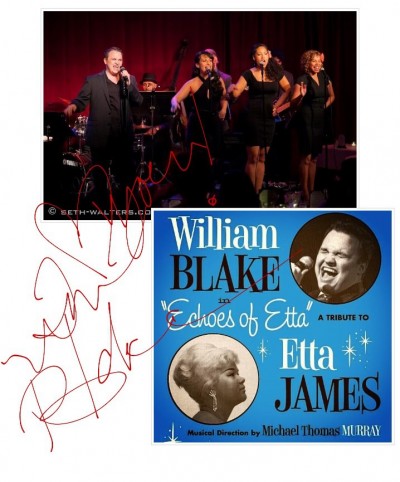
Picture it, New York City 1961. Grown people in girdles and fedoras could stumble into any one of dozen of night clubs and hear standards or jazz performed at the highest level. They would sit at their tiny tables; a shaded candle casting them in a flattering glow, sip their Manhattans while wrapped in a haze of cigarette smoke and either bop or swoon to sophisticated stylings. Sitting last night in the Cafe Carlyle, wrapped in Marcel Vertes murals, those halcyon days were brought back to life by William Blake. Resplendent in his black velvet jacket and beatific smile, Mr. Blake brings the best of the past back to life with his flawless show, Echoes of Etta: A Tribute To Etta James.

The audience danced in their seats to the rocking numbers ably backed by the swaying singing synchronicity of The Peaches (Ashley Betton, Shira Elias and Stephany Mora). The Peaches and the audience’s upper bodies were given a break periodically when Mr. Blake turned to the standards made famous by Ms. James. Pianist and co-creator Michael Thomas Murray joined Blake in duets to wonderful effect. Their strong smooth voices complemented each other and created something rich and large. The band (
Oscar Bautista, guitar; 
Mike Shapiro, drums; Frank Canino, bass)
 filled the stage and filled the room. Together they created a magnificent sound one rarely stumbles upon today. This fact was confirmed towards the end of the show when the curtained doorway parted. Jammed into the entry of the club were half a dozen people drawn to the sound. Their faces were a mix of joy and absolutely awe.

While the Etta James songbook is an ideal canvas for Mr. Blake’s range, he is not an impersonator but in fact the real thing. With the power of a rocker and the soul of a jazz singer he brings a tender strength to ballads and a growling ferocity to blues. There’s little doubt his talent could take him wherever his heart desires, but for the sake of those yearning to come taste the wine, and to come hear the band, let us hope Mr. Blake never leaves the cabaret.

 
Leave a comment

Posted by on April 20, 2013 in Uncategorized


Tags: , , , , , , , , , , , , , , , ,